
Updated July 21, 2026 – If you wear contact lenses, you probably don’t think about the physical structure or mechanical properties of those little plastic devices you put in your eyes. Most wearers simply want clear vision, easy handling, and the most comfortable contact lenses for their prescription and daily routine.
However, the flexibility and stiffness of soft contact lenses can influence handling, fit, movement, and comfort. One important but lesser-known property is modulus, which describes how resistant a lens material is to bending or deformation. This article explains what contact lens modulus means and why it matters, particularly for silicone hyrdogel and hydrogel contact lenses.
What is Contact Lens Modulus?
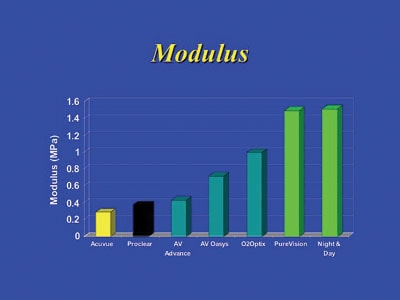
The modulus of a silicone hydrogel contact lens is the measure of the material’s resistance to deformation under tension or strain. The modulus describes the material’s degree of flexibility or elasticity. In simpler terms, it is the stiffness of a silicone hydrogel contact lens.
The higher the modulus, the stiffer the contact lens material. When comparing options such as Clearsoft lenses, your eye care professional may consider modulus along with lens material, water content, fit, and replacement schedule to help determine what feels best on your eyes.
Why is the Modulus of a Contact Lens Important?
It’s crucial to keep in mind that the modulus is a property of the silicone hydrogel material and not the contact lens itself.
Stiffer or higher modulus silicone hydrogel contact lenses are easier for wearers to handle and insert into their eyes. These silicone hydrogel contact lenses are also more durable than their lower-modulus counterparts. High-modulus silicone hydrogel contact lenses are more resistant to tearing or ripping. It is also easier to determine if a contact lens is inside out if it’s a high-modulus silicone hydrogel material.
How Does Modulus Affect Contact Lens Fit?
The easier handling and durability of high-modulus silicone hydrogel materials do come with a few trade-offs. A high-modulus silicone hydrogel contact lens is stiff, so it tends to not fit well and not completely conform to the shape of the wearer’s cornea. An improper contact lens fit results in edge fluting, which means the edges of the contact lens are somewhat lifted off the surface of the cornea.
Contact lens fluting often leads to several problems for the wearer. For one, fluting tends to cause supreme eye discomfort and even pain. Apart from discomfort, fluting causes lens awareness or the sensation that there is a foreign body in the eye. Contact lens fluting can also result in the edge of the lens sitting on the lower eyelid, which causes additional discomfort.
Contact lens fluting also results in the appearance of air bubbles between the cornea and the lens material. Improper contact lens fit and fluting often lead to ocular complications. The wearing of high-modulus contact lenses is associated with eye conditions such as contact lens-associated papillary conjunctivitis (CLAPC) and giant papillary conjunctivitis (GPC).
The problem with an improper contact lens fit and fluting from high-modulus contact lenses is that the fit is unlikely to improve with continuous wear. Wearers can’t easily adjust to ill-fitting high-modulus silicone hydrogel contact lenses. Their eye care professional (ECP) will need to prescribe them contact lenses made of a material with a lower modulus.
Meanwhile, low-modulus silicone hydrogel contact lens materials are softer and more flexible than their high-modulus counterparts. The flexibility of a low-modulus silicone hydrogel contact lens means it conforms to the shape of the cornea more easily, making it more comfortable to wear than a high-modulus contact lens. Compared to a high-modulus silicone hydrogel contact lens, such as Comfilcon A contacts, a low-modulus lens requires little adjustment. A low-modulus silicone hydrogel contact lens also doesn’t interfere with the eyelids during blinking.
However, low-modulus silicone hydrogel contact lenses are not as easy to handle and insert as high-modulus contact lenses. The softness of low-modulus contact lenses also means that they are less durable than high-modulus contact lenses.
Shop Quality Affordable Contacts at Lens.com
Understanding Modulus: Debunking Common Misconceptions
The modulus of a contact lens is often misunderstood, leading to confusion about what makes a lens comfortable or suitable for specific needs. Modulus refers to the stiffness of the lens material, affecting how it feels on the eye, its ease of handling, and its durability. While it plays a critical role in lens design, misconceptions about modulus can cause wearers to make uninformed decisions. Let’s address these misconceptions and provide clarity on what modulus truly means for your contact lens experience.
1. Higher Modulus Equals Better Durability
A common belief is that stiffer lenses with a high modulus are always more durable. While these lenses are less likely to tear during handling, their rigidity can make them less comfortable, especially for first-time users or those with sensitive eyes. The increased stiffness can lead to friction with the eyelids, resulting in irritation over time. For some, durability may come at the cost of daily comfort. If you want to buy Biofinity contact lens, you will find that these lenses balance durability and comfort well.

2. Softer Lenses Are Always More Comfortable
It’s often assumed that softer, low-modulus lenses are inherently more comfortable. While these lenses are flexible and adapt well to the eye’s shape, they can present challenges due to their flexibility. New wearers may find them difficult to insert or remove. Additionally, their soft nature may compromise stability, particularly for conditions like astigmatism, where precise lens positioning is crucial.
3. Modulus Determines Lens Quality
Some wearers mistakenly associate a high modulus with superior lens quality. In reality, modulus is just one factor among many that contribute to lens performance. When comparing great contact lenses, consider modulus alongside fit, material, comfort, and your individual vision needs. The ideal modulus varies depending on individual needs. For example, a person with dry eyes may benefit from a softer, lower-modulus lens that retains moisture. Meanwhile, someone seeking long-lasting stability might prefer a stiffer, higher-modulus lens. Look for a discount ULTRA contact lens if you want a quality lens designed for moisture retention.
4. Low Modulus Lenses Are Better for All-Day Wear
Another misconception is that low-modulus lenses are better for extended wear. While they provide initial comfort, they may dry out more quickly, especially in air-conditioned environments. High modulus lenses, on the other hand, may offer better oxygen permeability and maintain clarity for longer durations.
5. Modulus Doesn’t Affect Vision Stability
Modulus impacts how well a lens maintains its shape on the eye, directly influencing vision stability. For conditions like astigmatism, higher modulus lenses often provide more reliable correction by staying in place, whereas low modulus lenses may shift, affecting clarity.
Modulus is only one factor in lens performance. For specialty options such as myopia control contact lenses, treatment purpose, fit, and your eye care professional’s recommendation should also guide lens selection.
By understanding the role of modulus and addressing these misconceptions, wearers can make informed decisions that balance comfort, handling, and vision stability. Always consult with an eye care professional to determine which lens modulus suits your unique lifestyle and eye health needs.
If you are wearing silicone hydrogel contact lenses and find them too uncomfortable despite continuous wear, you may be wearing contact lenses with a high modulus. In this case, you need to consult your ECP about switching over to a low-modulus contact lens for better comfort.
Summary Graphic: What is Contact Lens Modulus?