
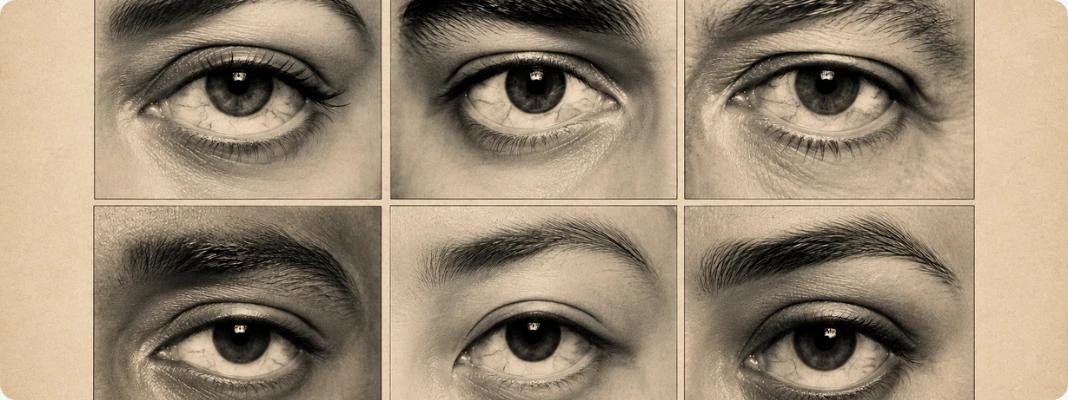
You may first notice it in a mirror or photo, with a thin strip of white showing under or above your iris while you look straight ahead. That appearance is often called sanpaku eyes, but the amount of visible white around the iris can also reflect ordinary differences in your eyelids and surrounding anatomy.
In a 2025 Scientific Reports study of 28 adults with age-related drooping upper eyelids and 26 healthy controls, researchers measured inferior scleral show alongside lower-eyelid muscle activity, highlighting that visible sclera can relate to measurable eyelid anatomy and function. Sanpaku itself remains a cultural and descriptive term, so what matters medically for people who wear contact lenses is whether the appearance is natural and stable or new, changing, or accompanied by other eye symptoms.
What does sanpaku mean to your eyes?
Sanpaku eyes describe an appearance in which the white part of your eye is visible above or below the iris while you look straight ahead. The Japanese term sanpaku is commonly translated as “three whites,” referring to the sclera appearing on three sides of the iris. Put simply, the meaning of “sanpaku eyes” describes where the eye white is visible, not how well your eyes work or whether you need vision correcting contacts.
Sanpaku also carries historical and cultural interpretations, including the familiar yin sanpaku and yang sanpaku labels. Those beliefs are separate from modern eye care, and sanpaku is not a medical diagnosis or a scientifically validated way to determine someone’s personality, mental state, health, or future. Clinically, an eye care professional is more interested in your eyelid position, eye prominence, symptoms, and whether the amount of visible sclera has changed.
Curious how eye professionals describe the visible size of the iris separately from scleral show? Learn what HVID means in contact lenses so common eye measurements are easier to understand.
How are sanpaku eyes different from scleral shows?
Sanpaku eyes is mainly a cultural and popular description, while scleral show is a clinical term for visible white between an eyelid and the edge of the cornea and should not be confused with scleral contact lenses. The border where the clear cornea meets the white sclera is called the limbus. Eye care professionals can measure scleral show when evaluating eyelid position. A small amount of visible sclera may simply be part of your natural anatomy.
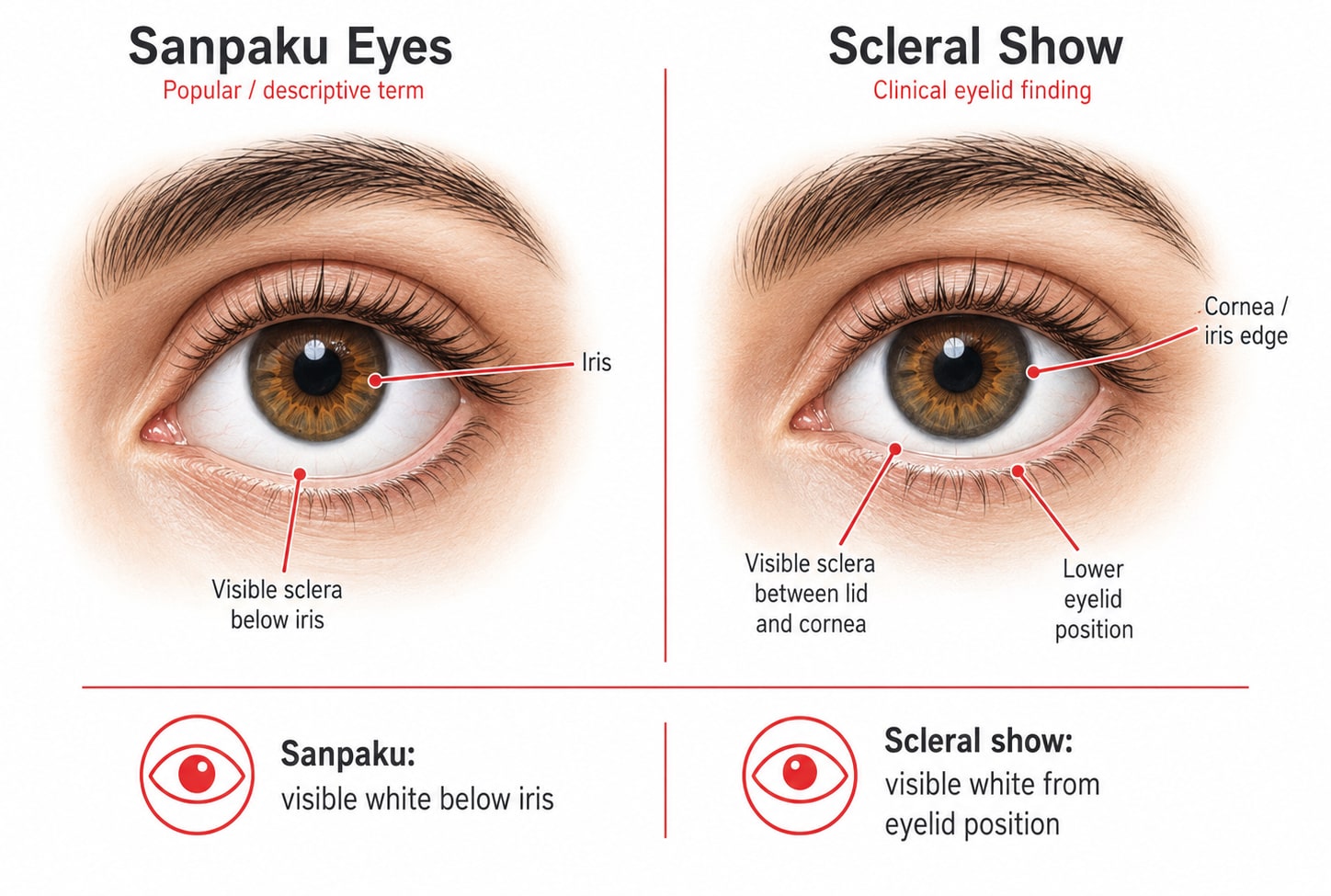
The two terms overlap, but they are not completely interchangeable because scleral show can also reflect changes in eyelid position, eye prominence, aging, trauma, or previous eyelid surgery. Seeing white above or beneath the iris does not automatically mean something is wrong. It becomes more important to evaluate when the appearance is new, increasing, one-sided, or accompanied by discomfort or vision changes. In those cases, an eye doctor can check whether the visible sclera is simply anatomical or related to an underlying eyelid or eye condition.
Are sanpaku eyes a medical condition?
No, sanpaku eyes are not considered a medical condition or diagnosis. The term describes an eye appearance in which more sclera is visible above or below the iris when you look straight ahead. In clinical eye care, an eye professional may describe this appearance as scleral show and assess factors such as eyelid position and eye prominence. If the appearance has always been stable and causes no symptoms, it may simply reflect your natural anatomy.
However, newly developed scleral show can sometimes occur with eyelid retraction, prominent eyes, trauma, surgery, or conditions such as thyroid eye disease. That does not mean visible sclera by itself proves you have an eye or medical condition. What matters is whether the appearance is new, increasing, one-sided, or accompanied by dryness, pain, double vision, or
What are yin and yang sanpaku eyes?
Sanpaku eyes are commonly described using two cultural labels, yin and yang, based on where the white of the eye appears around the iris. These labels come from historical interpretations of eye appearance rather than modern medical classifications. Your gaze, natural anatomy, and eyelid position can all influence how much sclera is visible.
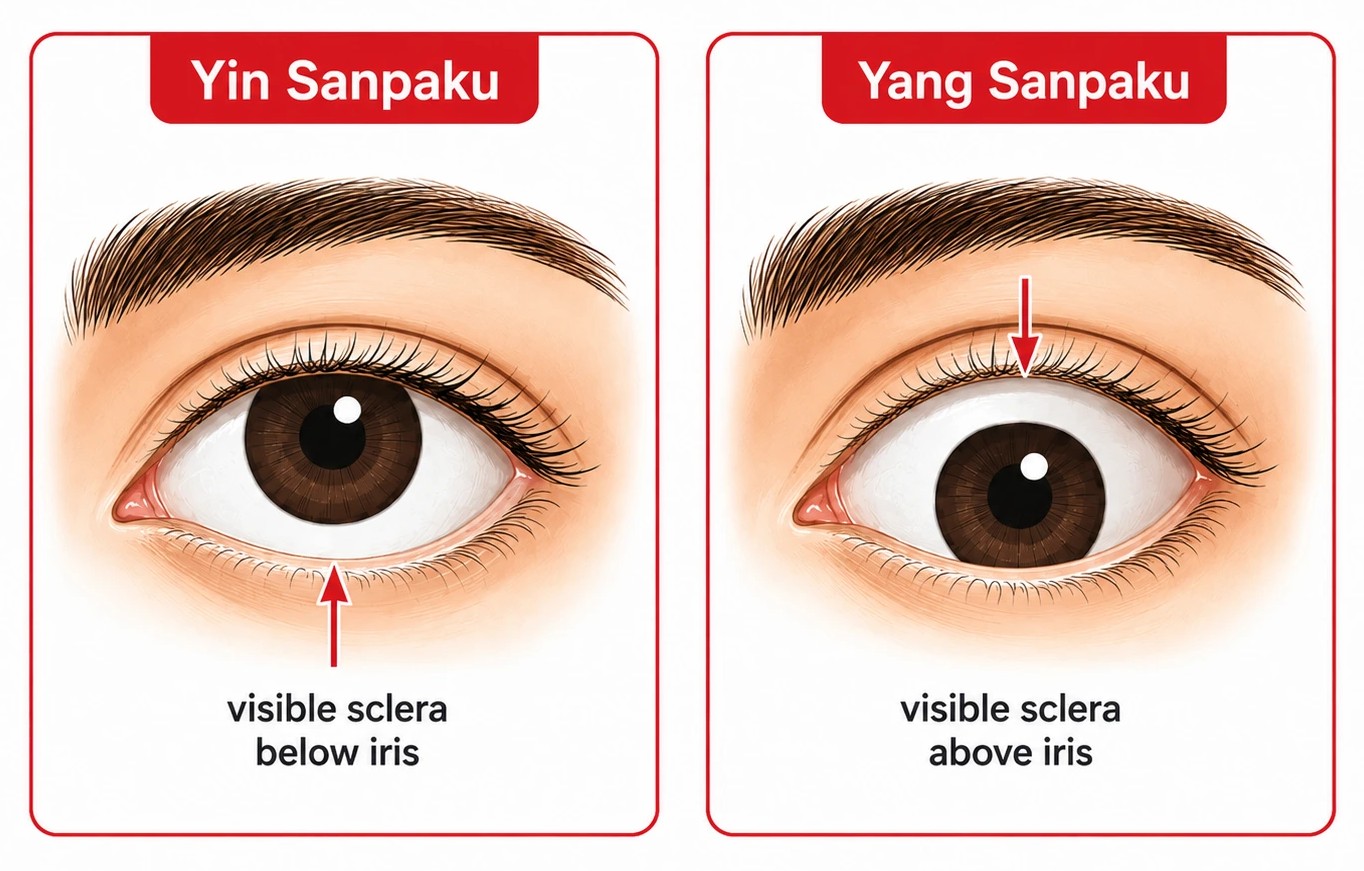
Yin sanpaku eyes generally show a strip of white beneath the iris when you look straight ahead, while yang sanpaku eyes show white above the iris. Older traditions associated yin sanpaku with vulnerability, imbalance, or misfortune and yang sanpaku with aggression or emotional instability. These meanings are cultural beliefs, not scientifically proven indicators of health, personality, or behavior. In clinical eye care, visible white above or below the iris is assessed as scleral show, without attaching those traditional personality meanings.
The difference is simply where the sclera appears, below the iris for yin sanpaku and above it for yang sanpaku. If the appearance has always been stable and causes no symptoms, it may simply reflect your natural eye anatomy. A new or changing amount of visible sclera, especially if it affects one eye more than the other or comes with discomfort or vision changes, is worth discussing with an eye care professional.
Are sanpaku eyes rare?
There is no reliable worldwide estimate for how common sanpaku eyes are because sanpaku is a cultural description rather than a standardized medical diagnosis. Researchers typically measure features such as scleral show and eyelid position instead of classifying people as having sanpaku eyes. One small 2020 study of 123 healthy adults found lower scleral show in 61 participants, or 49.6%. Across the full group, the average lower scleral show measured about 0.4 millimeters.
That finding does not mean roughly half of all people have sanpaku eyes. The study focused on lower eyelid anatomy in a relatively small group and did not measure sanpaku prevalence across different ages, populations, or regions. It does show that some visible white below the iris can occur in healthy adults. So, a small amount of visible sclera may simply be a normal variation in eye appearance rather than something rare or unusual, and it is separate from cosmetic changes created by natural looking colored contacts.
What causes sanpaku eyes?
Several factors can make more sclera visible above or beneath the iris, including natural eye and eyelid anatomy, gaze, aging, eye prominence, trauma, and previous eyelid surgery. What people commonly call sanpaku eyes causes are therefore better understood as factors that affect how much sclera is visible and where your eyelids sit.
Natural eye and eyelid anatomy
Some people naturally show more sclera because of differences in their eyelids, eye sockets, facial structure, and how far forward their eyes sit. These anatomical differences can affect how much white appears above or beneath the iris. Stable, symmetrical scleral show without discomfort or vision changes may simply be part of how your eyes naturally look.
Gaze, expression, and head position
Where you look and how you hold your head can temporarily change how much sclera is visible. Looking upward, widening your eyes, raising your eyebrows, or tilting your head may expose more white above or below the iris. Camera angle and facial expression can have the same effect, so one selfie is not a reliable way to judge your natural eye anatomy.
Aging and eyelid position
The tissues supporting your eyelids gradually change with age, which can affect where the upper and lower lids rest against the eyes. Changes in skin, muscles, fat, and surrounding facial support may make scleral show more noticeable over time. A gradual change is not automatically a problem, but you can learn more about related changes in how aging affects your eyes.
Thyroid eye disease and eye prominence
Thyroid eye disease can cause the eyes to become more prominent and the eyelids to retract, increasing scleral exposure. Current ophthalmology research continues to recognize eyelid retraction and eye prominence as important features of the condition, along with possible dryness, irritation, pressure or pain, and double vision. Visible sclera alone does not mean you have thyroid eye disease, so an eye doctor should evaluate new changes when other symptoms are present.
Trauma or eyelid surgery
Injuries around the eye and eyelid procedures such as blepharoplasty can sometimes change eyelid position and create new scleral show. Lower eyelid retraction and scleral show are recognized possible complications after lower eyelid surgery, although they do not occur in everyone. If the change appears after an injury or procedure, especially with pain, difficulty closing your eye, double vision, or reduced vision, have it professionally evaluated.
The main thing to notice is whether the amount of visible sclera has always been part of your appearance or has recently changed. If it is new, worsening, one-sided, or accompanied by discomfort or vision changes, an eye care professional can help identify the cause rather than assuming it is simply sanpaku eyes.
Do sanpaku eyes reveal your personality, health, or fate?
No reliable scientific evidence shows that sanpaku eyes can predict your personality, mental health, dangerous behavior, illness, luck, or future. These claims come from physiognomy, the historical practice of interpreting character from physical features, as well as later macrobiotic and popular interpretations. Modern research still examines why people form personality impressions from faces, including appearances changed with cosmetic contact lenses, but that is different from proving that a feature such as a scleral show reveals someone’s character or fate.
That does not mean every new change in visible sclera should be dismissed. A newly developed or increasing scleral show can sometimes occur when eyelid position changes or the eyes become more prominent, and current ophthalmology research continues to identify eyelid retraction and proptosis as important features of conditions such as thyroid eye disease. If the appearance is new, one-sided, changing, or accompanied by eye discomfort or vision changes, an eye doctor can evaluate the medical cause rather than the folklore.
- Claims that yin sanpaku eyes predict vulnerability, imbalance, or misfortune are cultural beliefs, not medical findings.
- Claims that yang sanpaku eyes identify aggression, instability, or dangerous behavior are not supported diagnostic tools.
- Stable, symptom-free scleral visibility may simply reflect your natural eye and eyelid anatomy.
- A new, increasing, one-sided, or symptomatic scleral show deserves medical evaluation based on the change and your symptoms, not a sanpaku eyes superstition.
Where did the sanpaku eye idea come from?
The sanpaku meaning comes from a Japanese term commonly translated as “three whites,” referring to the white of the eye showing on three sides of the iris. The concept became better known to English-speaking audiences through Japanese macrobiotic writer George Ohsawa. His book You Are All Sanpaku, first published in 1965, helped popularize the sanpaku eye theory outside Japan. In Ohsawa’s writings and some older Japanese face reading traditions, sanpaku was given symbolic meanings beyond simple eye appearance, long before modern cosmetic colored contacts could temporarily alter iris appearance.
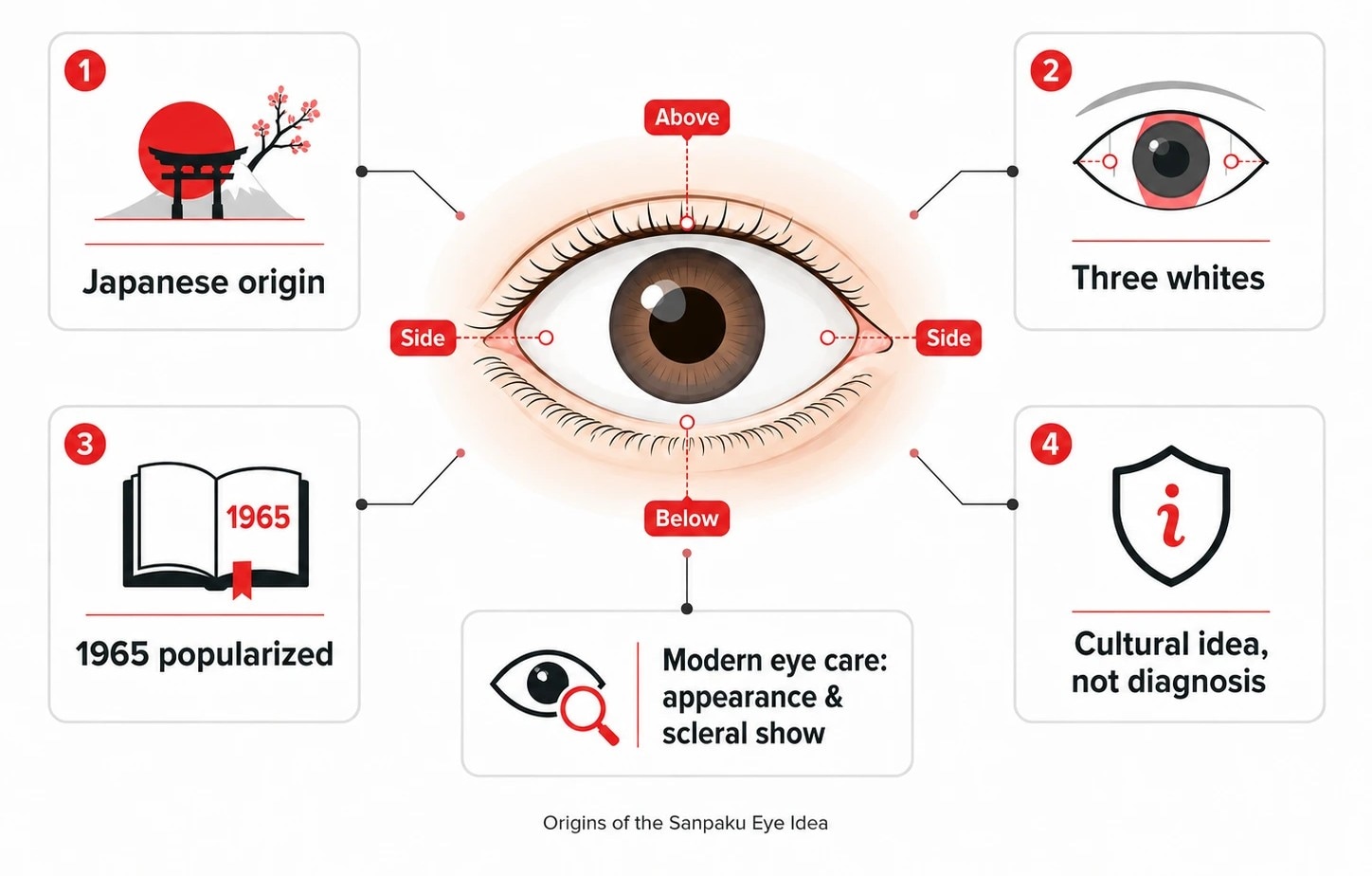
Yin sanpaku was associated with vulnerability, imbalance, or misfortune, while yang sanpaku was linked with aggression or emotional instability. These ideas are part of the cultural history of sanpaku, not evidence-based conclusions about a person’s health, personality, or future. Beliefs about sanpaku eyes have varied across people, communities, and generations, and the term is now widely discussed through social media and popular culture. From an eye-care perspective, modern evaluation focuses on anatomy, scleral show, symptoms, and changes in the eyes rather than folklore.
How can you tell if you have sanpaku eyes?
You can get a rough idea by checking how much white is visible above or below your iris while your head and eyes are in a neutral position. This is only an appearance check, not a medical sanpaku eyes test, because your gaze, expression, and head position can temporarily change how much sclera you see.
- Stand in front of a mirror in even lighting.
- Keep your head level instead of tilting it upward or downward.
- Look straight ahead without widening or squinting your eyes.
- Check whether a noticeable strip of white shows beneath the iris in either eye.
- Check whether you can see white above either iris.
- Compare both eyes rather than judging one eye by itself.
- Repeat the check later if your gaze, expression, or viewing angle may have affected what you saw.
If you are wondering how do you know if you have sanpaku eyes, this mirror check can help you notice the general appearance, but it cannot tell you why the sclera is visible. A new, increasing, or one-sided amount of scleral show, especially with discomfort or vision changes, should be evaluated by an eye doctor rather than self-diagnosed from a mirror or photo.
Comparing your right and left eyes and noticing they do not look or see exactly the same? Know how to read contact lens prescriptions (OD vs. OS) so you can keep each eye’s prescription details straight.
Can sanpaku eyes affect vision or contact lens wear?
Sanpaku eyes themselves do not automatically affect how clearly you see or determine which types of contact lenses you need. Contact lens selection depends on your prescription, eye health, corneal measurements, tear film, and how well the lenses fit your eyes. The CDC recommends that contact lenses be prescribed and properly fitted by an eye care provider. So, visible sclera alone is not a reason to change your lens type, size, or prescription.
In some cases, the reason for increased scleral show can affect eye comfort. Eyelid retraction or prominent eyes may expose more of the eye surface, which can contribute to dryness or irritation and make contacts feel less comfortable. If dryness keeps returning, learning what causes dry eyes and how to make your contacts more comfortable can help you understand common causes. Discuss persistent discomfort, dryness, redness, or vision changes with your eye care professional rather than adjusting your lenses on your own.
To help keep your eyes comfortable and your lenses safe, follow these reminders:
- Keep wearing only the contact lenses prescribed and fitted for you.
- Do not change your lens size or type based only on how much sclera is visible.
- Remove your contacts if your eyes become painful, very red, unusually dry, light sensitive, or blurry, and contact your eye doctor if symptoms persist or are significant.
- Schedule an eye exam if contact lens discomfort keeps returning.
Are your eyes easily irritated when contacts are in, even when your prescription seems right? Compare contact lenses for sensitive eyes so you can discuss comfort-focused options with your eye doctor.
Do sanpaku eyes need treatment?
Natural, stable sanpaku eyes usually do not need treatment simply because more sclera is visible. If the appearance is part of your normal anatomy and you have no discomfort or vision problems, there may be nothing medically wrong to treat. The sanpaku label itself describes an appearance rather than a medical diagnosis and, by itself, is not a reason to switch to specialty contact lenses. Treatment becomes more relevant when scleral show is caused by eyelid retraction, thyroid eye disease, trauma, or changes after surgery.
In those cases, treatment depends on the underlying cause, your symptoms, eye-surface exposure, and whether vision is affected. Options may include lubrication, treatment of the underlying condition, or eyelid procedures in selected cases. Fillers or surgery should not be viewed as routine ways to “fix” sanpaku eyes. If the appearance is new, bothersome, or you are considering cosmetic treatment, an ophthalmologist or qualified oculoplastic specialist can evaluate your eyelid position, eye surface, and overall eye health.
When should you see an eye doctor about a scleral show?
A stable eye appearance you have always had is usually different from a scleral show that suddenly appears, becomes more noticeable, or affects one eye more than the other. Schedule an eye exam if the change is new, progressive, uncomfortable, or follows an injury or eyelid surgery, since changes in eyelid position or eye prominence can sometimes need medical evaluation.
See an eye doctor if you notice:
- New or rapidly increasing white above iris or white below iris
- A noticeable change in only one eye
- Bulging or unusually prominent eyes
- Eyelids that suddenly sit higher or lower than before
- Persistent dryness, grittiness, redness, or watering
- Eye pain or pressure
- Trouble closing your eyelids completely
- New double vision
- Blurry or decreased vision
- Changes after an eye injury or eyelid surgery
- Contact lens discomfort that continues after you remove your lenses
If you wear contact lenses and develop unusual redness, worsening pain, light sensitivity, sudden blurry vision, or discharge, remove your lenses and contact your eye care professional right away. Do not put them back in until your eye doctor says it is safe.
Has a new change in your eye appearance also made bright light uncomfortable? Review contact lens options for light sensitivity so you know what symptoms and comfort concerns to discuss during your eye exam.
What Should You Know About Sanpaku Eyes?
Sanpaku eyes describe an appearance in which more of the white of your eye shows above or below the iris, and for many people this may simply be part of their natural eye and eyelid anatomy. The yin sanpaku and yang sanpaku meanings you may see online come from cultural beliefs rather than scientific evidence that your eye shape predicts personality, health, or fate. What matters medically is whether scleral show is new, changing, one-sided, or accompanied by dryness, pain, bulging, double vision, or other vision changes. If something about your eyes has noticeably changed, an eye care professional can examine your eyelids, eye surface, vision, and possible underlying cause.
Do changes in your eye comfort or appearance have you wondering whether your current lenses still fit your needs? Browse our contact lenses to compare prescribed options for your vision needs, wearing schedule, and daily routine.
Learn More about Sanpaku Eyes
Can sanpaku eyes develop later in life?
Yes, sanpaku eyes can become more noticeable later in life if changes in eyelid position expose more sclera above or below the iris. Aging can affect the tissues that support your eyelids, while trauma, surgery, eye prominence, or certain medical conditions may also contribute to new scleral show. A gradual, stable change may simply reflect aging or anatomy. If the appearance develops suddenly, affects one eye more than the other, or comes with discomfort or vision changes, schedule an eye exam.
Can only one eye have a sanpaku appearance?
Yes, the amount of visible sclera can differ between your two eyes. Natural facial and eyelid asymmetry can make one eye show slightly more white without indicating a problem. However, trauma, eyelid retraction, eye prominence, or other changes can also affect one eye more than the other. Have a new or increasing one-sided change evaluated by an eye doctor, especially if you also have pain, swelling, double vision, or reduced vision.
Can lack of sleep cause sanpaku eyes?
There is no established evidence that lack of sleep directly causes sanpaku eyes as a specific condition. Fatigue can affect your facial expression, eyelid position, puffiness, or how wide your eyes appear, which may temporarily make the sclera look more noticeable. Photos taken when you are tired can also exaggerate the effect depending on your gaze and expression. If visible sclera remains noticeably different after you are rested, do not automatically assume poor sleep is the cause.
Can photos make your eyes look sanpaku?
Yes, a photo can make your eyes look more sanpaku than they do in a neutral gaze. Camera angle, head tilt, looking upward or downward, widening your eyes, and facial expression can all change how much sclera appears above or beneath the iris. For a better comparison, check your eyes in a mirror with your head level and your gaze straight ahead. A photograph alone cannot diagnose scleral show or determine why the sclera is visible.
Can sanpaku eyes go away?
Whether sanpaku eyes go away depends on why the sclera is visible. If the appearance comes from your natural anatomy, it may remain fairly stable, while temporary changes related to gaze, expression, or swelling may become less noticeable. Scleral show caused by eyelid retraction, trauma, surgery, or another condition may change only when the underlying cause is addressed. New or persistent changes should be assessed professionally rather than treated with DIY methods.
Are sanpaku eyes the same as bulging eyes?
No, sanpaku eyes and bulging eyes are not the same thing. Bulging eyes, medically called proptosis, occur when the eyeball sits farther forward than usual, while sanpaku describes visible sclera above or below the iris. Proptosis can make scleral show more noticeable because more of the eye surface may become exposed. However, many people with visible sclera do not have bulging eyes.
Can children have sanpaku eyes?
Yes, children can naturally have different eye shapes and eyelid positions, including some visible sclera above or below the iris. If the appearance has been stable and the child has no symptoms, it may simply reflect normal anatomical variation. A new, increasing, or one-sided change should be evaluated rather than assumed to be a natural sanpaku eye appearance. Seek prompt eye care if the change comes with pain, significant swelling, double vision, or any decrease or change in vision.
Disclaimer: This content is for general informational purposes only and is not a substitute for professional advice, diagnosis, or treatment.
References
Sanpaku Eyes: Meaning, Psychology and How to Tell If You Have Them. Hayley Foster; medically reviewed by Sonia Kelley, O.D., M.S. All About Vision.
https://www.allaboutvision.com/eye-care/cosmetic/sanpaku-eyes/. Date Accessed: August 31, 2026.
Lower Eyelid Retraction. Anne Barmettler, M.D., et al. EyeWiki / American Academy of Ophthalmology.
https://eyewiki.aao.org/Lower_Eyelid_Retraction. Date Accessed: August 31, 2026.
Upper Eyelid Retraction. Anthony S. Wong, M.D., M.S., et al. EyeWiki / American Academy of Ophthalmology.
https://eyewiki.org/Upper_Eyelid_Retraction. Date Accessed: August 31, 2026.
Management of Graves’ Upper Eyelid Retraction (GUER): A Review. Akruti Desai, Pallavi Singh, Dan Rootman, and Milind N. Naik. Indian Journal of Ophthalmology / PubMed.
https://pubmed.ncbi.nlm.nih.gov/39728613/. Date Accessed: August 31, 2026.
Thyroid Eye Disease (Graves’ Eye Disease): Symptoms & Causes. Cleveland Clinic.
https://my.clevelandclinic.org/health/diseases/17558-thyroid-eye-disease. Date Accessed: August 31, 2026.
Similar Articles
-

Contact Lens Packaging, Labels, and Expiration Dates: A Simple Guide for Buyers
-

Dailies AquaComfort Plus Toric vs Dailies Total 1 for Astigmatism: Choosing the Best Toric Contact Lens
-

Flying With Contact Lenses: Frequently Asked Questions & Travel Tips (2025 Update)
-

Can You Use Contact Solution as Eye Drops? The Definitive Answer
-

The 20-20-20 Rule (How to Stop Digital Eye Strain)