

The world is a wonderful carousel of marvelous, brilliant, almost infinite colors. From the fiery blaze of a maple tree in autumn to the deep, electric sapphire of a twilight sky, color is a brilliant visual symphony, a vivid tapestry that shapes how we feel, move, and make sense of life every single day.
But what about those people who see colors differently?
Worldwide, color vision deficiency affects roughly 1 in 12 men and 1 in 200 women, making it one of the most common inherited vision conditions. Despite its name, color blindness is rarely a world drained into monochrome. Instead, it is a dynamic shift in perception where certain shades soften, overlap, or quietly blend into one another.
How Do You See Colors?
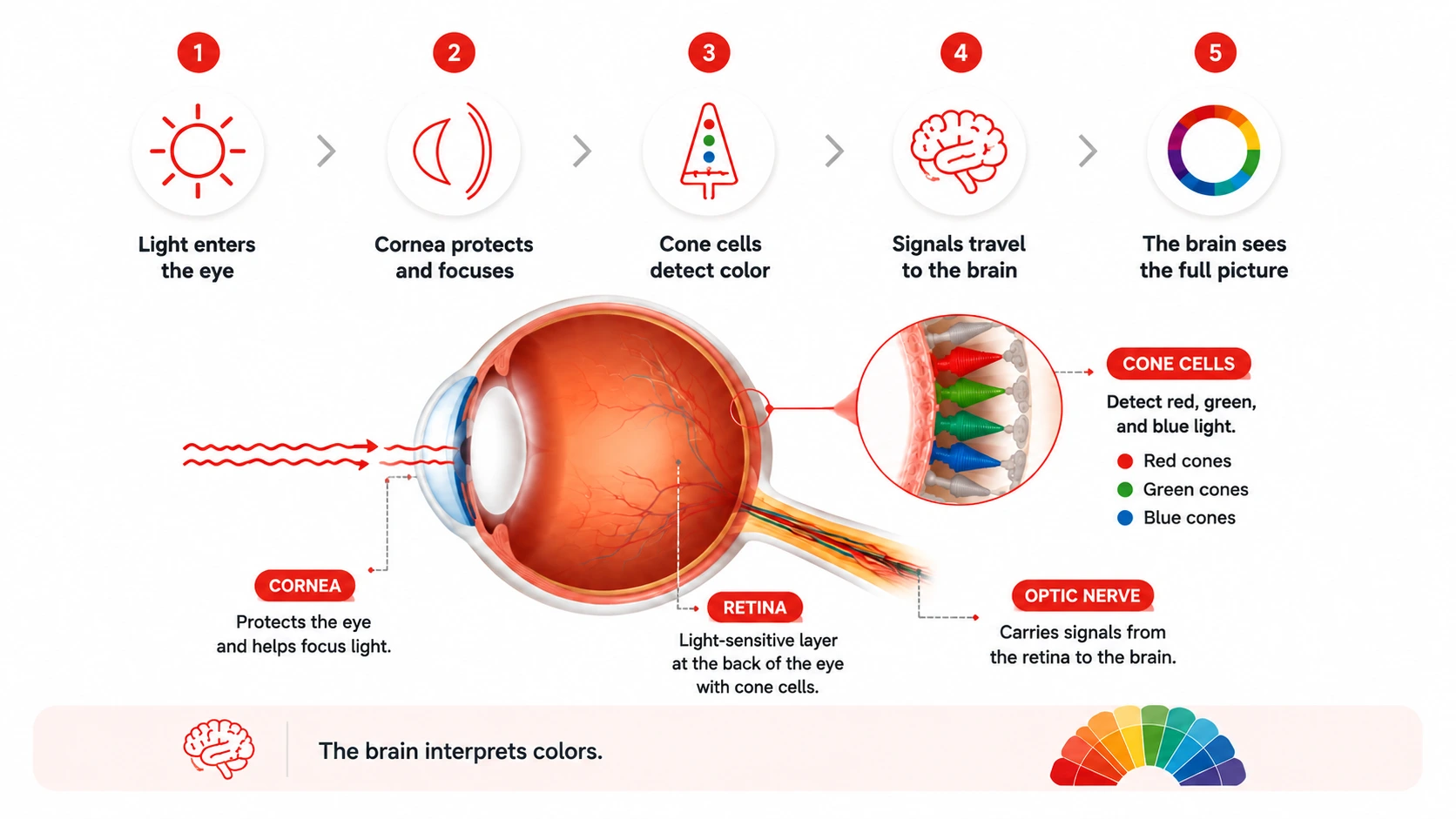
Every color you have ever seen is magic born from light. When daylight spills into your eye, it passes through the lens and strikes the retina, a delicate, light-sensitive tissue tucked at the back of your eye. Millions of photoreceptors line up the retina, specialized cells that detect incoming light and translate it into signals that your brain can read.

The true visual artists of these photoreceptors are the cone cells, which allow you to perceive color.
Most human eyes carry three distinct types of cone cells, each tuned to capture a different wavelength of light: red, green, and blue. Rather than painting in plain primary strokes, your brain acts like a master colorist, constantly mixing signals from all three cones to render the vast world in full color around you.
Seeing a lemon, for instance, isn’t the work of a single “yellow” sensor. It’s the result of your red and green cones firing together, prompting your brain to interpret the combined signal as bright yellow.
Your entire visual world depends on how smoothly these microscopic artists work together. When all three cone types are in harmony, you can distinguish a kaleidoscope of around a million distinct shades. It’s astonishing to think how our brain can blend these three primary colors to an almost infinite number of hues!
A subtle, continuous bit of daily magic, indeed. It’s the unseen thread that lets you read a shifting street signal, spot a vibrant berry hidden in green leaves, or marvel at the layered hues of a sunset.
What Changes for Someone Who Is Color-blind?
Sometimes, however, the eye’s internal palette is mixed a little differently. Color blindness, or color vision deficiency, occurs when the eyes or brain translate the story of light in a slightly, more unique way.
Light still strikes these cone cells. But when these cells behave unexpectedly, the signals sent to the brain are rewritten, altering how we see certain hues.
Color blindness can take root in several different ways:
- Genetic inheritance: The most common cause is a genetic variation passed down through the family’s genes.
- Changes in the eye or retina: Certain eye conditions or damage to the retina can affect the cells responsible for color perception.
- Changes in the brain or nervous system: Conditions that affect the areas of the brain involved in processing visual information can affect color perception.
- Aging: As people get older, natural changes in the eye can affect how clearly they perceive certain colors.
- Medications or health conditions: Some medications and medical conditions can interfere with normal color vision in rare cases.
Because color vision exists on a vast and varied spectrum, no two color-blind people wander through the exact same world. One person might only notice a soft blur between neighboring tones. Another finds entire color groups blurring into gentle neutrals. It all depends on which cone cells are affected and how the brain interprets the visual signals it receives to make sense of the vibrant world around them.
What Do Colors Look Like to Color-blind People?
The most common forms of color-blindness change how people distinguish certain color groups. These shifts can subtly alter the appearance of everyday life.
Look at the image below. That’s what people with normal vision see when they look at a field of flowers.

Red-Green Color Vision Deficiency
Red-green color vision deficiency is the most common type of color blindness. People with this type of vision deficiency have a different perception of red, green, and any color that contains similar tones.
Some colors may appear less vivid or blend together. Red shades may look darker, deeper, and earthier, looking closer to warm brown or shadowy charcoal. Greens may appear more yellow, gray, or muted. Colors such as orange, brown, and green can sometimes look similar because they share overlapping tones.
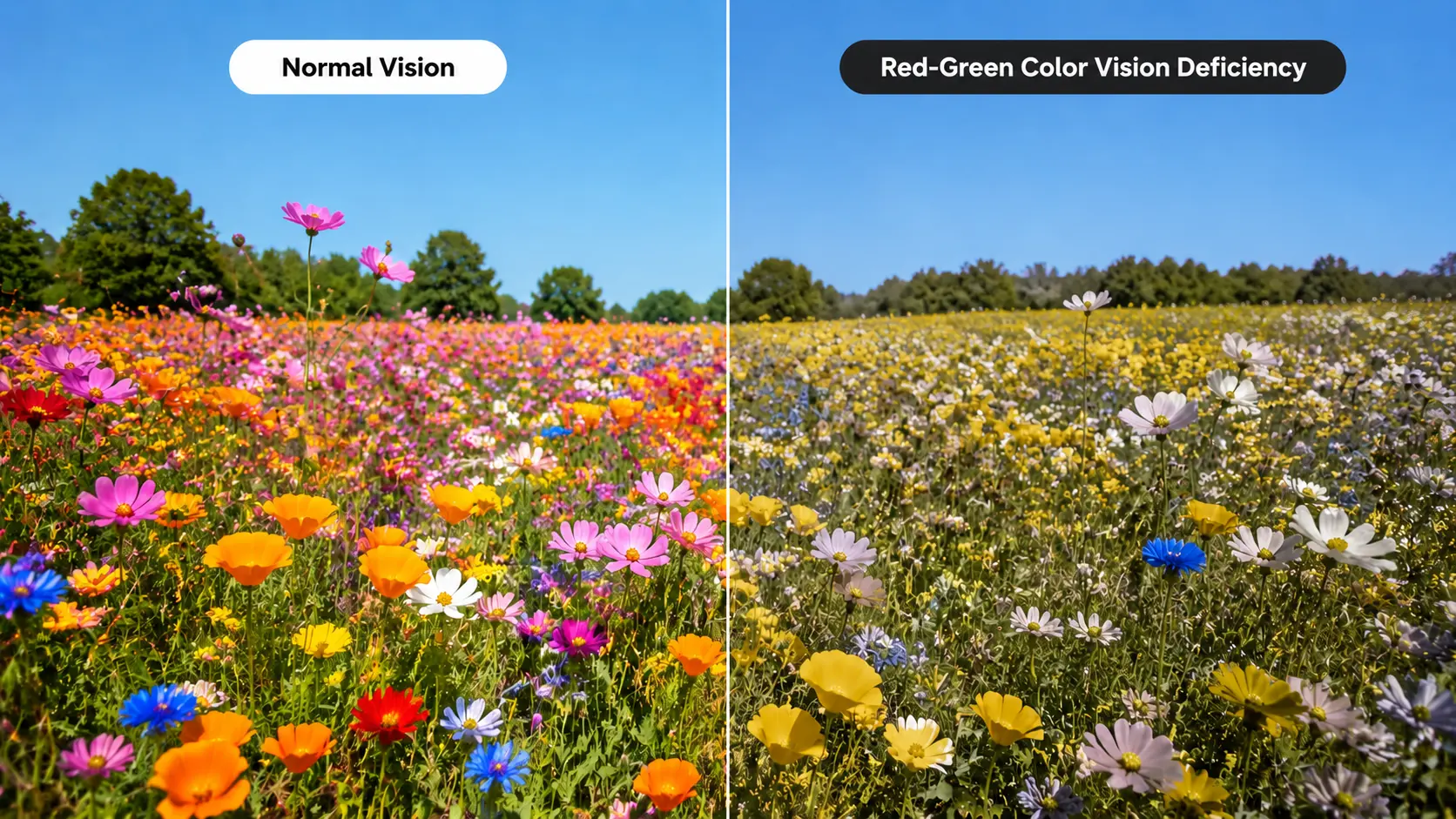
- A ripe, red apple may appear darker or more brown than bright red.
- Green grass on a lawn may look less vibrant or closer to yellow or beige.
- A purple flower may be harder to distinguish from a blue flower because the red tones that create purple are less noticeable.
- A traffic light may rely more on position and brightness rather than color alone for identification.
Blue-Yellow Color Vision Deficiency
Blue-yellow color vision deficiency changes how someone distinguishes between blues, greens, yellows, and certain neutral shades. While far less common than red-green color deficiency, it creates a unique shift in how everyday objects present themselves.
The usual contrast between cool and warm shades softens. Blues lean toward green hues. Vibrant yellows lose a bit of their warmth, lightening into subtle off-whites or muted grays.
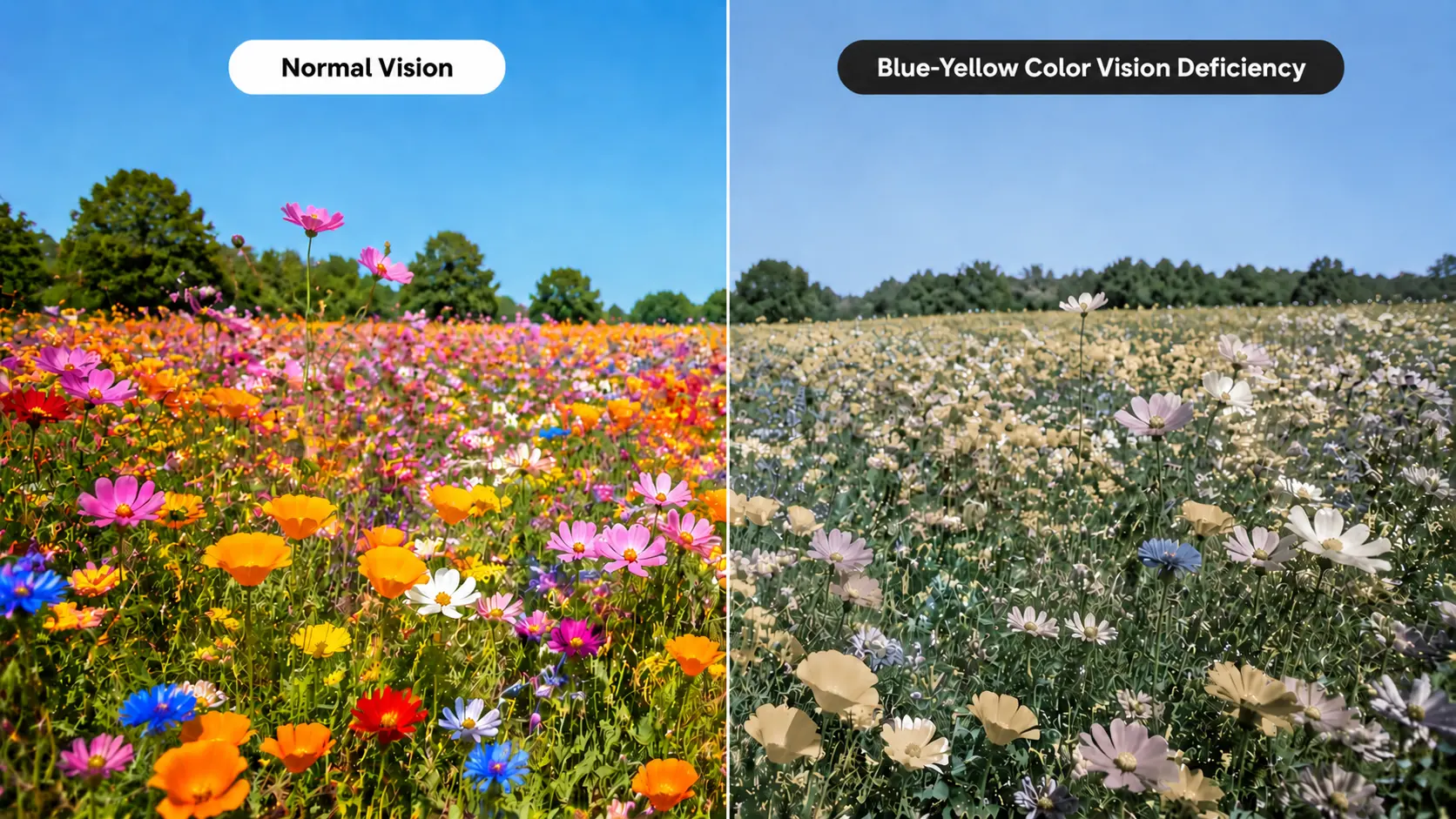
- An open cloudless summer sky can seem to blend more smoothly into green hills on the horizon rather than standing out as a sharp blue backdrop.
- A blue shirt and a green shirt lying side-by-side in a drawer can look surprisingly similar, making them easy to mix up.
- A bright yellow object, like a sticky note or a lemon, may appear far softer, leaning closer to a light cream or pale gray.
- Color-coded maps and graphs that rely strictly on blue, green, and yellow keys can become tricky to read without clear labels or contrasting patterns.
Complete Color Vision Deficiency
Complete color vision deficiency is a rare condition where the cone cells that detect color don’t process wavelengths normally. A person with this condition relies almost entirely on variations in light, shadow, and contrast to make sense of their surroundings.
Without functioning cone signals, the visual world loses its chromatic variety. Bright colors flatten into similar tones. Objects that would usually stand out by hue alone must instead be identified by their shape, depth, and intensity.
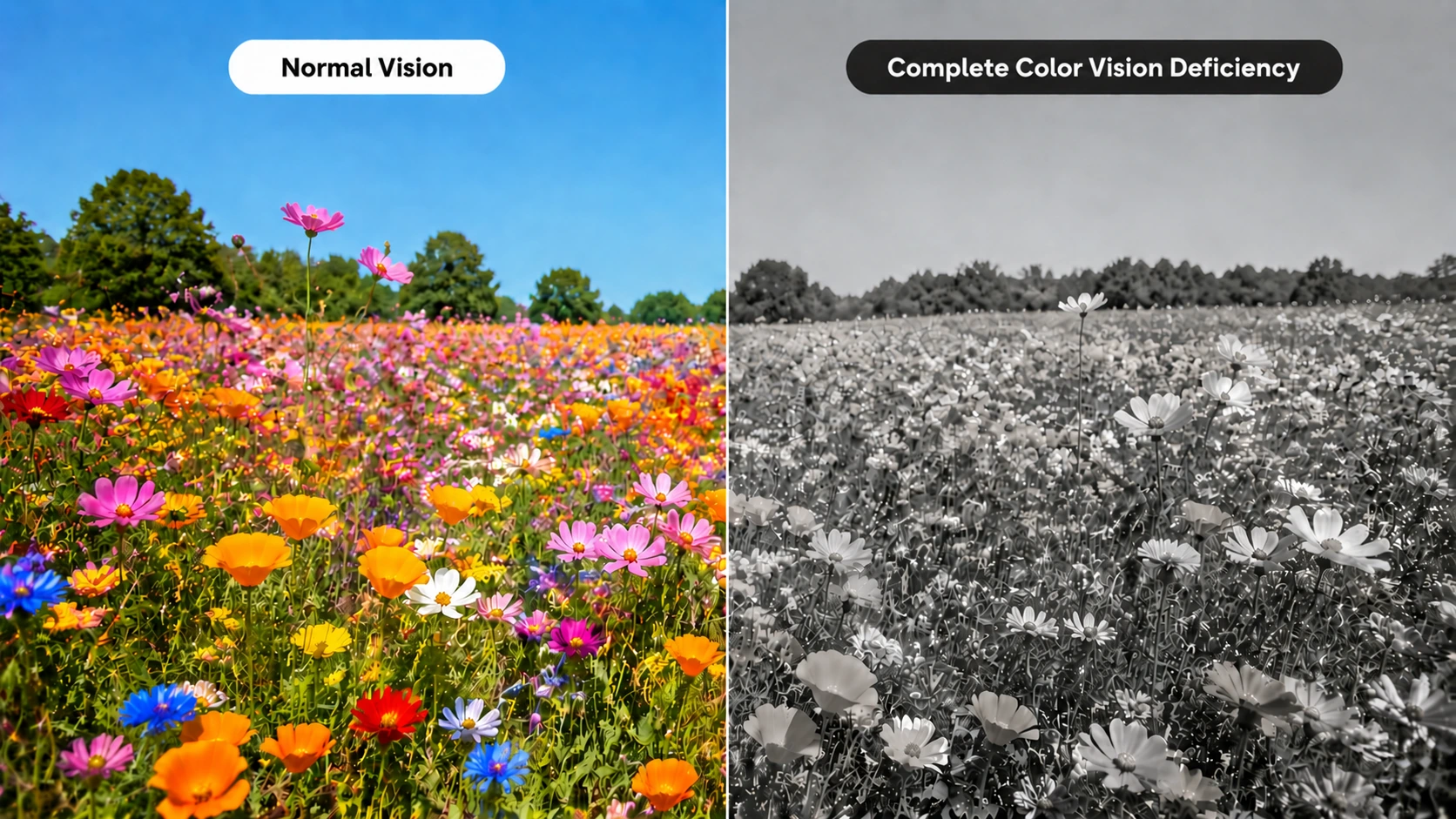
- A vibrant artwork is experienced through its composition of light and shadow much like a black-and-white photograph rather than its palette.
- Bright sunlight or harsh glare can feel significantly more intense, as the eyes process incoming light without the softening filter of colors.
- Choosing outfits, reading signs, or using apps becomes an exercise in looking for clear text labels, high contrast, or distinct patterns rather than color cues.
How Do Color-blind People Adapt to Their Condition?
While it may be difficult for us to imagine seeing the world through a narrower palette, perception is never set in stone. People with color blindness naturally train their minds to interpret their surroundings through a different lens, proving that understanding our world relies on far more than color alone.

- Use context clues to identify colors.
The environment around an object often gives away its color. For example, someone may recognize a ripe banana based on its shape, texture, and familiarity rather than its exact shade. - Remember common color patterns.
Familiar objects follow predictable color patterns. Learning that traffic signals run in a fixed top-to-bottom sequence or that highway warning signs follow distinct shapes creates an instant, reliable roadmap. - Pay attention to brightness and contrast.
Differences in lightness, darkness, and intensity help separate colors that appear similar. A person may distinguish between two objects by noticing contrast rather than the colors. - Use labels, symbols, and patterns.
Text, icons, and patterns provide extra information. This is helpful for reading maps, charts, apps, workplace materials, and warning signs. - Organize clothing and personal items carefully.
Some people arrange their clothes by outfit combinations, label items, or ask for help when matching colors. These habits make choosing clothes easier and reduce uncertainty. - Use technology and accessibility tools.
Color identification apps, digital settings, EnChroma glasses, and other technologies help color-blind people recognize colors or adjust displays to make information easier to understand. - Rely on memory and experience.
Over time, many people with color vision deficiency build familiarity with how certain objects typically look. They use past experiences to make quick judgments about colors in everyday situations.
What Are Common Myths About What Color-blind People See?
Color blindness is frequently misunderstood, leading to common misperceptions about how people with color vision deficiency experience the world.

- Myth: Colorblind people only see in black and white.
Fact: The vast majority of colorblind individuals see a wide range of colors. Their visual system simply processes certain wavelengths differently, causing specific shades to appear muted, blended, or shifted. Seeing strictly in grayscale is extremely rare. - Myth: Everyone with color blindness sees the world the exact same way.
Fact: Color vision deficiency exists along a wide spectrum. Even two people with the same classification can experience colors differently based on how their cone cells are affected and how their brain adapts to those signals. - Myth: Color blindness means an inability to recognize any colors at all.
Fact: Most people with color blindness regularly identify colors by pairing what they see with context, brightness, and memory. Recognizing green grass or a red stop sign relies on a combination of visual cues and lived experience. - Myth: Color blindness prevents someone from enjoying art, nature, or design.
Fact: People with color vision deficiency deeply engage with art and nature through form, shadow, light contrast, texture, and composition. They experience beauty like us, only that they do so through a slightly different lens. - Myth: People with color blindness cannot learn or memorize colors.
Fact: Color memory remains strong. Through experience and context, people naturally build lasting associations, learning where specific colors belong and using that knowledge to make quick, accurate judgments in daily life.
Seeing the World Through a Different Color Lens
Human perception is a marvel of resilience and imagination. Color blindness may change the palette of daily life, but it never dims the richness of the world itself. By leaning on the play of light and shadow, the rhythm of familiar patterns, and the deep reservoir of memory, people with color vision deficiency craft their own unique ways of reading their surroundings, proving just how wonderfully adaptable we truly are.

When we take time to understand these distinct ways of seeing, we begin to build a world that welcomes everyone into the picture. It reminds us that beauty doesn’t depend on seeing every color. It lies in the endless, creative ways we make sense of the world around us.
Disclaimer: This content is for general informational purposes only and is not a substitute for professional advice, diagnosis, or treatment.
References
Color Blindness. National Eye Institute. https://www.nei.nih.gov/eye-health-information/eye-conditions-and-diseases/color-blindness. September-19-2025. Date Accessed: September 2, 2026.
Facts About Color Blindness. Centers for Disease Control and Prevention. https://www.cdc.gov/vision-health/about-eye-disorders/color-blindness.html. May-15-2024. Date Accessed: September 2, 2026.
Color Vision Deficiency. American Academy of Ophthalmology. https://www.aao.org/eye-health/diseases/what-is-color-blindness. January-09-2025. Date Accessed: September 2, 2026.
Human Color Vision and Color Blindness. National Library of Medicine, National Center for Biotechnology Information (NCBI Bookshelf). https://www.ncbi.nlm.nih.gov/books/NBK11538/. January-01-2001. Date Accessed: September 2, 2026.
The Genetics of Color Vision Deficiency. National Human Genome Research Institute. https://www.genome.gov/genetics-glossary/Color-Blindness. Updated-2024. Date Accessed: September 2, 2026.