
You sit across from a close friend in a softly lit cafe, lost in conversation. You notice something mesmerizing. Their gaze seems to widen, softening their expression and drawing you deeper in.
It’s one of romance’s most beautiful mysteries. It’s a fleeting change that feels deeply personal, as if their eyes are physically expanding just to take you in.
It leaves you wondering, why do your pupils get bigger when you’re in love? Or when you’re attracted to someone?
While we poetically look at this dreamy expression as an unspoken confession of affection, biology tells us it’s a complex dance between the heart, the brain, and the nervous system. Before a single word is uttered, before a hand reaches out to hold another, our eyes reveal the tender excitement building within us. They give us a sweet, pure glimpse into what it truly means to be captivated by someone.
Your Heart’s Unspoken Signal of Affection
When you lock eyes with a special person who takes your breath away, your body reveals what your lips might not yet say. Attraction triggers a quick surge of neurotransmitters, activating your sympathetic nervous system.

In an instant, your pupils expand, an involuntary physiological response called mydriasis.
Because pupil size is regulated entirely by your nervous system, it isn’t something you can consciously control or fake. It’s your brain’s subconscious way of dialing in its focus, sharpening visual detail, and quite literally opening your eyes wider to take in every detail of that beautiful person in front of you.
It’s science, yes, but it’s also one of nature’s most subtle signals of affection.
How Your Nervous System Whispers Through Your Eyes
In every shared glance lies a breathtaking biological dance. Controlled by the autonomic nervous system, the body’s secret keeper of our deepest and unprompted feelings, pupil size changes without you knowing it. The moment attraction takes hold, the sympathetic nervous system awakens, translating the sweet stirrings of the heart into a silent, physical expression.
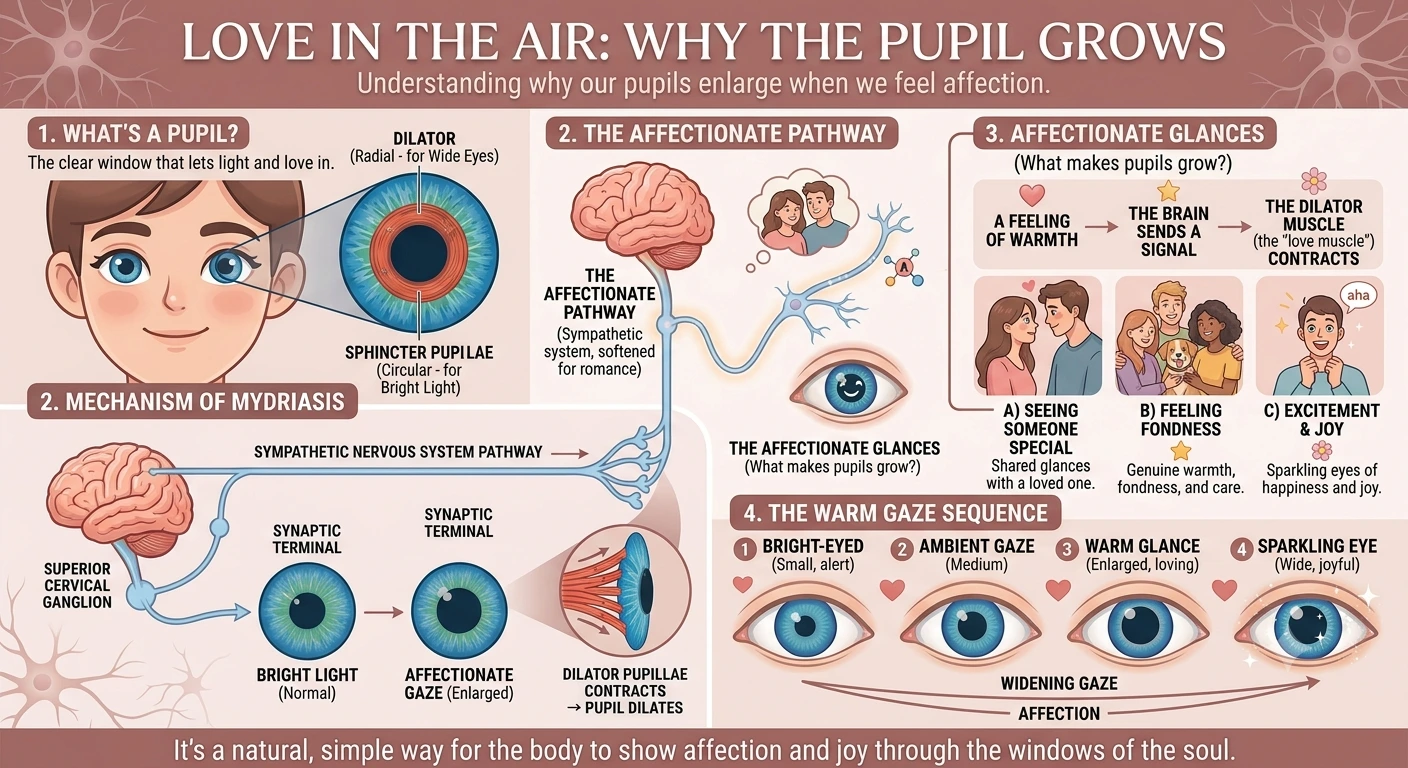
Here is how a single spark of passion unfolds within your eyes:
1. A Spark of Emotional Arousal
Simply catching their eye or hearing the voice of someone you like triggers a sudden uptick in emotional intensity. You feel warm and excited. Your brain lights up with increased focus and sweet anticipation, locking your full attention onto the person before you.
2. The Sympathetic System Ignites
Driven by doses of neurotransmitters like norepinephrine and dopamine, the sympathetic nervous system awakens. It’s the same system that prepares us for thrilling moments, stirring your body into a tender state of heightened awareness. Those butterflies in your tummy when you encounter your crush or sweetheart? Yes, that’s your sympathetic system in overdrive.
3. The Iris Dilator Muscles Engage
As signals race to your eyes, tiny fan-like fibers within the iris, the dilator pupillae muscles, contract. They gently pull the iris outward, expanding the dark center of your eye like an unfolding blossom.
4. The Aperture Widens for More Light
As your pupils enlarge, your eyes allow more light. It’s as if your body instinctively wants to capture every single detail, expression, and flicker of warmth of the person you’re admiring.
5. An Unfettered, Unconscious Truth
Because this entire pathway relies on involuntary nerve signals, the response occurs instantly and without conscious control. It’s an honest reflex of the heart. You can’t force it, nor can you hide it. It’s nature’s way of whispering what you feel before you even say a word.
6. A Gentle Return to Calm
As the initial rush of the moment gently subsides and emotional intensity cools, the parasympathetic cradles your back into balance. The pupils slowly ease back to normal, returning your pupils to normal until the next captivating moment.
The Chemistry of a Romantic Spark
Before your pupils widen, an invisible alchemy takes place deep within your brain. Attraction isn’t merely a mood. It’s a sudden flow of neurochemistry that changes how we see, feel, and experience the world around us.
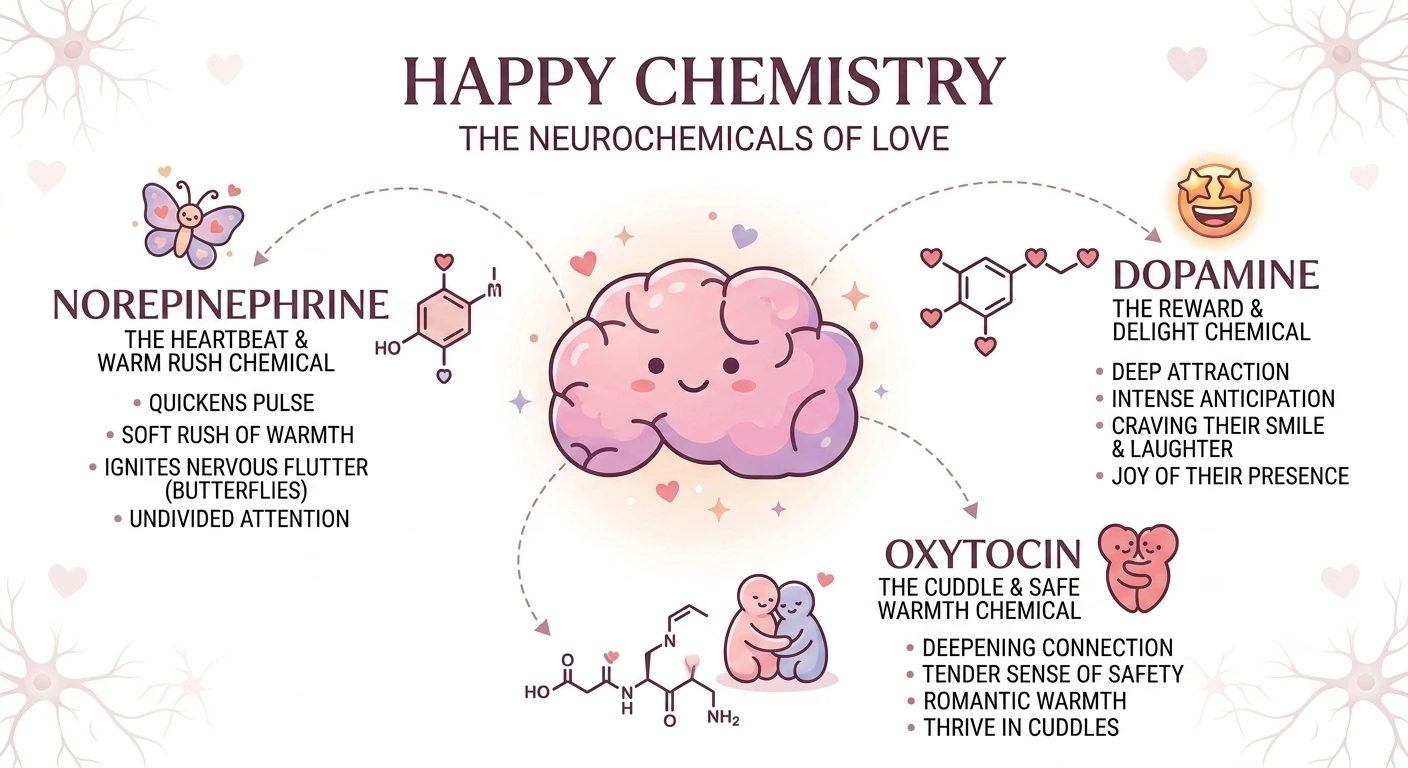
When you look at someone who makes your heart skip a beat, your brain unleashes a tailored cocktail of chemical messengers, each playing its own sweet part in the symphony of romance:
- Dopamine, the Molecule of Longing
The brain’s reward chemical. Dopamine floods your system with delight the moment you catch their eye. It creates that intoxicating anticipation, leaving you craving their smile, their laughter, and their presence. - Norepinephrine, the Spark of Excitement
Working hand in hand with dopamine, norepinephrine quickens your pulse and sends a soft rush of warmth beneath your skin. It sharpens your senses, ignites that familiar flutter of nervous energy in your chest, and commands your undivided attention. - Oxytocin, the Whisper of Closeness
As emotional connection deepens, oxytocin, the cuddle hormone, weaves its way into this mix, transforming thrilling excitement into a tender sense of safety and romantic warmth.
This chemical combo signals the autonomic nervous system to widen your pupils, letting in more light so you can take in every minute detail of the person before you. It’s the very same rush that makes your heart flutter, your palms warm, and your thoughts drift continuously back to them.
Can Dilated Pupils Prove Someone Likes You?
A lingering, wide-eyed gaze is one of romance’s sweetest gestures, but biology reminds us to tread gently. Dilated pupils alone aren’t a foolproof guarantee of love. Since our eyes are sensitive instruments of both emotion and environment, they respond to a vast spectrum of internal and external sparks:

- The Spectrum of Emotion: The same nervous system surge that accompanies romantic desire can also be ignited by sudden surprise, quiet anticipation, nervous jitters, or profound curiosity. The brain simply opens the eye wider whenever something captures its attention.
- The Interplay of Light and Shadow: Before reading a deeper meaning into a gaze, take a look at the romantic ambiance itself. In candlelit restaurants, soft moonlight, or dim coffee shops, pupils naturally bloom outward, an optical grace designed to gather more light so we can see clearly in the dark.
- The Noise of Everyday Life: Physical fatigue, caffeine, certain medications, or even a sudden burst of stress can affect pupil size, creating fluctuations that have little to do with the heart’s affection.
Dilated pupils offer a glimpse into our nervous system’s heightened state. But love is best read in a full picture, including the smiles, the hugs, the presence, and the unspoken sweetness of being truly seen.
When the Heart Whispers Through the Eyes
The eyes are windows to unspoken feelings within. From the quiet dance of neurochemicals in the brain to the tender widening of your pupils, your body possesses its own poetic language of desire.

As beautiful as these biological signals are, the true magic of attraction lies in a complete rhythm of connection. While dilated pupils offer a glimpse into the heart’s excitement, it’s the shared laughter, the intentional gazes, the cuddles, the caresses, and the warmth of each other that bring love to life. Nature gives us the spark, but the sweet rhythm of mutual care is what keeps the flame burning bright.
Get that sweet, doe-eyed look with our colored contact lenses that enhance your lovely eyes.
Disclaimer: This content is for general informational purposes only and is not a substitute for professional advice, diagnosis, or treatment.
References
Dilated Pupils (Mydriasis). Cleveland Clinic. https://my.clevelandclinic.org/health/symptoms/22238-dilated-pupils. Published Date (January-04-2022). Date Accessed: July 29, 2026.
The Pupil as a Measure of Emotional Arousal and Autonomic Activation. Margaret M. Bradley, Laura Miccoli, Miguel A. Escrig, and Peter J. Lang/Psychophysiology. https://pubmed.ncbi.nlm.nih.gov/18282202/. Published Date (February-11-2008). Date Accessed: July 29, 2026.
Arousal Effects on Pupil Size, Heart Rate, and Skin Conductance in an Emotional Face Task. Chin-An Wang, Talia Baird, Jeff Huang, Jonathan D. Coutinho, Donald C. Brien, and Douglas P. Munoz/Frontiers in Neurology. https://pubmed.ncbi.nlm.nih.gov/30559707/. Published Date (December-03-2018). Date Accessed: July 29, 2026.
Pupil Size as Related to Interest Value of Visual Stimuli. Eckhard H. Hess and James M. Polt/Science. https://pubmed.ncbi.nlm.nih.gov/14401489/. Published Date (August-05-1960). Date Accessed: July 29, 2026.
Attractiveness in the Eyes: A Possibility of Positive Loop between Transient Pupil Constriction and Facial Attraction. Hsin-I Liao, Makio Kashino, and Shinsuke Shimojo/Journal of Cognitive Neuroscience. https://pubmed.ncbi.nlm.nih.gov/33166194/. Published Date (November-09-2020). Date Accessed: July 29, 2026.
Romantic Love: An fMRI Study of a Neural Mechanism for Mate Choice. Helen Fisher, Arthur Aron, and Lucy L. Brown/The Journal of Comparative Neurology. https://pubmed.ncbi.nlm.nih.gov/16255001/. Published Date (December-05-2005). Date Accessed: July 29, 2026.
Romantic Love: A Mammalian Brain System for Mate Choice. Helen E. Fisher, Arthur Aron, and Lucy L. Brown/Philosophical Transactions of the Royal Society B: Biological Sciences. https://pmc.ncbi.nlm.nih.gov/articles/PMC1764845/. Published Date (December-29-2006). Date Accessed: July 29, 2026.
The Neuroendocrinology of Love. Krishna G. Seshadri/Indian Journal of Endocrinology and Metabolism. https://pmc.ncbi.nlm.nih.gov/articles/PMC4911849/. Published Date (July-01-2016; exact day not listed). Date Accessed: July 29, 2026.