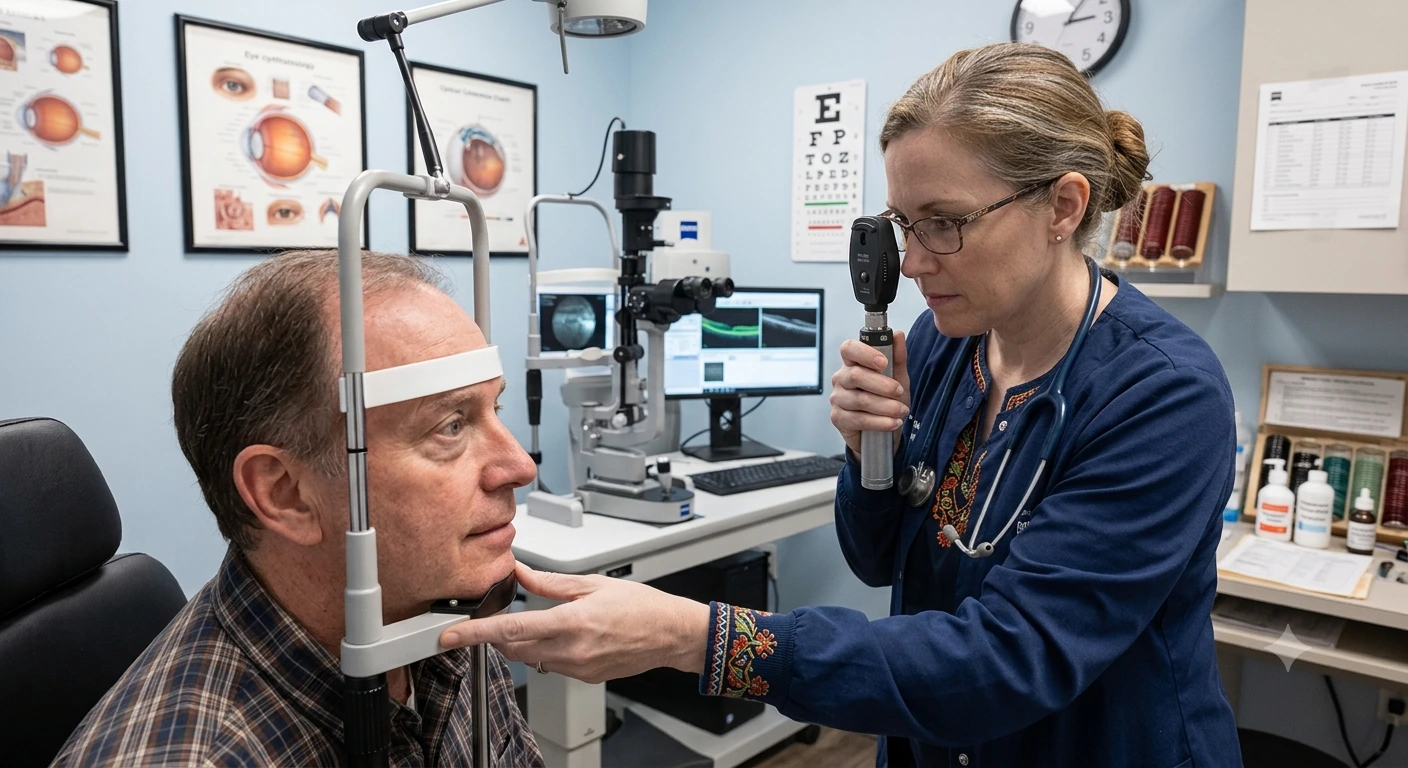

You probably know whether you are right-handed or left-handed, but your eyes may have a “favorite” side too. Cleveland Clinic notes that left eye dominant sighting dominance is not rare, with about 30% of people relying more on the left eye for certain aiming tasks. A dominant eye test can help you find which eye your brain tends to prioritize when you focus on a target. That can be useful for contacts, sports, photography, and certain eye-care decisions, even if it barely affects your day-to-day vision.
How do you know which eye is dominant?
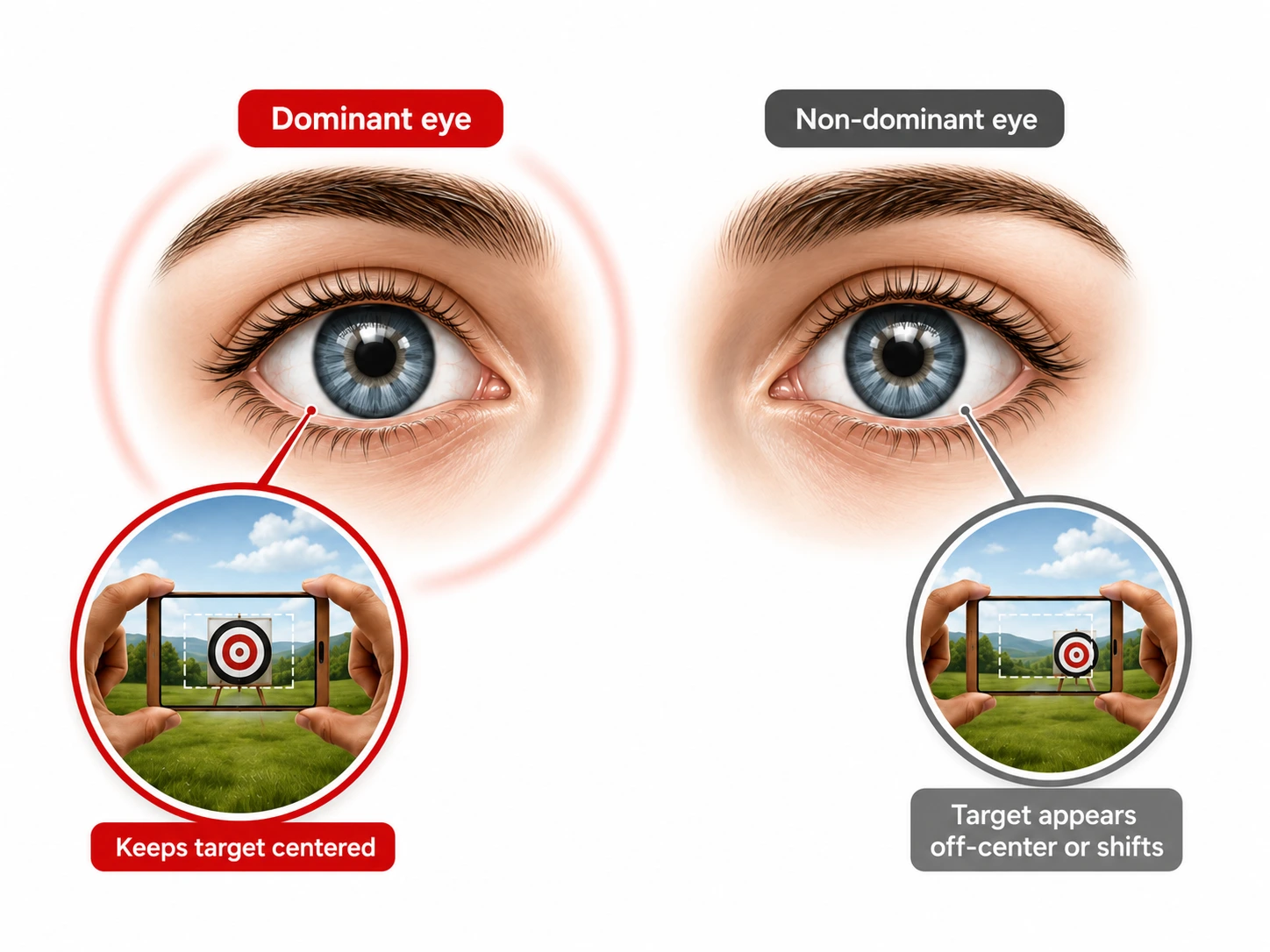
You can usually find your dominant eye with a simple at-home sighting test, such as the Miles test, where you frame a distant object with your hands and close one eye at a time. The eye that keeps the object centered is typically your dominant sighting eye. This is a normal trait for most people, but an eye doctor can test eye dominance more precisely during an eye exam if the result matters for contact lenses, surgery planning, or vision concerns.
If the result will influence a contact lens fitting, understanding what OD means for contact lenses can also help you distinguish the right-eye prescription from the left-eye prescription.
What does it mean to have a dominant eye?
Having a dominant eye means your brain tends to rely a little more on input from one eye for certain visual tasks. This often matters most when you are lining something up, aiming, looking through a camera viewfinder, or focusing on a distant object. It does not always mean that the eye has better visual acuity or sharper vision.
For most people, ocular dominance is common and normal, and both eyes still work together as a team. Your dominant eye may matter more for specific tasks than for everyday vision, so it is not something you usually need to “fix.” If one eye suddenly sees worse, turns, feels different, or causes double vision, that needs an eye exam rather than an at-home dominance guess. Eye dominance alone does not determine whether you need vision correcting contacts, since vision correction depends on your prescription, eye health, and professional fitting.
How to find your dominant eye at home
You can do a simple dominant eye test at home with your hands and a distant object. This is often called the Miles test, and it helps check which eye your brain tends to use as the “sighting” eye when you line something up.
- Choose a small distant object, such as a clock, door knob, light switch, or picture frame.
- Extend your arms in front of you.
- Make a small triangle or opening with your hands.
- Keep both eyes open and center the object inside the opening.
- Close your left eye, then open it.
- Close your right eye, then open it.
- The eye that keeps the object centered is usually your dominant sighting eye.
- Repeat once or twice to confirm.
This test checks sighting dominance, which is the type most people mean when they say dominant eye. If the object shifts with both eyes, stays visible with both eyes, or the result changes, you may have weaker dominance, mixed dominance, or you may simply need a professional test. Ask an eye care professional if the result matters for contacts, surgery planning, sports vision, or a vision concern.
If the result will be used for monovision planning, your provider may confirm it professionally and use trial contact lenses to evaluate how comfortably your eyes adapt.
What do your dominant eye test results mean?
Your dominant eye test result usually points to the eye your brain prefers for lining up a target. It does not measure personality, intelligence, or which eye is “better.” It also does not replace an eye exam if one eye sees worse, feels different, or gives you new vision symptoms.
Right eye dominant
If you are right eye dominant, the object usually stays centered when your right eye is open and your left eye is closed. Right-eye dominance is common, but it does not automatically mean your right eye has better vision. It simply means your brain may rely more on input from the right eye for sighting tasks.
Left eye dominant
If you are left eye dominant, the object usually stays centered when your left eye is open and your right eye is closed. Left-eye dominance is less common than right-eye dominance, but it is not rare. It also does not mean anything is wrong with your right eye.
No clear dominant eye
Some people do not get a strong or consistent result from an at-home test. One eye may lead for some tasks, while the other leads for different tasks. Try repeating the test with a farther target, steady hands, and your head in the same position, or ask an eye care professional to check if the result matters for your vision needs.
Your result may help guide how prescription contact lenses are assigned between your eyes, but it should never be used to change lens powers without professional guidance.
What are the types of eye dominance?
There are a few types of eye dominance, which is why one quick online test may not tell the whole story. Most at-home tests check the eye you use to line up a target, but eye care professionals may look at dominance differently depending on your vision needs.
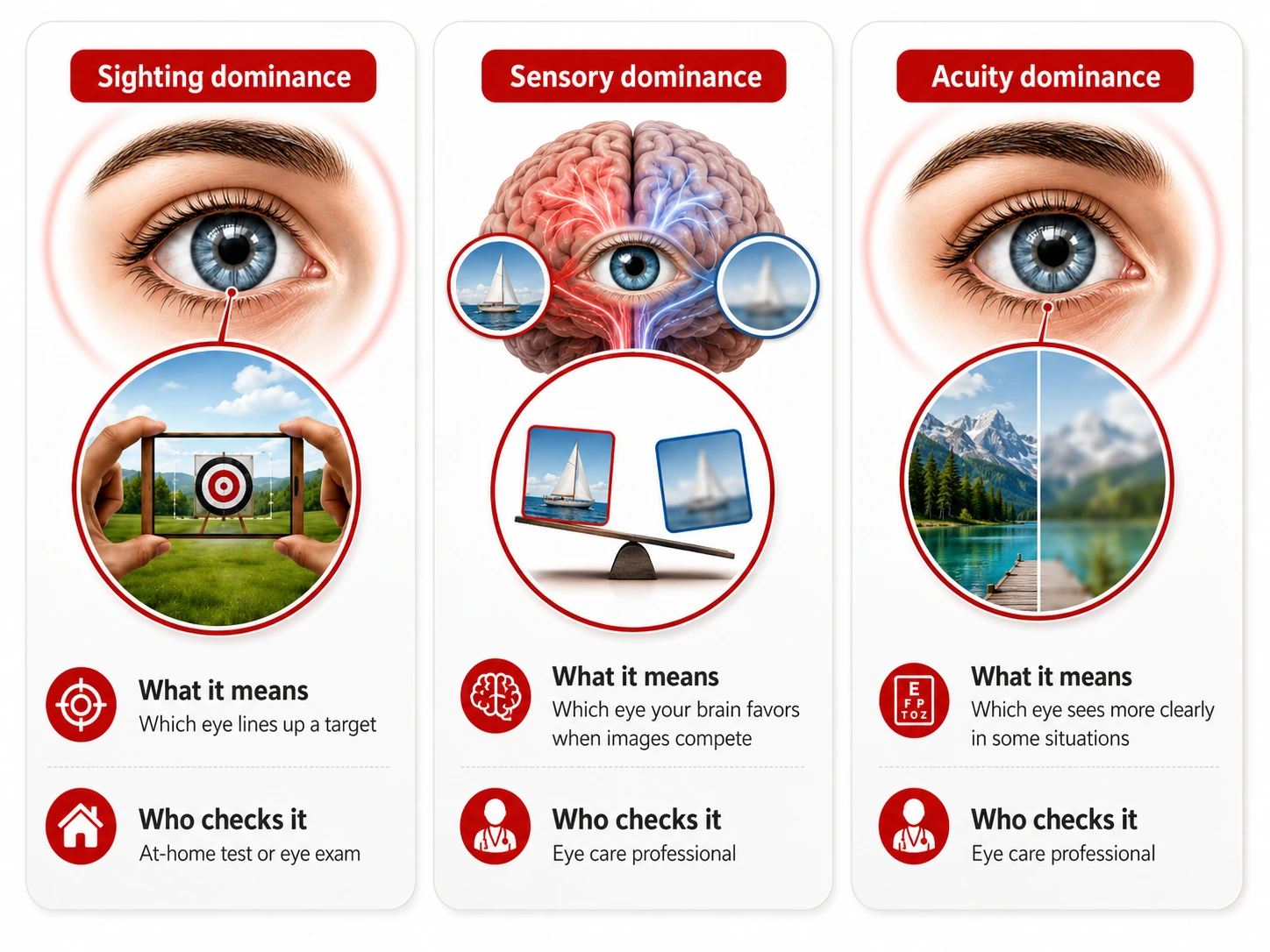
Note: Most at-home dominant eye tests check sighting dominance only. If dominance matters for monovision contacts, cataract surgery planning, or unexplained vision symptoms, an eye care professional can use a more appropriate test.
Is your dominant eye the same as your dominant hand?
Your dominant eye and handedness often match, but not always. Many right-handed people are also right-eye dominant, but you can be right-handed and left-eye dominant, left-handed and right-eye dominant, or have no strong eye preference. Handedness can give you a guess, but it cannot reliably tell you which eye your brain favors.
Cross dominance means your dominant hand and dominant eye are on opposite sides. For example, you may write with your right hand but line up a target more naturally with your left eye. That is not automatically a problem, and it does not say anything meaningful about personality. It may matter more for aiming sports, photography, or certain vision correction decisions.
Why is it helpful to know your dominant eye?
Knowing your dominant eye may not change much in ordinary day-to-day life, but it can help when one eye naturally leads a task. It is most useful for activities that involve aiming, lining up a view, or assigning different visual jobs to each eye.
Sports and aiming
Eye dominance can matter in sports and activities that involve lining up a target, such as archery, shooting sports, golf, baseball, tennis, and darts. If you have cross dominance, you may need small adjustments in head position, stance, or aiming technique. Knowing your dominant eye can help you talk more clearly with a coach, instructor, or sports vision specialist.
Photography and viewfinders
Your dominant eye in photography may be the eye that feels more natural when you look through a camera viewfinder. Using that eye can make framing and alignment feel easier, especially with cameras that rely on one-eye viewing. This matters less for phone photography, where you usually use a screen instead of a viewfinder.
One-eye viewing tasks
Your dominant eye may also show up when you look through a telescope, microscope, peephole, or similar one-eye tool. Most people naturally choose the eye that feels more comfortable for these tasks. That eye is often the dominant sighting eye.
Do sports, aiming, or fast movement make you more aware of which eye leads? Explore top contact lenses for athletes and active people so you can compare lens features that may support an active routine.
Why is eye dominance important for contacts?
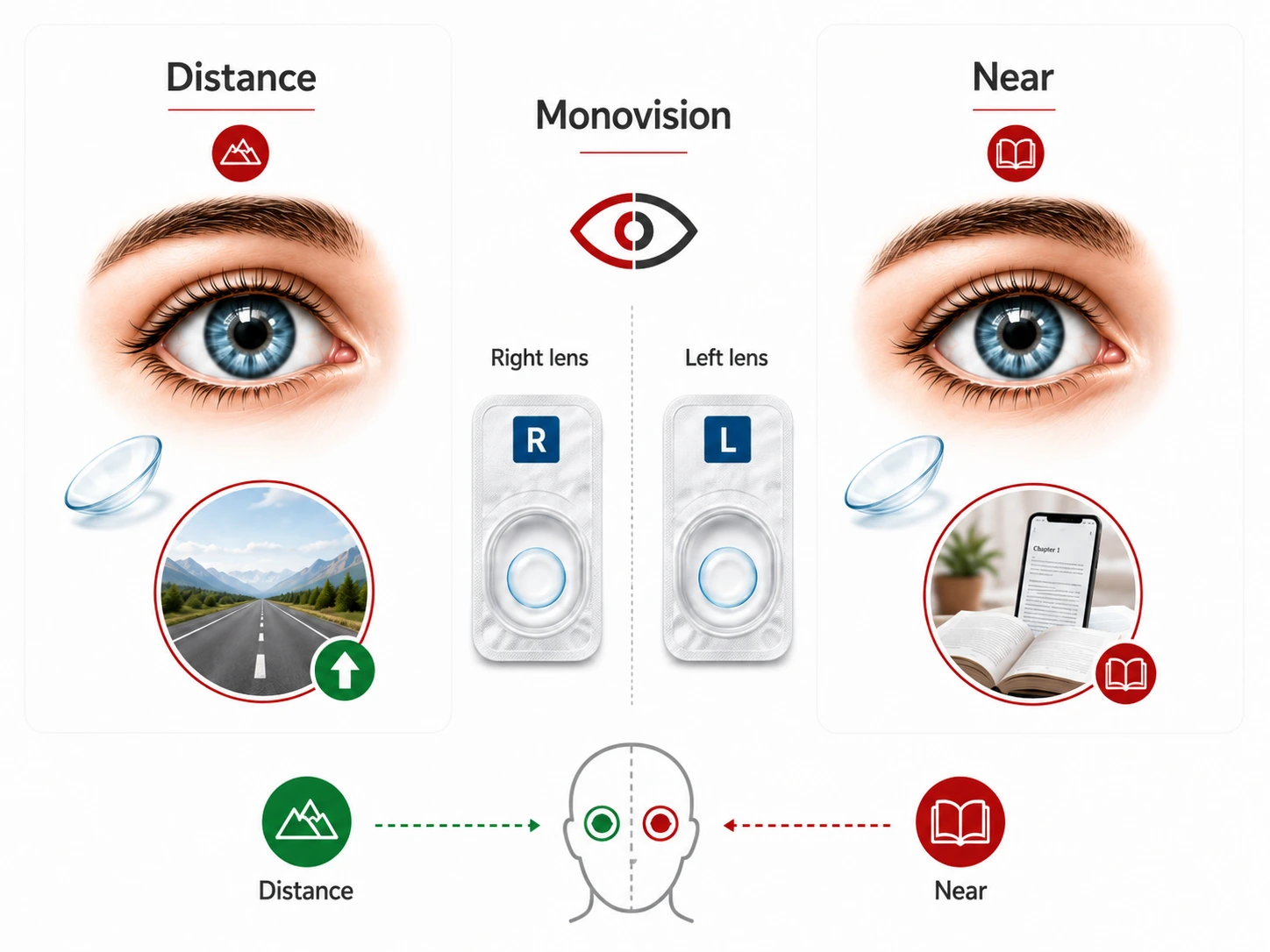
Eye dominance can matter when your eye care professional fits monovision, modified monovision, or multifocal contact lenses. With monovision contacts, one eye may be corrected more for distance while the other is corrected more for near vision. In many monovision approaches, the dominant eye is often considered for distance vision, but the final plan depends on your prescription, comfort, adaptation, and professional fitting.
You should not swap lenses between eyes, change which eye gets which lens, or self-adjust your prescription based on an at-home dominant eye test. Contact lens wearers should follow the prescription for each eye exactly, especially if the right and left lenses have different powers or designs. If your lenses feel off, blurry, or uncomfortable, ask your eye care professional before making changes.
Eye dominance may also come up before cataract surgery, LASIK, or other vision correction planning. It is one piece of information your provider may use along with your prescription, eye health, lifestyle, and vision goals. For everyday lens wear, the safest move is simple: wear your contact lenses exactly as prescribed.
Curious why one eye may be assigned distance vision while the other handles near tasks? Learn how monovision contact lenses work so the role of your dominant eye feels easier to understand.
Does eye dominance affect depth perception or eye health?
Normal eye dominance usually does not mean something is wrong with your eyes. It simply means your brain may prioritize input from one eye for certain tasks, especially aiming or lining up a target. Your dominant eye is not automatically the healthier eye or the eye with better vision.
Depth perception depends mostly on binocular vision, which means both eyes working together to help your brain judge distance. Eye dominance can influence which eye leads certain tasks, but it does not replace the teamwork between your eyes. That is why a person can have a dominant eye and still have normal day-to-day vision. During a contact lens fitting, your provider may compare monovision with multifocal contacts when maintaining balanced binocular vision and depth perception is important.
Do not try eye exercises or patching to “fix” eye dominance unless an eye care professional recommends it. Amblyopia, strabismus, cataracts, injury, or vision loss can change how the brain uses the eyes and should be evaluated. Schedule an eye exam if you notice double vision, eye turning, new blur, eye pain, sudden vision changes, or one eye seeing worse than the other.
Can your dominant eye change over time?
Your dominant eye usually stays consistent for many tasks, but it can be flexible. Some people have mixed or task-dependent dominance, meaning one eye may lead for one activity while the other leads for another. At-home test results can also change if the target distance, hand position, or head position changes.
Eye dominance may also change after vision loss, eye injury, cataract surgery, or another vision procedure. One study on cataract surgery found that ocular dominance can shift in some patients after surgery, especially when vision improves in the previously nondominant eye. If your dominance seems to change along with blur, double vision, eye pain, new misalignment, or vision loss, schedule an eye exam instead of relying on another home test.
When should you ask an eye doctor about eye dominance?
Ask an eye doctor about eye dominance when the answer could affect your prescription, contact lens fit, sports vision needs, or vision correction planning. For most people, eye dominance is normal and not something to worry about, but it is worth bringing up during routine eye exams if it matters for how you use your eyes.
Ask an eye care professional about eye dominance if:
- You are being fitted for monovision or multifocal contacts.
- You are considering cataract surgery, LASIK, or another vision correction procedure.
- At-home tests give inconsistent results and the answer matters for a specific activity.
- You are struggling with aiming, photography, or sports tasks and want sports vision guidance.
- One eye suddenly sees worse than the other.
- You have double vision, eye turning, eye pain, sudden blur, or new depth-perception problems.
- A child appears to favor one eye, close one eye often, or have an eye that turns in or out.
Not sure what your doctor checks before assigning different visual roles to each eye? Understand how a contact lens fitting works so you know why dominance, comfort, and vision testing all matter.
A dominant eye is the eye your brain tends to rely on more for certain tasks, especially when you line up a target. A simple dominant eye test at home can help you find your dominant sighting eye, but it is not a full vision diagnosis. Knowing your dominant eye may help with sports, photography, one-eye viewing tasks, and contact lens decisions such as monovision. Ask an eye care professional if dominance matters for your prescription, your results are unclear, or you notice new vision symptoms.
Could your contact lens prescription or wearing needs involve different vision demands in each eye? Browse our contact lenses to compare prescribed options that may fit your vision, comfort, and daily routine.
Disclaimer: This content is for general informational purposes only and is not a substitute for professional advice, diagnosis, or treatment.
References
Dominant Eye: What It Means and How To Test. Cleveland Clinic. https://my.clevelandclinic.org/health/articles/dominant-eye. Date Accessed: July 29, 2026.
Eye Dominance. American Academy of Ophthalmology / Daniel Porter. https://www.aao.org/eye-health/anatomy/eye-dominance. Date Accessed: July 29, 2026.
Monovision LASIK. EyeWiki / American Academy of Ophthalmology. https://eyewiki.aao.org/Monovision_LASIK. Date Accessed: July 29, 2026.
Sensory Eye Dominance: Relationship Between Eye and Brain. Eye and Brain / Teng Leng Ooi and Zijiang J He. https://pmc.ncbi.nlm.nih.gov/articles/PMC6980844/. Date Accessed: July 29, 2026.
Eye-dominance, writing hand, and throwing hand. Laterality / I. C. McManus, C. Porac, M. P. Bryden, and R. Boucher. https://pubmed.ncbi.nlm.nih.gov/15513112/. Date Accessed: July 29, 2026.