
You expect tears during sad movies, rough days, and maybe while chopping onions, but happy tears can make your face feel like it skipped the meeting. Why do we cry when we’re happy is a fair question because humans are unusual in one big way: researchers have described emotional tears as a uniquely human behavior.
Research published in Frontiers in Psychology suggests that positive crying may calm mood more effectively than crying triggered by negative feelings, and that more frequent joyful tears have been linked with lower self-perceived temporary stress. A wedding, surprise, or graduation can overload your emotional system in the best possible way, and if you wear contact lenses, the resulting tears may briefly make them shift, feel less stable, or blur your vision.
What Are Happy Tears?
Happy tears are emotional tears that happen during positive or deeply meaningful moments. They are also called tears of joy, and they can show up during affection, amusement, beauty, achievement, relief, gratitude, pride, or love. They are different from reflex tears, which happen when something irritates your eyes and repeated irritation may be a reason to discuss the best contacts for sensitive eyes with your eye care professional.
We cry when we’re happy because intense positive emotion can overwhelm the brain and body, and tears may help support emotional regulation, release tension, and signal that something meaningful is happening. Researchers call one version of this a dimorphous expression, which means a positive feeling comes out through an expression usually linked with another emotion, such as crying. Happy crying is usually normal when the tears match the moment, and crying from happiness does not mean something is wrong or that you are secretly sad.
Wearing contacts and noticing tears mostly when your lenses are in? Learn why your eyes get watery while wearing contact lenses so you can separate emotional tears from lens-related irritation.
What Happens in Your Brain During Happy Tears?
During happy tears, intense positive emotion can activate brain systems involved in feelings, memory, body response, and tear production. The amygdala helps detect emotional intensity, while the hypothalamus helps coordinate automatic body reactions, such as changes in breathing, heartbeat, and tears. You do not need to remember those names; the simpler version is that your brain notices, “This is a lot,” and your body responds.
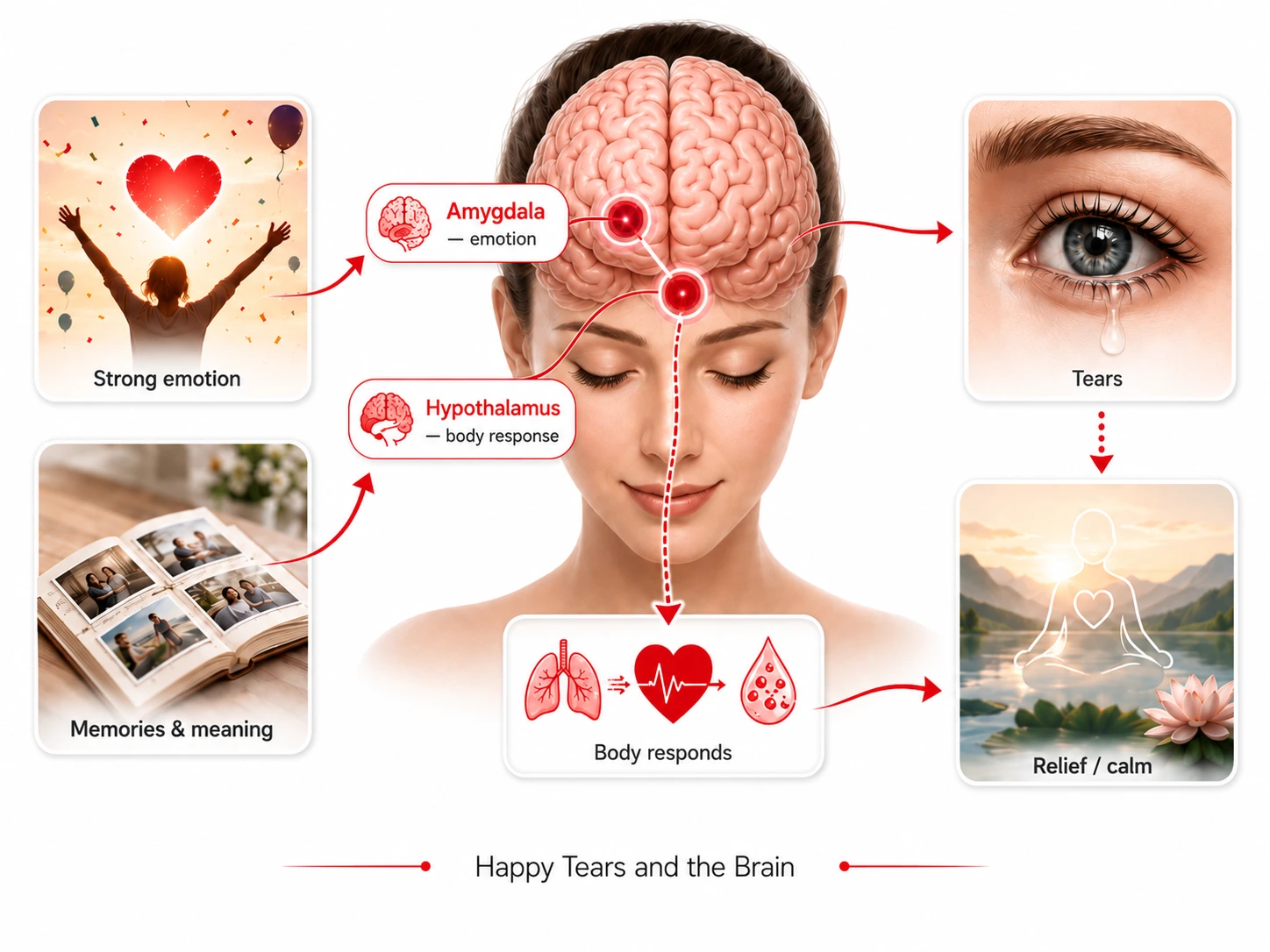
Memory and meaning may also play a role. A joyful moment can bring up everything around it, including relief after stress, pride after effort, love after distance, or gratitude after a hard season. That is why a graduation, reunion, proposal, or long-awaited good news can make you cry even when you feel genuinely happy.
Your nervous system may respond by producing tears and helping your body settle after the emotional high. One explanation is that crying helps bring intense emotions back toward a more manageable level, rather than proving the brain is “confused.” Scientists are still studying the exact pathway, but the main idea is simple: strong emotions can come out through tears, even when the emotion is joy.
Why Do Happy Tears Help Regulate Emotions?
Happy tears may help with emotional regulation by giving your body a way to settle after a big emotional high. Positive emotions can still feel overwhelming, especially when joy comes with relief, pride, gratitude, love, or a long wait finally ending. Crying does not mean you are secretly sad; it may simply be one way your body releases intensity and returns to a steadier place.
Researchers call this kind of mixed-looking response a dimorphous expression, which means one emotion shows up in a form that seems like it belongs to another emotion. In this case, a positive feeling comes out through tears, even though tears are usually linked with sadness. Research on dimorphous expressions suggests these reactions may help regulate intense positive emotion.
For example, you might cry after a proposal, graduation, reunion, or long-awaited piece of good news. The moment is happy, but it may also carry relief, memory, effort, and meaning. That emotional stack can be a lot for your body to hold quietly.
Happy tears may help you calm down, but they can still leave your eyes feeling salty or irritated. Know whether you can use eye drops with contact lenses before reaching for drops while your lenses are still in.
Why Do Happy Moments Make Me Cry?
Happy moments may make you cry because they can carry more than simple happiness. A joyful moment can also bring relief, nostalgia, pride, love, gratitude, awe, empathy, or the feeling of being deeply seen and supported.
Happy moments may make you cry when:
- You finally feel relief after waiting, worrying, or working hard.
- You feel proud of yourself or someone you love.
- A moment reminds you of past struggle, loss, or growth.
- You feel deeply loved, accepted, or understood.
- You see someone else’s joy and feel it with them.
- Something feels beautiful, meaningful, or bigger than words.
- The feeling arrives faster than you can explain it.
Not all watery eyes come from emotion, especially when wind, cold air, or irritation is involved. Try easy tips to stop watery eyes in cold or windy weather if your eyes tear up outside emotional moments too.
What Kinds of Happy Tears Do People Have?
Happy tears do not all come from the same kind of joy. According to the positive-tears research model by Zickfeld and colleagues, which included 13,124 people across 40 countries and 24 languages, positive tears can fall into four main types: achievement, beauty, affection, and amusement. That means crying at a graduation, tearing up at a wedding, getting misty during a beautiful song, and laughing until you cry can all fit under the bigger umbrella of happy tears.
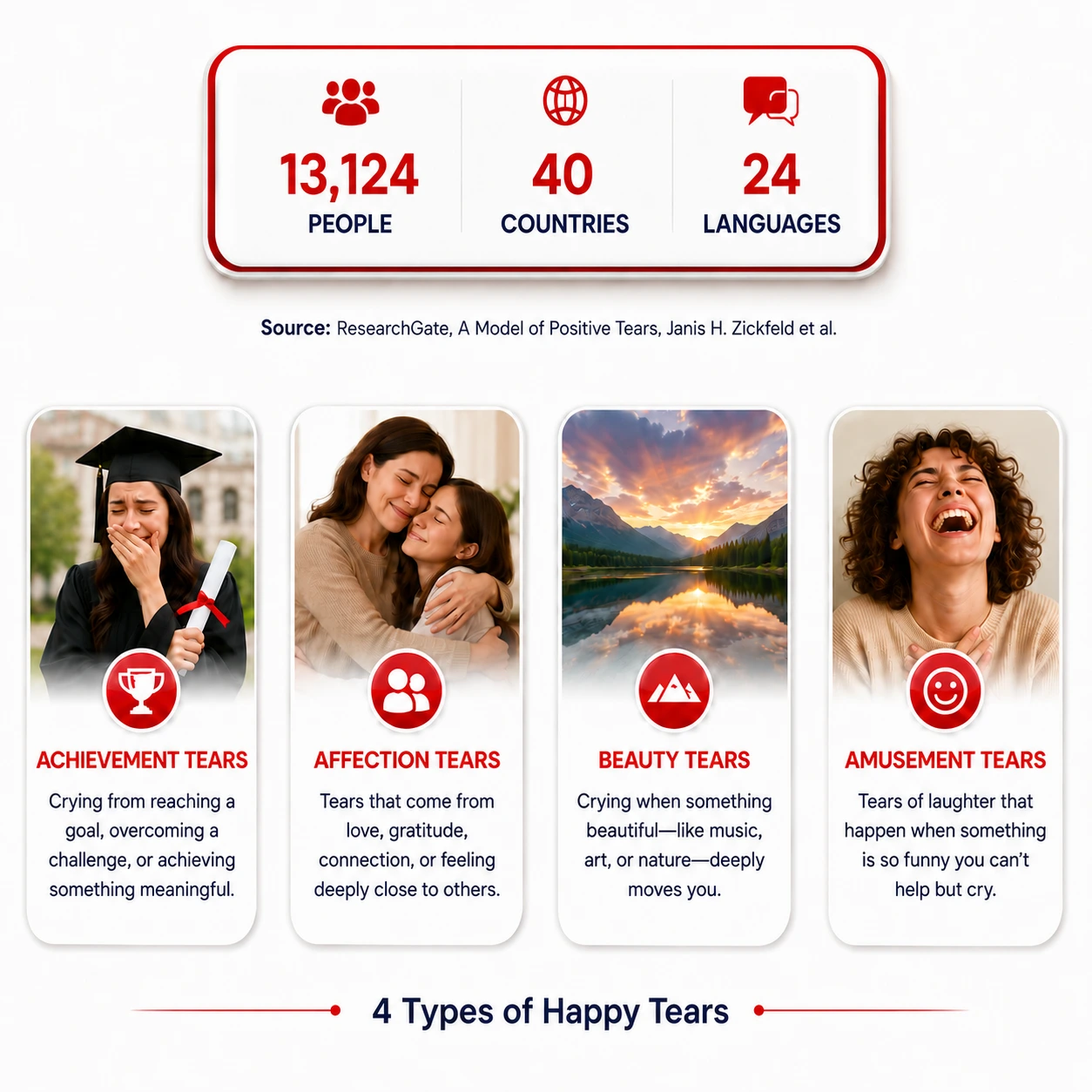
This helps explain why happy crying can feel different depending on the moment. Tears after a long-awaited win may feel like relief and pride, while tears at a reunion may feel warmer, softer, and more connected. So if your happy tears do not look like someone else’s, that is not strange; your tears may simply be responding to a different kind of meaning.
Why Do People Cry at Weddings, Reunions, and Big Wins?
People cry at weddings, reunions, and big wins because these moments often carry more than simple happiness. They may come after effort, distance, waiting, fear, stress, or a long season of hoping things would work out. That mix of joy, relief, pride, gratitude, and love can make tears of joy feel like the body’s natural punctuation mark.
Tears can also mark that a moment matters. Frontiers in Psychology describes tears of joy as appearing in significant life situations, especially moments tied to deep connection and personal success. That fits the emotional weight of weddings, births, graduations, reunions, recovery milestones, and sports wins.
Seeing someone else cry can also invite empathy and shared emotion. You may tear up because the couple looks overwhelmed, your friend finally gets the news they wanted, or a loved one reaches a milestone that once felt far away. Not everyone cries at these events, but when it happens, tears of happiness often say, “This matters,” before words catch up.
Getting emotional at a wedding, graduation, or photoshoot while wearing contacts and eye makeup? Use eye makeup tips for contact lens wearers so tears, makeup, and lenses do not turn into extra irritation.
Can Happy Tears Affect Your Eyes or Contact Lenses?
Yes, happy tears can briefly affect your eyes and contact lenses. Crying can make your eyes watery, red, salty, blurry, or a little irritated, especially if you cry for a while. If you wear contacts, the extra tears may make lenses shift, feel sticky, or seem less stable for a few minutes.
Try not to rub your eyes, especially with contacts in. Rubbing can move the lens, trap debris, or make irritation worse. If your lenses feel uncomfortable after crying, wash and dry your hands before touching your eyes or lenses, and discuss contact lenses recommended by doctors with your provider if the problem keeps returning.
Remove your lenses if your eyes feel irritated, painful, red, gritty, or blurry. Do not rinse lenses with water or saliva, and use only contact lens-compatible rewetting drops while lenses are in. Call an eye care professional if pain, redness, discharge, light sensitivity, or blurry vision continues. The Centers for Disease Control and Prevention (CDC) advises contact lens wearers to remove lenses and call an eye doctor right away for worsening eye pain, sudden blurry vision, unusual redness, discharge, light sensitivity, or symptoms that do not improve.
For safer eye health after crying:
- Avoid rubbing your eyes.
- Wash and dry your hands before touching lenses.
- Remove contacts if they feel uncomfortable, gritty, or blurry.
- Do not rinse contacts with water or saliva.
- Use only contact lens-compatible rewetting drops when lenses are in.
- Switch to glasses if your eyes stay red, irritated, or blurry.
- Contact an eye care professional if pain, discharge, light sensitivity, or blurry vision continues.
Worried that redness, discharge, or pain after crying could be more than temporary irritation? Review eye infection causes, treatments, and prevention tips so you know when symptoms need professional care.
When Should You Get Support for Happy Crying?
Happy tears during genuinely joyful or meaningful moments are usually normal, especially when they match what you feel inside. Support may be helpful when crying feels uncontrollable, happens very often, disrupts your day, or does not seem connected to your actual mood. In those cases, it is less about “fixing” happy crying and more about understanding why your emotional response feels hard to manage.
Consider talking with a healthcare or mental health professional if:
- Crying feels uncontrollable or happens very often.
- Tears do not match how you feel inside.
- You cry or laugh suddenly in ways that feel out of proportion.
- Crying disrupts work, relationships, school, or daily life.
- You feel ashamed, frightened, numb, or unable to calm down afterward.
- Crying comes with ongoing sadness, anxiety, panic, irritability, or sleep changes.
- You have a neurological condition, stroke history, brain injury, multiple sclerosis, Parkinson’s disease, ALS, or dementia and notice sudden laughing or crying episodes.
The American Stroke Association (ASA) describes pseudobulbar affect as involuntary bouts of crying, laughter, or anger that may happen with no clear cause or feel out of proportion to the situation. If your tears or laughter feel sudden, mismatched, or hard to control, ask a healthcare professional for an evaluation instead of trying to self-diagnose.
What to Remember About Happy Tears
Happy tears are usually a normal response to intense emotion, especially when joy comes with relief, love, pride, awe, gratitude, or meaning. Crying when you are happy may help your body with emotional regulation and may also show others that something deeply matters. If you wear contacts, avoid rubbing your eyes and remove your lenses if crying leaves them uncomfortable, red, painful, or blurry. If crying feels uncontrollable, mismatched to your mood, or disruptive, it is worth bringing up with a healthcare or mental health professional.
Do happy tears ever leave your contacts feeling watery, sticky, or blurry? Browse our contact lenses to compare prescribed options that may better match your comfort, vision, and daily routine.
Disclaimer: This content is for general informational purposes only and is not a substitute for professional advice, diagnosis, or treatment.
References
How Tears Work. National Eye Institute. https://www.nei.nih.gov/eye-health-information/healthy-vision/how-eyes-work/how-tears-work. Date Accessed: August 5, 2026.
Tears. Cleveland Clinic. https://my.clevelandclinic.org/health/body/tears. Date Accessed: August 5, 2026.
Dimorphous Expressions of Positive Emotion. Oriana R. Aragón, Margaret S. Clark, Rebecca L. Dyer, John A. Bargh / Psychological Science. https://journals.sagepub.com/doi/10.1177/0956797614561044. Date Accessed: August 5, 2026.
Tears of Joy as an Emotional Expression of the Meaning of Life. Bernardo Paoli, Rachele Giubilei, and Eugenio De Gregorio / Frontiers in Psychology. https://www.frontiersin.org/journals/psychology/articles/10.3389/fpsyg.2022.792580/full. Date Accessed: August 5, 2026.
Pseudobulbar Affect. American Stroke Association. https://www.stroke.org/en/about-stroke/effects-of-stroke/emotional-effects/pseudobulbar-affect. Date Accessed: August 5, 2026.
Similar Articles
-
Are You Left or Right-Eyed? Try This 10-Second Eye Dominance Test
-

The 20 Best Selling Contact Lenses of 2026 By Sales (Bonus: The Most Popular Brands)
-

Buying Contact Lenses in Los Angeles Just Got Easier (Here’s How)
-

What Does the World Look Like to Someone Who Is Color-Blind?
-

The Best-Selling Daily Disposable Contact Lenses of 2025