
You find a box of contacts in a drawer. The lenses are still sealed, the prescription looks familiar, and nothing seems wrong with the packs. Can you use them?
Unopened soft contact lenses expire on the date printed by the manufacturer on the box and individual blister packs. Check that date before opening a lens. A pack also needs an intact seal and proper storage, so an unexpired date alone does not settle every question. Check the label on the lens you are about to use. When you bought the box does not start a new shelf life.
Where is the expiration date on contact lenses?
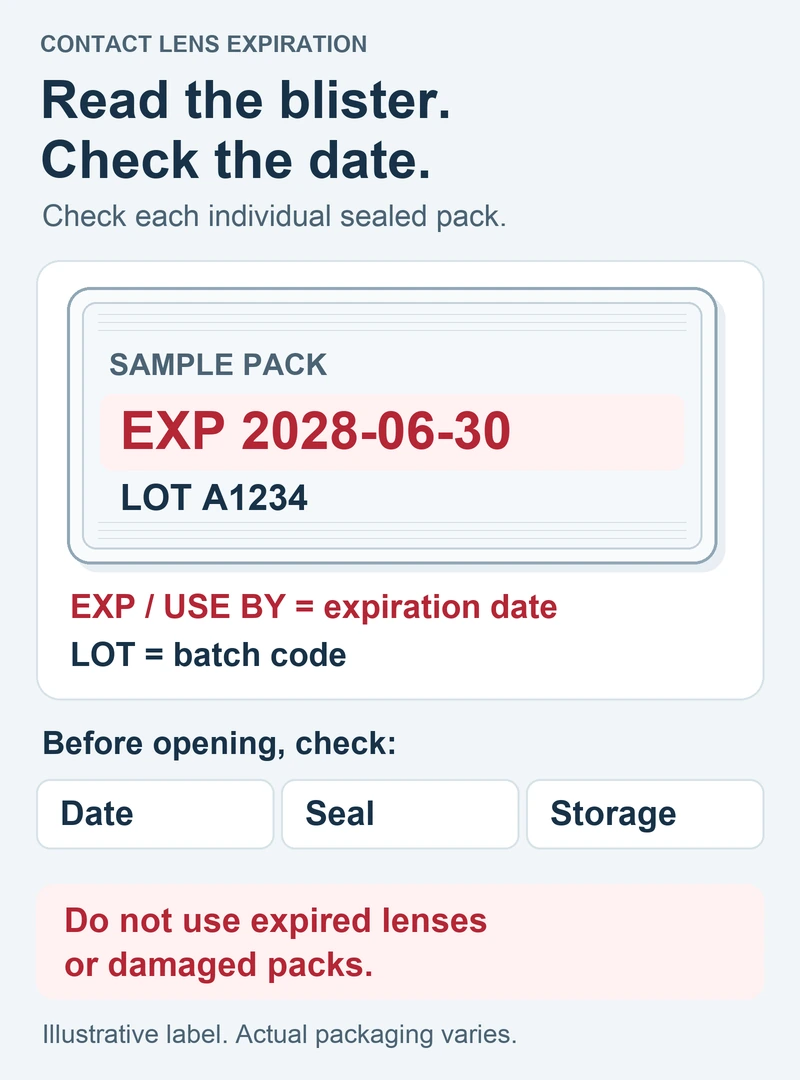
Look on the outer box and the foil covering each individual blister. The expiration date may appear beside EXP, a use-by label, or a packaging symbol explained in the manufacturer’s instructions.
Several other numbers can appear nearby. LOT identifies a manufacturing batch. BC and DIA describe lens measurements, while power numbers describe the prescription. A manufacture date tells you when the product was made. These are different from its expiration date.
For example, a hypothetical label reading EXP 2028-06-30 identifies June 30, 2028 as the expiration date. Actual labels vary, so follow the format and instructions for your product. If a date is unclear, ask the manufacturer or seller to help interpret it.
Does opening the cardboard box count as opening the lenses?
Opening the carton is different from peeling back a blister’s foil seal. Each factory-sealed blister protects its own lens.
For this reason, an open cardboard box can still contain unopened lenses. Check each blister rather than judging the entire supply by the condition of the carton. A previously opened, leaking, or damaged sterile pack should not be treated as unopened, even if its printed date has not passed.
How many years do unopened contacts last?
There’s no single number that applies to every soft contact lens. Shelf life depends on the product and the manufacturer’s supporting tests.
ACUVUE’s consumer guidance describes one to five years from manufacture as usual. But the FDA’s approval documentation for Alcon’s Precision7 lens family establishes a seven-year shelf life from sterilization. That is a product-specific example, not a rule for all Alcon lenses.
Neither figure tells you how much time remains on a box you buy today. Some of its shelf life has already passed during manufacturing, distribution, and storage. Read the printed date instead of adding a set number of years to your purchase date.
Why do sealed contact lenses have an expiration date?
A sealed blister is a storage system for a medical device. Its packaging has to maintain a sterile barrier while the lens retains its intended properties.
The FDA’s Precision7 record describes testing of lens stability, package integrity, and physical and optical properties through the labeled shelf life. This helps explain why expiration involves more than the liquid surrounding the lens.
The date is a boundary supported by product testing. It does not mean every pack suddenly becomes contaminated on that day. It does mean you should not assume that an older product remains suitable simply because it has stayed sealed.
Can you wear expired contacts if they look fine?
No. ACUVUE advises discarding expired lenses even when the package looks intact. Alcon also states that safety and efficacy beyond expiration have not been established.
Clear liquid and a normal-looking lens cannot confirm everything that matters. There is no recommended extra week or month to use an expired pack. Moving the lens into fresh solution does not give it a new expiration date. Saline is not a disinfectant, and a home care routine does not establish a new shelf life for an expired product.
What should you check before opening a blister?
Take a moment to check the individual pack, especially when using lenses from an older supply.
- Read the expiration date and make sure it has not passed.
- Check that the sterile seal is intact and the blister is not leaking or damaged.
- Skip a pack that appears dried out or otherwise abnormal.
- Consider its storage history and follow the product’s temperature and handling instructions.
These checks help identify reasons to avoid a pack; they do not guarantee that a lens is right for your eyes. If packaging or storage raises a question, ask the manufacturer or your eye-care professional before using it.
How is package expiration different from the replacement schedule?
Contact lens discussions often combine three separate timelines. Knowing which one you are checking makes the instructions easier to follow.
| Date or schedule | What it tells you |
|---|---|
| Unopened package expiration | The manufacturer’s labeled shelf life for the factory-sealed product. Check the printed date and storage instructions. |
| Replacement after opening | When to discard an opened lens under its prescribed schedule. Occasional wear does not turn a monthly lens into 30 separate wear days. |
| Prescription expiration | Whether the prescription is current for ordering. It does not change the expiration date printed on an existing lens pack. |
CooperVision’s wearing-schedule guidance explains that the schedule begins when lens packaging is opened, regardless of wear frequency. Follow your product instructions and the schedule prescribed by your eye-care professional. Lens.com’s guide to how long contact lenses last explains the replacement distinction.
Do unopened daily contacts expire too?
Yes. “Daily disposable” describes how the lens is used after opening, not how long it can remain on a shelf.
An unopened daily lens still has a manufacturer’s expiration date. Once used, it should be discarded according to its single-use instructions. Keeping it in a lens case does not turn it into a reusable contact.
How should you store an unopened supply?
Keep lenses in their original sealed packaging and follow the storage directions for the specific product. Keeping the carton also makes it easier to check identifying information and instructions.
Room-temp instructions can differ. Alcon’s U.S. guidance specifies 15–30°C for DAILIES TOTAL1, while the PureVision package insert specifies 15–25°C. Check your own label rather than applying another brand’s range.
If a supply was left in a hot car, froze during delivery, or experienced uncertain conditions, contact the manufacturer for product-specific advice. Do not assume returning it to room temperature resolves the question.
Can you open monthly lenses just before they expire?
Do not assume that opening a blister gives you permission to use the lens beyond its printed expiration date. Package expiration and the replacement schedule are separate instructions, and both matter.
If a reusable pack is approaching expiration, ask the manufacturer or your eye-care professional how its instructions apply. Avoid trying to create an extra month by opening it at the last moment.
What if the date is missing or your prescription has changed?
If you can’t read the date, contact the seller or manufacturer before using the lens. Do the same if the carton and blister appear to show conflicting dates. A batch number may help them identify the product, but it is not a date you should decode by guessing.
A clear, unexpired label also does not establish that an old prescription remains suitable. Keep your eye examinations current and order using a valid contact lens prescription.
What should you do with expired lenses?
Discard them and use an unexpired prescribed supply or your glasses. Do not use an expired pair briefly while waiting for a replacement order.
If you develop redness, worsening eye pain, light sensitivity, sudden blurred vision, unusual tearing, or discharge while wearing contacts, remove them and call your eye doctor immediately. The CDC advises avoiding further contact lens wear until your eye doctor says to resume.
For the next box you find in a drawer, start with the individual blister: read its date, inspect the seal, and check how it was stored. Keeping those habits separate from your replacement schedule makes an old supply much easier to assess.
Sources: FDA Precision7 approval and labeling records; FDA contact lens purchasing and solution guidance; CDC contact lens infection guidance; ACUVUE patient information; Alcon U.S. medical information; CooperVision lens handling and wearing-schedule guidance; Bausch + Lomb PureVision package insert.
Similar Articles
-
Contact Lens Care: Tips & Advice (Covid-19 Update)
-

The Best Selling Colored Contact Lenses of 2026: Sales Rankings & Care Tips
-

Contact Lens-Associated Peripheral Ulcer (CLPU) Guide: Is Your Contact Lens Routine Putting You at Risk?
-

Which Is Your Dominant Eye and Why It Helps to Know?
-

5 Cheaper Alternatives to DAILIES TOTAL1 Multifocal