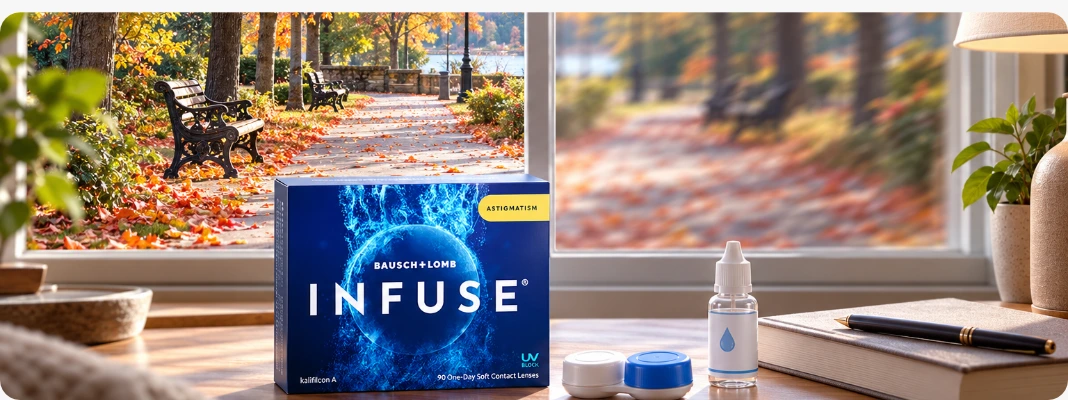

Generally, no. You should only sleep in contacts if your exact lenses are FDA approved for overnight wear and your eye doctor has specifically prescribed that schedule. Even then, sleeping in contacts increases your risk of an eye infection.1, 2
Some contacts can be prescribed for several nights of continuous wear. Others must come out before you sleep, even if they are comfortable enough to forget you are wearing them. Here is how to tell the difference.
Which contact lenses are FDA approved for overnight wear?
The table below covers 31 named soft contact lens products listed in the US market, including astigmatism and multifocal options. The limits are maximums in US labeling, not a wearing schedule for everyone. Your eye doctor may prescribe a shorter schedule or daytime wear only.
| Contact lens | Prescription type | Labeled maximum continuous wear |
|---|---|---|
| Johnson & Johnson | ||
| ACUVUE 2 | Standard | Up to 6 nights / 7 days |
| ACUVUE OASYS with HYDRACLEAR PLUS (two-week) | Standard | Up to 6 nights / 7 days |
| ACUVUE OASYS for ASTIGMATISM (two-week) | Astigmatism | Up to 6 nights / 7 days |
| ACUVUE OASYS MULTIFOCAL with PUPIL OPTIMIZED DESIGN (two-week) | Presbyopia | Up to 6 nights / 7 days |
| Alcon | ||
| AIR OPTIX NIGHT & DAY AQUA | Standard | Up to 30 nights |
| AIR OPTIX plus HydraGlyde | Standard | Up to 6 nights |
| AIR OPTIX plus HydraGlyde for Astigmatism | Astigmatism | Up to 6 nights |
| AIR OPTIX plus HydraGlyde Multifocal | Presbyopia | Up to 6 nights |
| AIR OPTIX AQUA † | Standard | Up to 6 nights |
| AIR OPTIX for Astigmatism † | Astigmatism | Up to 6 nights |
| AIR OPTIX AQUA Multifocal † | Presbyopia | Up to 6 nights |
| PRECISION7 | Standard | Up to 6 nights / 7 days |
| PRECISION7 for Astigmatism | Astigmatism | Up to 6 nights / 7 days |
| CooperVision | ||
| Biofinity | Standard | Up to 6 nights / 7 days |
| Biofinity XR | Standard; extended powers | Up to 6 nights / 7 days |
| Biofinity Energys | Standard | Up to 6 nights / 7 days |
| Biofinity toric | Astigmatism | Up to 6 nights / 7 days |
| Biofinity XR toric | Astigmatism; extended powers | Up to 6 nights / 7 days |
| Biofinity multifocal | Presbyopia | Up to 6 nights / 7 days |
| Biofinity toric multifocal | Astigmatism + presbyopia | Up to 6 nights / 7 days |
| Bausch + Lomb | ||
| ULTRA | Standard | Up to 7 days between removals |
| ULTRA for Astigmatism | Astigmatism | Up to 7 days between removals |
| ULTRA for Presbyopia | Presbyopia | Up to 7 days between removals |
| ULTRA Multifocal for Astigmatism | Astigmatism + presbyopia | Up to 7 days between removals |
| PureVision | Standard | Up to 30 days between removals * |
| PureVision Multi-Focal | Presbyopia | Up to 30 days between removals * |
| PureVision2 HD | Standard | Up to 30 days between removals * |
| PureVision2 for Astigmatism (also listed as PureVision 2 HD for Astigmatism) | Astigmatism | Up to 30 days between removals * |
| PureVision2 for Presbyopia (also listed as PureVision 2 Multi-Focal) | Presbyopia | Up to 30 days between removals * |
| SofLens 38 (also listed as Optima FW / SeeQuence II) | Standard | Up to 7 days between removals |
| SofLens Toric (SofLens 66 Toric) | Astigmatism | Up to 7 days between removals |
How to read this table: “Standard” means a lens for nearsightedness or farsightedness; “presbyopia” means a multifocal lens for age-related difficulty focusing up close. Each named prescription variant has its own row. Pack sizes and duplicate storefront names are not counted as additional products.
Days and nights: The table preserves the manufacturers’ wording. Seven days between removals does not mean seven full nights of sleep. Do not add a night to a prescribed schedule.
* PureVision limits depend on the exact design and power. The 30-day indication does not cover every power allowed for daily wear. Your eye doctor must confirm the applicable limit for your prescription.13, 14, 15, 16, 17
† Older AIR OPTIX products: AIR OPTIX AQUA, AIR OPTIX for Astigmatism, and AIR OPTIX AQUA Multifocal still have US retail listings. Availability can vary, and a listing does not establish ongoing manufacture. Their overnight indication is documented in US labeling.8, 36
Product names matter. An overnight indication for one ACUVUE OASYS or AIR OPTIX product does not extend to every lens bearing that brand name. Match the full name on your prescription and box.
Some contacts for astigmatism and some multifocal contacts have overnight indications, including the specific Biofinity, ULTRA, AIR OPTIX, and other variants listed above. The words “toric” or “multifocal” describe vision correction, not permission to sleep in the lens. Check the full product name and prescribed schedule.
Are there other specialty contacts approved for sleeping?
Yes. Some lenses have overnight indications for specialized needs. They require a different fitting or treatment plan from a typical soft contact lens prescription.
| Specialty lens | Who it is for | Labeled extended-wear limit |
|---|---|---|
| Silsoft Aphakic Adult | People with aphakia, meaning the eye has no natural crystalline lens. | Up to 30 days between removals, when prescribed.20 |
| Silsoft Super Plus Kids | Pediatric aphakia; fitted and monitored by the child’s eye care team. | Up to 30 days between removals under the SILSOFT indication.20 |
| Menicon Z rigid gas permeable lenses | Approved spherical, aspheric, non-prism-ballasted toric, and multifocal designs. | Up to 30 days / 29 nights. This does not authorize overnight wear of every custom lens made from Menicon Z material.21, 35 |
What about ortho-k lenses?
Orthokeratology, or ortho-k, uses specially fitted rigid lenses to temporarily reshape the cornea while you sleep. You remove them after waking. Their purpose and wearing routine differ from leaving a vision-correcting soft lens in for several days.1
US overnight ortho-k options include Paragon CRT, Euclid Emerald and MAX, ACUVUE Abiliti Overnight, and the Bausch + Lomb Arise Ortho-K System. These are examples of specialty programs, not a catalog of every custom laboratory design. Your specialist chooses the approved design and prescribed overnight schedule.29, 30, 31, 32
Why are some older overnight contacts missing from the main table?
An FDA approval can outlast a product’s commercial availability. A product page can also stay online after its manufacturer discontinues a lens.
For example, CooperVision marks Biomedics 55 Premier and Biomedics Toric as discontinued in the US. Historical FDA records document extended-wear indications, but these lenses should not be presented as current manufacturer-supported choices for a new fitting. Lens.com also lists Biomedics 55 Evolution Asphere as equivalent packaging to Premier, rather than a separate new lens design.25, 26, 27, 28
If you already wear an older product, ask your eye doctor about its exact instructions and a suitable replacement. Do not switch brands or extend your wear time on your own.
Is sleeping in FDA-approved contacts safe?
FDA approval means a particular lens has an approved overnight-wear use. It does not eliminate the additional risk associated with sleeping in contacts.
The CDC reports that sleeping in contact lenses raises the risk of contact lens-related eye infections by six to eight times. That statement includes accidental sleep, occasional sleep, and prescribed extended wear. It is a broad risk comparison, not a prediction of what will happen after one nap.2
During sleep, the closed-eye environment can reduce the cornea’s oxygen supply and resistance to infection. A contact lens changes that environment further. Materials that transmit more oxygen help address oxygen delivery, but they do not prevent every infection or other complication.20
A corneal infection can become serious quickly. Seek prompt eye care for symptoms, even when you wear an approved overnight lens.22
Does “monthly” mean you can sleep in contacts for a month?
No. Replacement schedule and wearing schedule answer different questions.
| Term | What it tells you |
|---|---|
| Replacement schedule | When to throw away a lens and start a new one, such as daily, weekly, every two weeks, or monthly. |
| Wearing schedule | Whether you must remove the lens before sleeping, or may leave it in overnight for a specifically prescribed period. |
For example, Biofinity is a monthly replacement lens, but its US extended-wear schedule is up to six nights and seven days. A monthly box label does not give you permission to sleep in it for 30 nights.10, 11
Likewise, the two-week ACUVUE OASYS products in the table are not approved for two uninterrupted weeks of wear. Their extended-wear limit is up to six nights and seven days. Your prescribed replacement instructions may also change when you use a lens for extended wear.4, 5
The overnight indication for these two-week lenses does not apply to every ACUVUE OASYS product. For example, OASYS with Transitions is labeled for daily wear.4, 5, 33
PRECISION7 and PRECISION7 for Astigmatism have a US extended-wear indication of up to six nights and seven days. They should only be worn during sleep when your eye doctor prescribes that use. A weekly replacement schedule by itself is not authorization for overnight wear.9, 34
Daily disposable contacts are intended to be worn while awake and discarded after use. “Daily disposable” is not an overnight-wear category. Remove them before sleeping and start with a fresh pair for the next day.1
Ask your eye doctor to give you both schedules clearly: when the lenses come out, whether they are discarded or disinfected, and when the next pair starts. The FDA advises at least one night without lenses after each scheduled extended-wear removal.1, 37
Can you take a nap with contacts in?
Unless your eye doctor has prescribed overnight wear for your exact lens, take your contacts out before a nap. A short sleep still counts as sleeping in lenses.
There is no universal “safe 20-minute nap” allowance to apply to daily-wear contacts. The CDC’s guidance is to avoid sleeping in contacts unless your eye care provider directs you to do so.23
If you tend to doze off on the couch or during a flight, remove your lenses before settling in and keep your glasses nearby.
What should you do if you accidentally sleep in contacts?
Waking up with your contacts in does not automatically mean you have an infection. The next step is to remove them safely and pay attention to how your eyes feel.
If you have eye pain, unusual redness, light sensitivity, discharge, or blurred vision, contact an eye doctor right away. See the warning signs below.22
- Wash and dry your hands. If the lenses move normally, remove them using the technique your eye doctor taught you.23
- If a lens feels dry or stuck, do not pull it off by force. Use contact lens rewetting drops recommended for your lenses, blink, and wait until the lens moves freely before removing it. If it still will not move after a few minutes, contact your eye doctor.4
- Use glasses while your eyes recover. Leave lenses out if your eyes are irritated, painful, red, or blurry, and seek professional advice.22
- Follow the right disposal or cleaning instructions. If you have no symptoms, discard daily disposables; clean and disinfect reusable lenses according to their instructions before any future use. If you have symptoms that could indicate an infection, keep the removed lenses and case for your eye doctor instead of throwing them away.22, 23
Use drops labeled for use in the eye with your contact lenses. Do not substitute tap water or assume that any bottle of contact lens solution is an eye drop. Unneutralized hydrogen peroxide solution must never go directly into your eyes.23, 24
When should you get urgent eye care?
Seek prompt eye care for pain, unusual or persistent redness, sensitivity to light, new blurred vision, discharge, or swelling. Remove your contacts if you can do so safely, leave them out, and tell the clinician you slept in them.22
Severe pain or sudden loss of vision needs urgent assessment. If you cannot reach your eye doctor, use an urgent eye care service or emergency department. Do not wait for a routine appointment or put the lenses back in because the irritation seems to improve.
How should you care for contacts prescribed for overnight wear?
Follow the schedule your eye doctor gives you, including planned nights without lenses. An overnight prescription does not remove the need for cleaning, replacement, or eye exams.
Keep your lenses away from water, including during showers and swimming. When you remove reusable lenses, use the recommended disinfecting system and fresh solution. Do not add fresh solution on top of old solution in the case.8
Ask what to do if you remove an extended-wear lens early. Some prescribed disposable schedules require throwing it away after removal; other reusable schedules require cleaning and disinfection. Do not assume you can simply put it back in and restart the clock.18, 15
Keep a current pair of glasses available. They make it easier to take your lenses out when it is time, when you are tired, or when your eyes do not feel right.
There is no single best lens for everyone. Your prescription, lens fit, eye health, and ability to follow the care schedule all matter. A longer approved wear limit does not make a lens a better choice for your eyes.
If your eye doctor prescribes an extended-wear lens, use the product links above to find the exact lens on your prescription. Before your first overnight wear, make sure you know how many nights are allowed, when to remove the lenses, and when to start a fresh pair.
Sources
US product labeling and availability checked October 20, 2026.
- FDA: Types of Contact Lenses
- CDC MMWR: Corneal Infections Associated with Sleeping in Contact Lenses (August 17, 2018)
- Johnson & Johnson: ACUVUE 2 package insert
- Johnson & Johnson: ACUVUE OASYS two-week package insert
- Johnson & Johnson: ACUVUE OASYS MULTIFOCAL package insert
- Alcon US: AIR OPTIX NIGHT & DAY AQUA
- Alcon US: AIR OPTIX plus HydraGlyde professional information
- Alcon: US lotrafilcon B patient instruction booklet, archived third-party-hosted copy
- FDA: PRECISION7 family approval, P220007
- CooperVision: US Product Reference Guide, May 2026
- FDA: Biofinity approval order, P080011
- Bausch + Lomb: ULTRA family package insert
- Bausch + Lomb: PureVision package insert
- Bausch + Lomb: PureVision Multi-Focal package insert
- Bausch + Lomb: PureVision2 package insert
- Bausch + Lomb: PureVision2 for Astigmatism package insert
- Bausch + Lomb: PureVision2 for Presbyopia package insert
- Bausch + Lomb: SofLens 38 package insert, revision June 2026
- Bausch + Lomb: SofLens Toric package insert
- Bausch + Lomb: SILSOFT package insert
- FDA: Menicon Z 30-day extended-wear approval, P990018S002
- FDA: Contact Lens Risks
- CDC: Preventing Eye Infections When Wearing Contacts (May 27, 2025)
- FDA: Contact Lenses: Safe Use of Hydrogen Peroxide Solution
- CooperVision US: Biomedics 55 Premier
- CooperVision US: Biomedics Toric
- FDA: Biomedics 55 UV Asphere approval, P890023S013
- FDA: Biomedics Toric extended-wear device record, P890023S032
- Paragon Vision Sciences: US Paragon CRT product information
- Euclid: Ortho-K product information
- Johnson & Johnson: ACUVUE Abiliti Overnight
- Bausch + Lomb: Arise Ortho-K System
- Johnson & Johnson: ACUVUE OASYS with Transitions package insert
- Alcon US: PRECISION7 and PRECISION7 for Astigmatism care and support
- Menicon America: Menicon Z authorized laboratories
- FDA: AIR OPTIX AQUA trade-name/indication supplement, P010019S021
- Bausch + Lomb: ULTRA patient information booklet
Similar Articles
-
FTC Begins Enforcement of the Contact Lens Rule Making it Easier to Save Money
-

Contact Lens Rebates: What Are Rebates And How Do They Work?
-

Are You Left or Right-Eyed? Try This 10-Second Eye Dominance Test
-

Contact Lens-Associated Peripheral Ulcer (CLPU) Guide: Is Your Contact Lens Routine Putting You at Risk?
-

Can Your Eye Color Change Over Time?