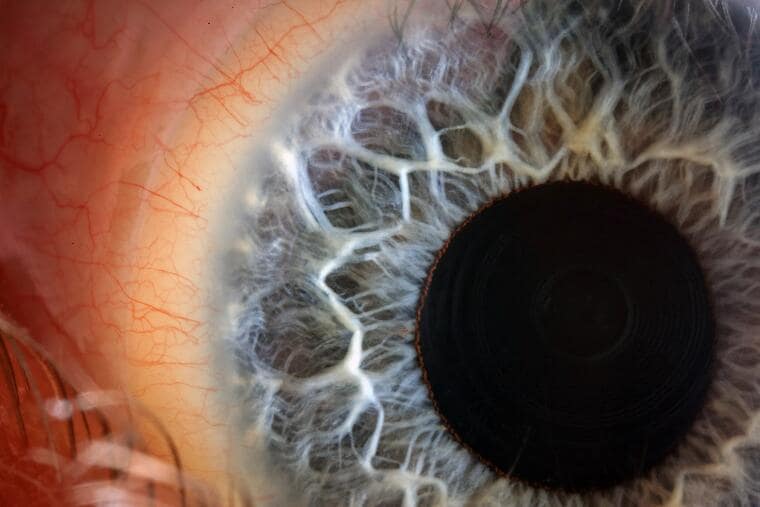
Violet eyes are real in the sense that human eyes can naturally look violet, but the iris does not contain purple pigment. The shade depends on pigmentation, how light interacts with the eye, and viewing conditions, all of which help explain why people have different eye colors. In some people with albinism, reduced pigmentation can also make eyes look reddish or violet under certain lighting. A violet appearance is real, but it does not always have the same explanation.
Elizabeth Taylor’s famous eyes brought this unusual shade into the spotlight. They looked deep blue in some photographs and almost purple in others, helping make her gaze one of Hollywood’s most talked-about features. Today, contact lenses can create a temporary violet look, but Taylor’s story centers on how her natural eyes appeared in different settings.
Did Elizabeth Taylor Really Have Violet Eyes?
Elizabeth Taylor was a British-born American actress best known for films such as Cleopatra and Cat on a Hot Tin Roof. The late Hollywood star was also famous for her violet-looking eyes, though assigning them one permanent color label is harder. Her official website describes deep blue and green tones that appeared violet in certain conditions. Lighting, costumes, and filmmaking techniques helped shape their appearance on screen.
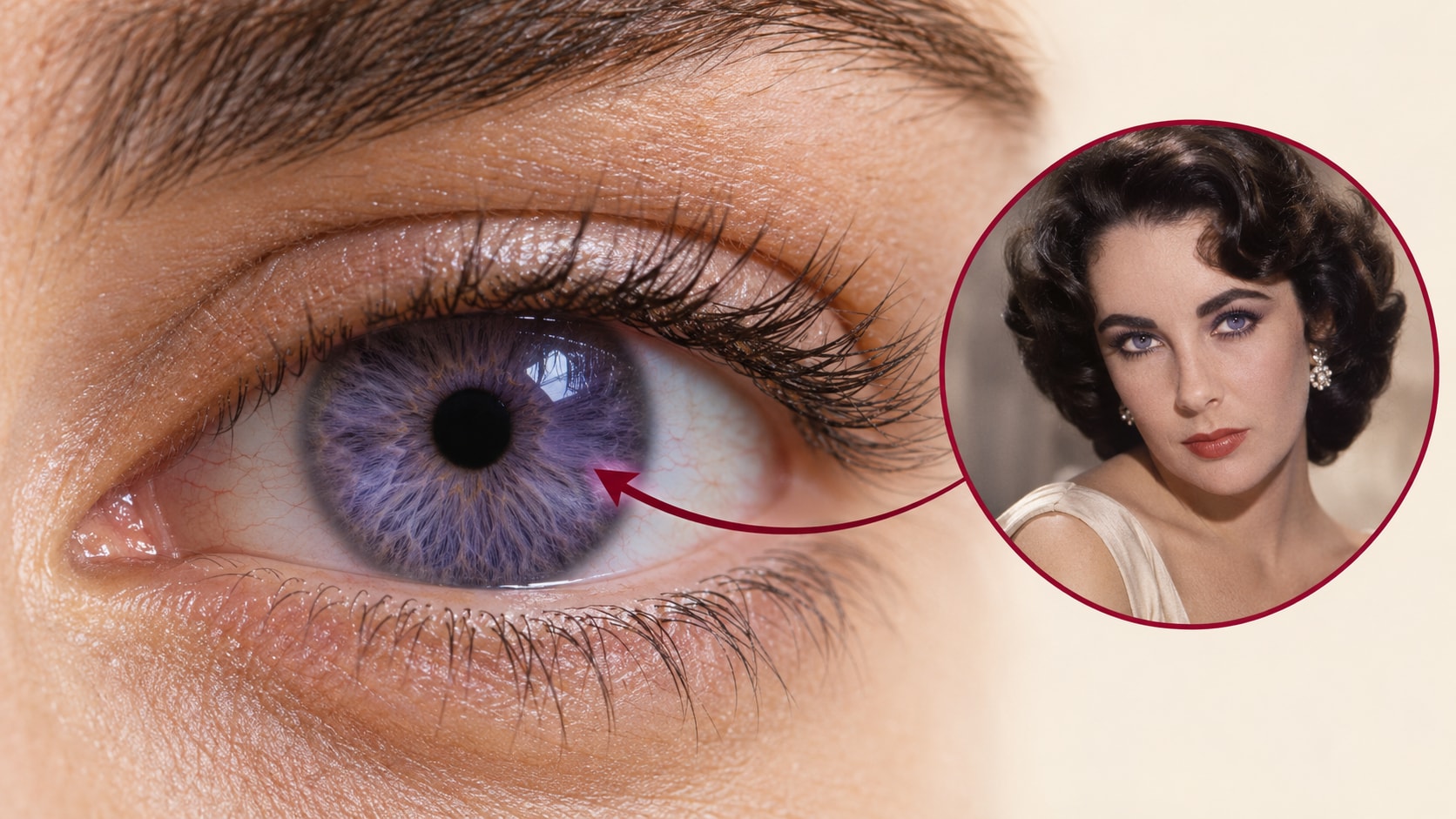
Her dark lashes framed her eyes, while surrounding colors drew attention to different tones. Some photographs brought out a deep blue. Others captured the purple cast that became part of her public image. The fascination with Elizabeth Taylor’s violet eye color lasted well beyond her films. She even named a fragrance Violet Eyes.
But Are Violet Eyes Real or Just Really Blue?
Eyes can naturally look violet, but violet is not a clearly defined eye-color category. MedlinePlus groups eye colors broadly as blue, green or hazel, and brown. A review in Eye notes that no single definition is widely agreed on, so labels such as lavender and violet can vary between observers. The same eyes may look blue to one person and slightly purple to another.
The truth behind blue eyes comes down to low melanin in the front layers of the iris and light scattering. In some people with albinism, reduced pigment can also allow reddish or violet reflections under certain lighting. Colored contact lenses can create a temporary violet look by placing a tinted pattern over the iris. This changes how the eyes look while the lenses are worn without changing their natural pigmentation.
What Makes Eyes Look Violet?
Calling an eye color violet describes its appearance rather than its cause. The term can refer to a faint lavender tint in blue-gray eyes or a more noticeable purple cast. These descriptions are not standardized medical classifications and do not identify a specific genetic condition.
Factors Influencing Violet Eye Appearance
Eyes can look violet without purple pigment. Pigment, genetics, and lighting influence their appearance.
Pigment
No Purple Pigment Needed
Melanin and the way light scatters inside the iris help create the color you see.
Genes
OCA2 + HERC2 + Other Genes
No Single Violet-Eye Gene
Several genes affect eye pigmentation. Parents' eye colors cannot predict every shade.
Lighting
Same Eyes, Different Impression
Light, clothing, makeup, and camera settings can bring out a violet cast without changing iris pigment.
Simplified illustrations, not a color simulation.
Violet is best treated as a description of appearance rather than a distinct genetic category. The shade we see reflects both the eye’s physical characteristics and the conditions in which we view it, so similar-looking eyes do not necessarily share the same biological explanation. Lighting can change how an iris looks, while eye color changes over time may involve age, medication, or an eye condition.
Can You Have Violet Eyes Without Albinism?
Violet-looking eyes are not exclusive to people with albinism. Similar shades can result from different combinations of pigmentation, lighting, and color perception, so a violet appearance alone does not indicate a genetic condition.
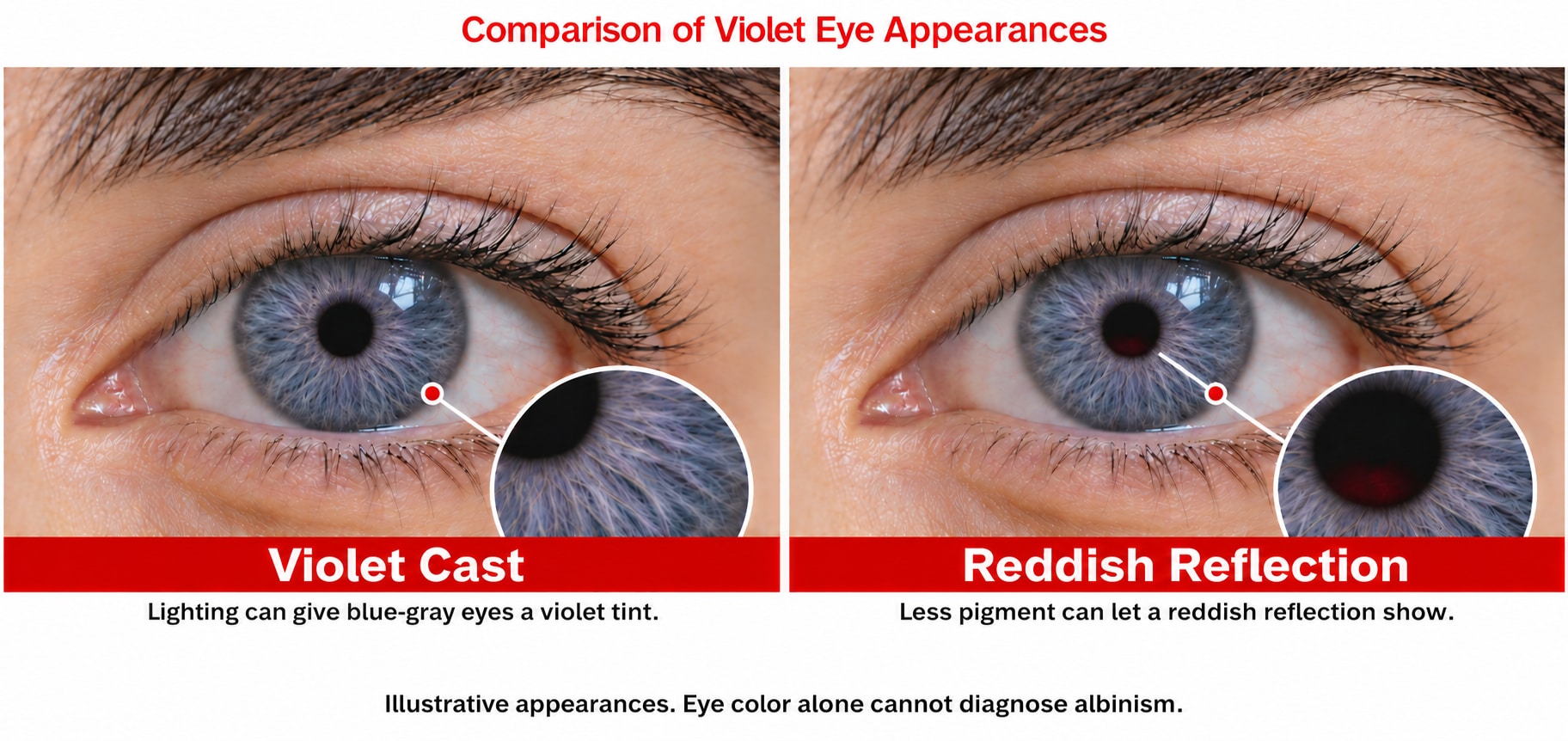
Blue or gray-blue eyes may look lilac, lavender, or violet under certain lighting, while makeup, nearby colors, and camera settings can bring out the tint without changing iris pigmentation. Albinism can create a different effect because reduced melanin allows a reddish reflection from within the eye to show, sometimes producing a reddish-violet appearance. This does not happen in everyone with albinism, and most have blue eyes, while some have hazel or brown eyes. Ocular albinism primarily affects the eyes, while oculocutaneous albinism also affects the skin and hair.
How Rare Are Violet Eyes? An Exact Number is Hard to Find
Violet-looking eyes are uncommon, but there is no well-established worldwide percentage. The frequently repeated claim of “less than 1%” means fewer than 1 in 100 people, yet the sources reviewed do not provide a reliable population study supporting it. Counting is difficult because the same iris may be described as blue, gray, or violet depending on the observer and lighting.
The National Organization for Albinism and Hypopigmentation estimates that approximately 1 in 18,000 to 20,000 Americans has some form of albinism, equivalent to about 0.005% to 0.006% of the population. These are albinism figures, not violet-eye statistics. Most people with albinism have blue eyes, and some have hazel or brown eyes, so those numbers cannot establish how many people have violet-looking eyes.
Is Violet the Rarest Eye Color?
Violet is often called the rarest eye color, but there is not enough reliable population data to confirm that ranking. Eye-color studies commonly use broad categories such as brown, blue, green, and hazel. Violet-looking eyes may be grouped with blue or gray rather than counted separately, making direct comparisons difficult.
A violet appearance can also arise under different circumstances, including lighting effects and reduced pigmentation associated with albinism. Grouping these appearances into one category can produce misleading rankings. Violet-looking eyes are unusual, but describing violet as the world’s rarest eye color goes beyond what the available evidence establishes.
A rare-looking shade does not always reflect a rare natural eye color. Natural looking colored contacts use blended patterns to create a temporary change that can resemble the detail of a natural iris.
Why Do Your Eyes Look Purple in Pictures?
Your eyes may look purple in a photograph even when that shade is not noticeable in person. A camera records and processes the entire scene, so a color shift affecting your skin, clothing, or background may also affect your eyes. Checking those details can help distinguish a photographic effect from your usual iris color.
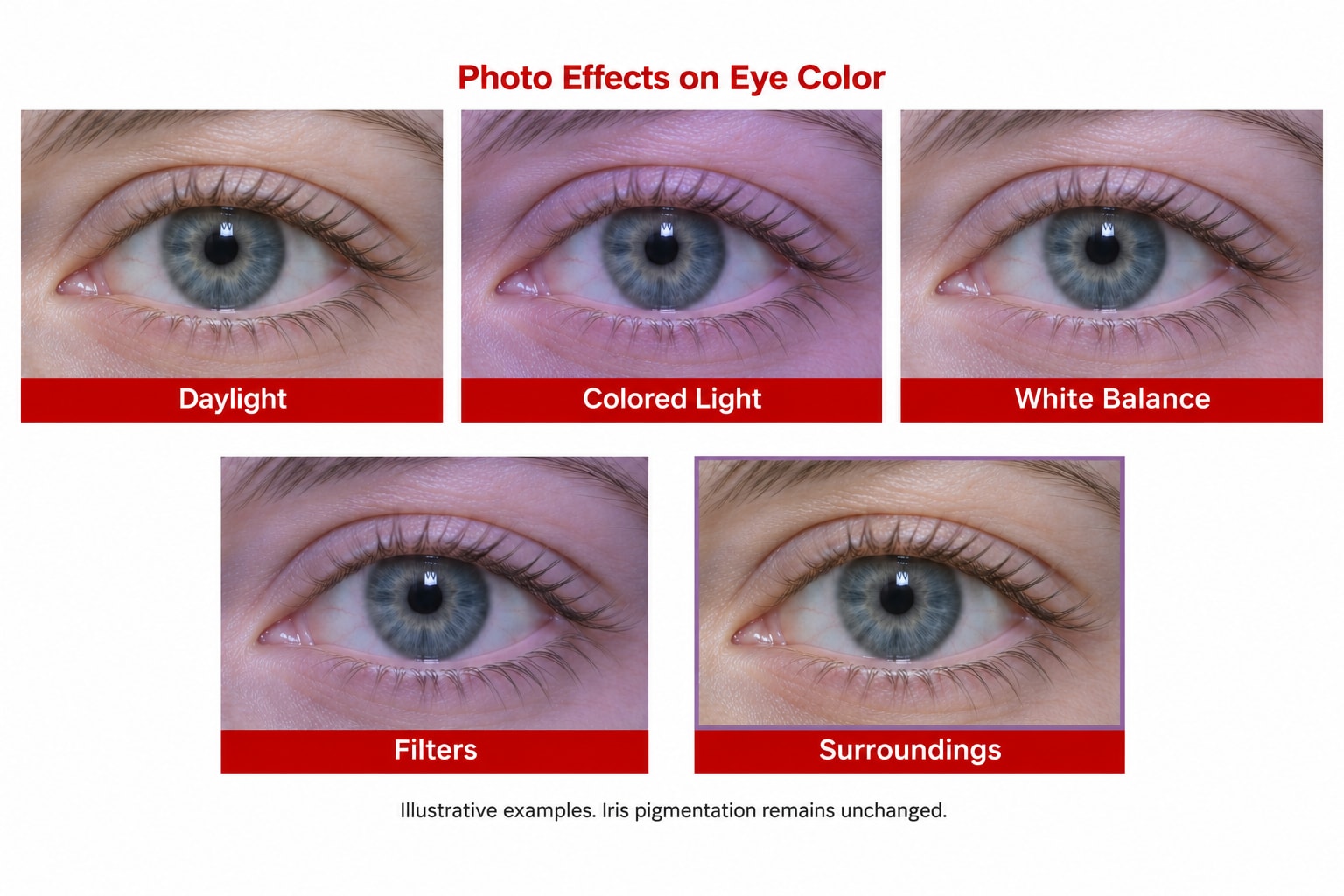
For a more reliable comparison, use several unedited photographs taken in indirect daylight, without flash or colored lamps. Keep the camera and surroundings consistent, and avoid judging subtle shades from a single close-up. These comparisons can document how your eyes appear, but they cannot measure iris pigmentation or identify a medical condition.
Violet Contacts Can Create a Temporary Change
Violet lenses use a tinted pattern to change the appearance of your iris while you wear them. The effect depends on how much of your natural color shows through. A translucent enhancement tint adds to the existing shade, while an opaque design masks more of it. Neither changes your natural iris pigmentation.
| LENS FEATURE | EFFECT ON APPEARANCE |
|---|---|
| Enhancement tint | Blends with your natural iris color and generally creates a subtler effect on light eyes. |
| Opaque color pattern | Covers more of the underlying color and can create a more noticeable change on darker eyes. |
| Iris pattern and outer ring | Influence how defined or dramatic the lens looks. |
| Prescription power | Corrects vision when needed. Available powers vary by lens product. |
| Noncorrective or plano power | Changes appearance without correcting vision. A prescription is still required in the United States. |
People who need vision correction can ask about purple prescription contact lenses that suit their prescription. A preferred color may not be available in every power or lens design, particularly for astigmatism or multifocal correction.
A Prescription Comes Before the Color
In the United States, all colored contacts require a prescription, including lenses worn only for appearance. During a fitting, an eye doctor evaluates your eye health, measures your eyes, and checks how the selected lenses fit. Matching a prescription power alone is not enough. The prescribed brand and lens specifications also matter because contact lenses are not interchangeable.
Buying colored contacts safely starts with choosing a retailer that verifies your prescription and following the prescribed wearing and replacement schedules. Never share contacts or expose them to tap water. Remove them and contact your eye doctor promptly when pain, unusual redness, light sensitivity, or blurred vision develops. Poorly fitted or improperly used decorative lenses can cause corneal scratches, infections, and vision loss.
What Do Violet Eyes Symbolize?
In fiction and art, violet eyes often suggest mystery, royalty, or magic. Writers and artists may use the shade to make a character memorable or hint at an unusual background. These meanings draw on purple’s long association with luxury and status, along with its use in fantasy storytelling. They are symbolic choices, not biological traits. In real life, violet-looking eyes do not reveal someone’s personality, character, or abilities.
All About Violet Eyes
Learn how violet-looking eyes relate to genetics and albinism, which claims are myths, how to buy violet contacts safely, and when an eye color change needs medical attention.
Can people be born with purple eyes?
Eyes may appear violet early in life, particularly under certain lighting or with reduced pigmentation. This does not indicate purple pigment or predict a baby's lasting eye color. Unusual pigmentation accompanied by involuntary eye movements or vision concerns should be assessed by a pediatric eye specialist.
Can violet eye color be inherited?
Traits that influence eye pigmentation can be inherited, but a violet appearance does not follow a simple inheritance pattern. Several genes contribute to eye color, so parents' eye colors cannot reliably predict violet-looking eyes in a child.
What genetic conditions are linked to violet-looking eyes?
Ocular albinism and oculocutaneous albinism can reduce eye pigmentation, sometimes allowing a reddish-violet appearance under certain lighting. These conditions also affect eye development and vision. A violet tint alone cannot diagnose either condition.
Do people with albinism always have violet eyes?
No. People with albinism can have blue, hazel, or brown eyes. Pigmentation varies, and a reddish or violet cast in particular lighting is not a feature everyone with albinism shares.
Is Alexandria's Genesis real?
No. Alexandria's Genesis is an internet myth, not a recognized genetic condition. Claims connecting purple eyes with exceptional immunity, an unusually long life, or other extraordinary traits are not supported by scientific evidence.
Where can I buy violet contact lenses safely?
Start with an eye exam and a prescription for suitable lenses. Buy the prescribed product from an optical practice or a retailer that verifies prescriptions. In the United States, colored contacts require a prescription even when they do not correct vision.
Should a new change in eye color be checked?
Yes. A clear, lasting change in iris color should be checked by an ophthalmologist. Differences between photographs can result from lighting or processing, but eye pain or sudden vision changes need prompt medical attention.
Disclaimer: This information is for educational purposes and is not a substitute for professional medical advice, diagnosis, or treatment. Seek eye care for sudden eye color changes, pain, or vision problems.
References
Is eye color determined by genetics? MedlinePlus Genetics. https://medlineplus.gov/genetics/understanding/traits/eyecolor/. Date Accessed: November 11, 2026.
What colour are your eyes? Teaching the genetics of eye colour & colour vision. Eye. https://pmc.ncbi.nlm.nih.gov/articles/PMC8956647/. Date Accessed: November 11, 2026.
Your Blue Eyes Aren’t Really Blue. American Academy of Ophthalmology. https://www.aao.org/eye-health/diseases/your-blue-eyes-arent-really-blue. Date Accessed: November 11, 2026.
Information Bulletin – What Is Albinism? National Organization for Albinism and Hypopigmentation. https://albinism.org/information-bulletin-what-is-albinism/. Date Accessed: November 12, 2026.
The Enduring Allure of Elizabeth Taylor’s Violet Eyes. Elizabeth Taylor Official Website. https://elizabethtaylor.com/the-enduring-allure-of-elizabeth-taylors-violet-eyes/. Date Accessed: November 12, 2026.
Setting White Balance. Nikon. https://www.nikonusa.com/learn-and-explore/c/tips-and-techniques/setting-white-balance. Date Accessed: November 12, 2026.
Decorative Contact Lenses for Halloween and More. U.S. Food and Drug Administration. https://www.fda.gov/medical-devices/contact-lenses/decorative-contact-lenses-halloween-and-more. Date Accessed: November 13, 2026.
About Decorative Contact Lenses. Centers for Disease Control and Prevention. https://www.cdc.gov/contact-lenses/about/about-decorative-contact-lenses.html. Date Accessed: November 13, 2026.
What Is Alexandria’s Genesis? All About Vision. https://www.allaboutvision.com/resources/human-interest/alexandrias-genesis/. Date Accessed: November 13, 2026.
Why Are My Eyes Changing Color? American Academy of Ophthalmology. https://www.aao.org/eye-health/tips-prevention/why-are-my-eyes-changing-color. Date Accessed: November 13, 2026.