
Before eye color became a family trait, a beauty marker, or a symbol in art and myth, it was pigment reacting to light.
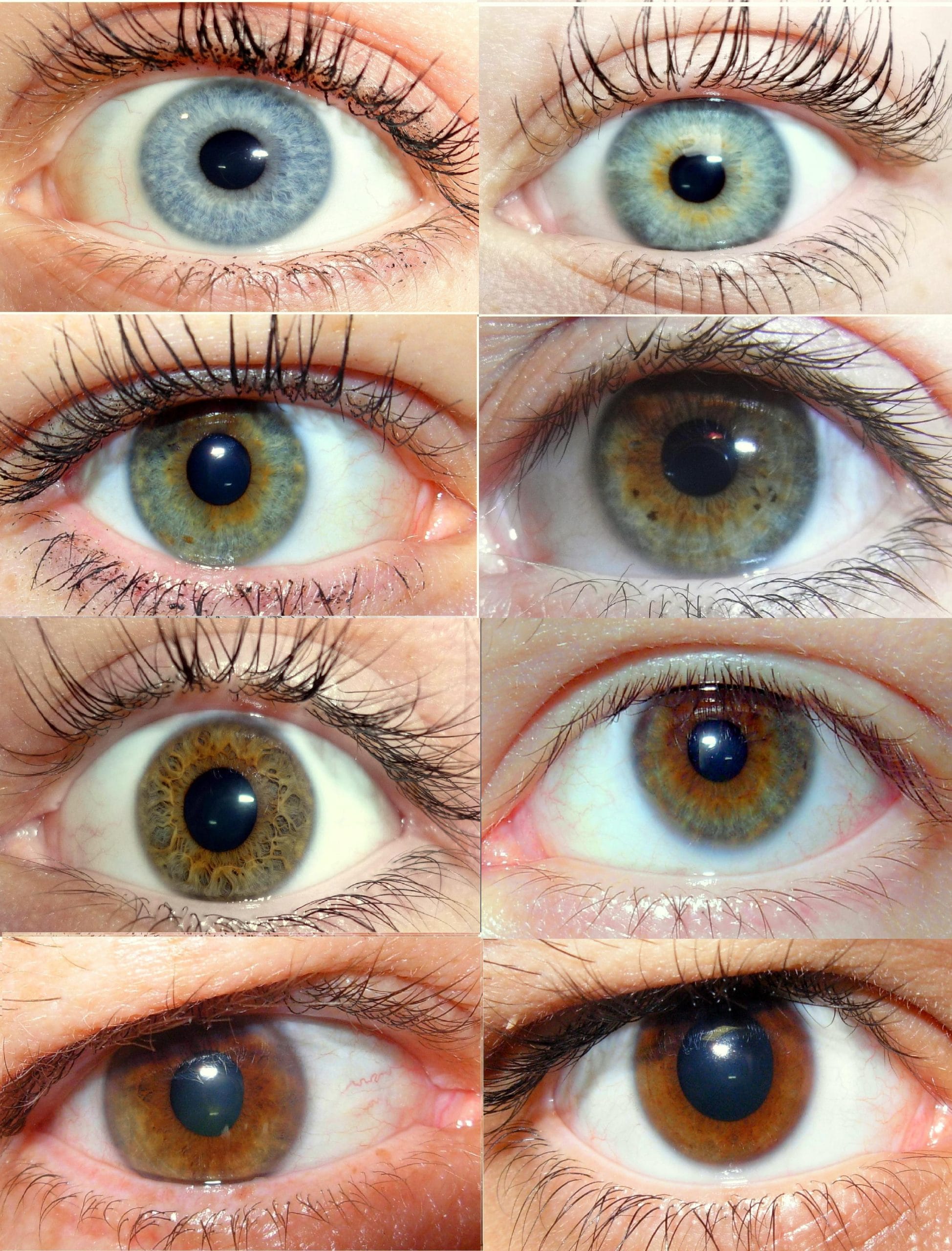
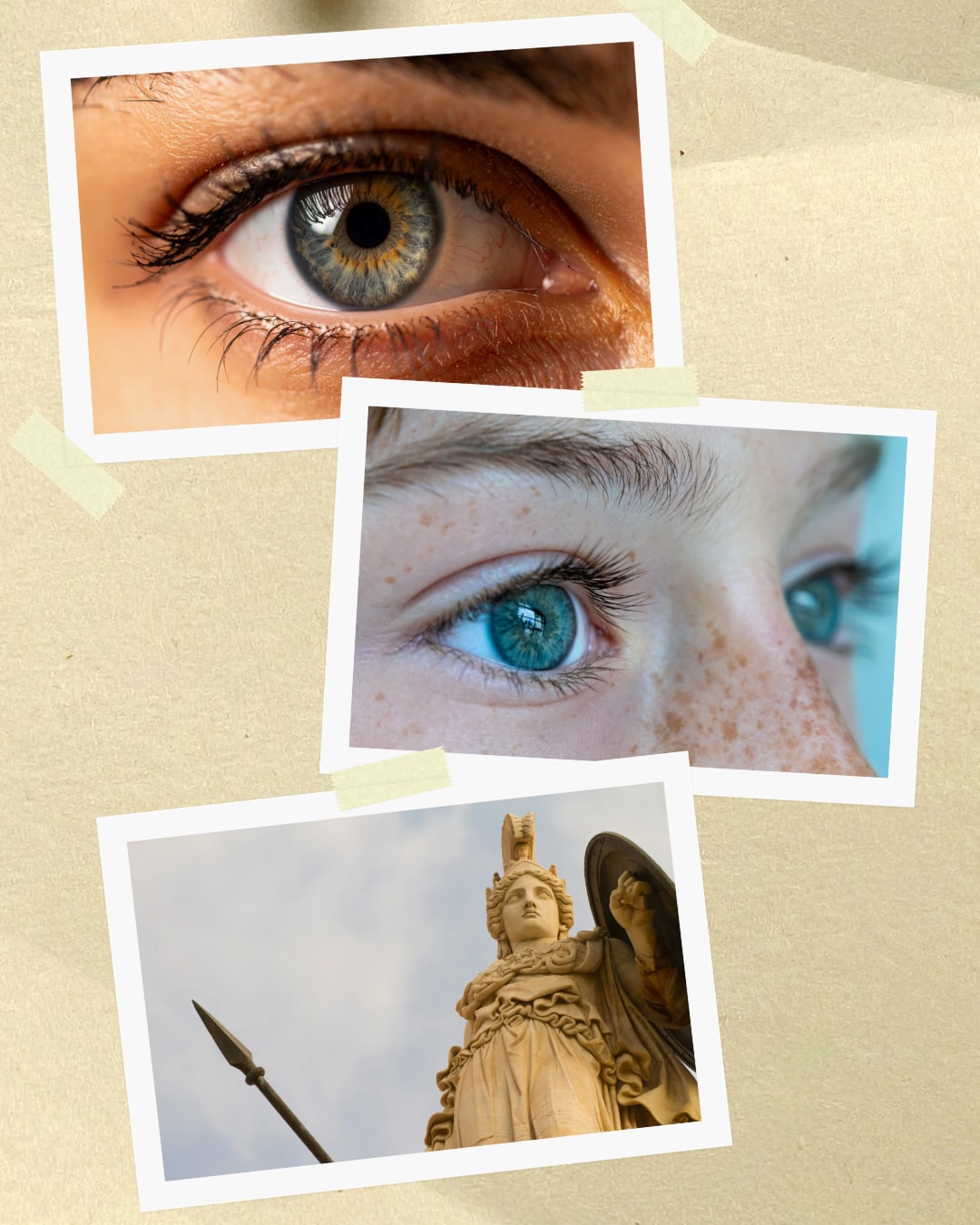
Today, we give that variation a few familiar names: brown, blue, hazel, green, gray, and amber. Brown dominates the map, with more than half of the world’s population having brown eyes. Green sits near the other end, often cited at about 2% worldwide. The rest fall somewhere in between, shaped by ancestry, region, and the way researchers sort blended shades.
That uneven spread is the interesting part. If eye color were only a decoration, why would one shade cover so much of the planet while others appear in smaller pockets across human history?
But before eyes had color, eyes had to exist at all.
Table of Contents
How Did Eyes First Evolve?
Eyes began with photoreceptors, cells that react when light hits them. Early animals did not need sharp sight for that to matter. A patch of photoreceptors could tell the difference between light and dark, which gave an animal useful information about direction, shade, movement, and the daily cycle of sunlight.
The next major step was shape. When a light-sensitive patch curved into a shallow cup, it no longer sensed only brightness. It could also detect where light came from. That small change made vision more spatial. A deeper cup and a narrower opening sharpened that directional signal, working almost like a pinhole camera.
Lenses came later. A transparent covering over the eye could bend incoming light and help form clearer images on the retina. Across animal history, eyes did not all become the same structure. Compound eyes, cup eyes, pinhole eyes, and camera-like eyes all reflect different answers to the same pressure: animals that could read light better could react to the world around them with greater precision.
Eye color enters the story much later. First came light-sensing. Then came direction, shape, focus, and image formation. Only after the eyes became working visual organs could the iris become part of the human story.

What Was the First Human Eye Color?
Research points to the one and most popular color: brown.
Long before blue, green, gray, hazel, or amber eyes appeared in human populations, our distant relatives lived under strong sunlight. Their irises held more melanin, the pigment group also involved in skin and hair color. In the eye, melanin absorbs light. A darker iris helps cut glare and protect the inside of the eye from intense brightness.
Brown wasn’t a later variation, rather, the starting point.
Other eye colors came from a change in the amount and placement of pigment inside the iris. Blue and gray eyes have very little melanin in the front layer of the iris. Green, hazel, and amber sit between dark brown and pale blue, with different pigment patterns changing how the eye catches and scatters light. The iris became a place where tiny genetic changes could show up every time a person looked at someone else.

How Did Other Eye Colors Appear?
The shift from brown eyes to lighter eyes did not happen because a new blue or green pigment entered the human iris. It happened because some genetic variants reduced how much melanin appeared there.
Two genes, OCA2 and HERC2, sit near the center of this story. OCA2 helps control pigment production, while a well-studied change near HERC2 can reduce OCA2 activity in the iris. When less melanin appears in the front layer, the eye can look blue because light scatters through the iris instead of being absorbed by brown pigment.
Green, hazel, gray, and amber eyes came from a wider range of pigment combinations. Green eyes have more visible pigment than blue eyes, but less than brown eyes. Hazel eyes often show brown, gold, and green in the same iris. Amber eyes are closer to a copper, honey, or yellow-brown tone and tend to look more even than hazel.
So the human iris did not gain a neat set of new colors one by one. It changed through pigment being reduced, shifted, blended, or scattered in different ways.
What Did Migration Have to Do With It?

Once humans began moving into new regions, eye color variation traveled with them. Small groups carried certain genetic variants into different climates, landscapes, and communities. Over generations, some variants became more visible because of ancestry, population size, isolation, and later mixing between groups.
Ancient DNA has made this part of the story more surprising. Cheddar Man, a Mesolithic hunter-gatherer who lived in Britain about 10,000 years ago, is described by the Natural History Museum as having dark skin and blue eyes. A genome from La Braña in Spain, dated to about 7,000 years ago, also pointed to blue eyes and darker skin.
That evidence breaks the modern habit of treating pale skin, light hair, and light eyes as if they always moved together. They did not. Eye color, skin color, and hair color followed different timelines. In ancient Europe, light eyes appeared before pale skin became widespread.
Why Did Eye Colors Change at All?
Dark brown eyes have the clearest practical explanation. In bright environments, melanin absorbs more light, reduces glare, and gives the iris stronger protection against intense sunlight. For early humans living under strong sun exposure, dark pigmentation made sense.
Lighter eyes are harder to tie to one survival need. They seem to have spread through a mix of mutation, migration, population history, and mate choice. In places with weaker sunlight, lighter irises carried less disadvantage than they would have under harsher glare. In smaller communities, a rare eye color could also stand out, which gave social and sexual selection more room to shape what became common over time.
That is what makes eye color such a strange human trait. Brown eyes tell us about protection and ancestry. Lighter eyes tell us about chance, movement, attraction, and the way small genetic changes can become part of a population’s visible history.
Ancient Cultures And Eye Color
Ancient people did not always divide eye color the way we do now. Modern labels like hazel, amber, blue-gray, and green come from a much newer habit of sorting human features into neat categories. Older writers and artists often cared less about the exact shade and more about what an eye seemed to do: shine, watch, attract, judge, protect, or harm.
That gives eye color two stories. One was biological, written through genes and migration. The other was cultural, written through poetry, amulets, myth, medicine, beauty, fear, and belief.
Dark Eyes and the Familiar Human Face
If dark brown was the older human baseline, then dark eyes were the familiar face of humanity for many ancient communities. In places where brown eyes were common, the color itself was less likely to be treated as strange. It was simply the gaze people saw in family, neighbors, rulers, workers, lovers, and enemies.
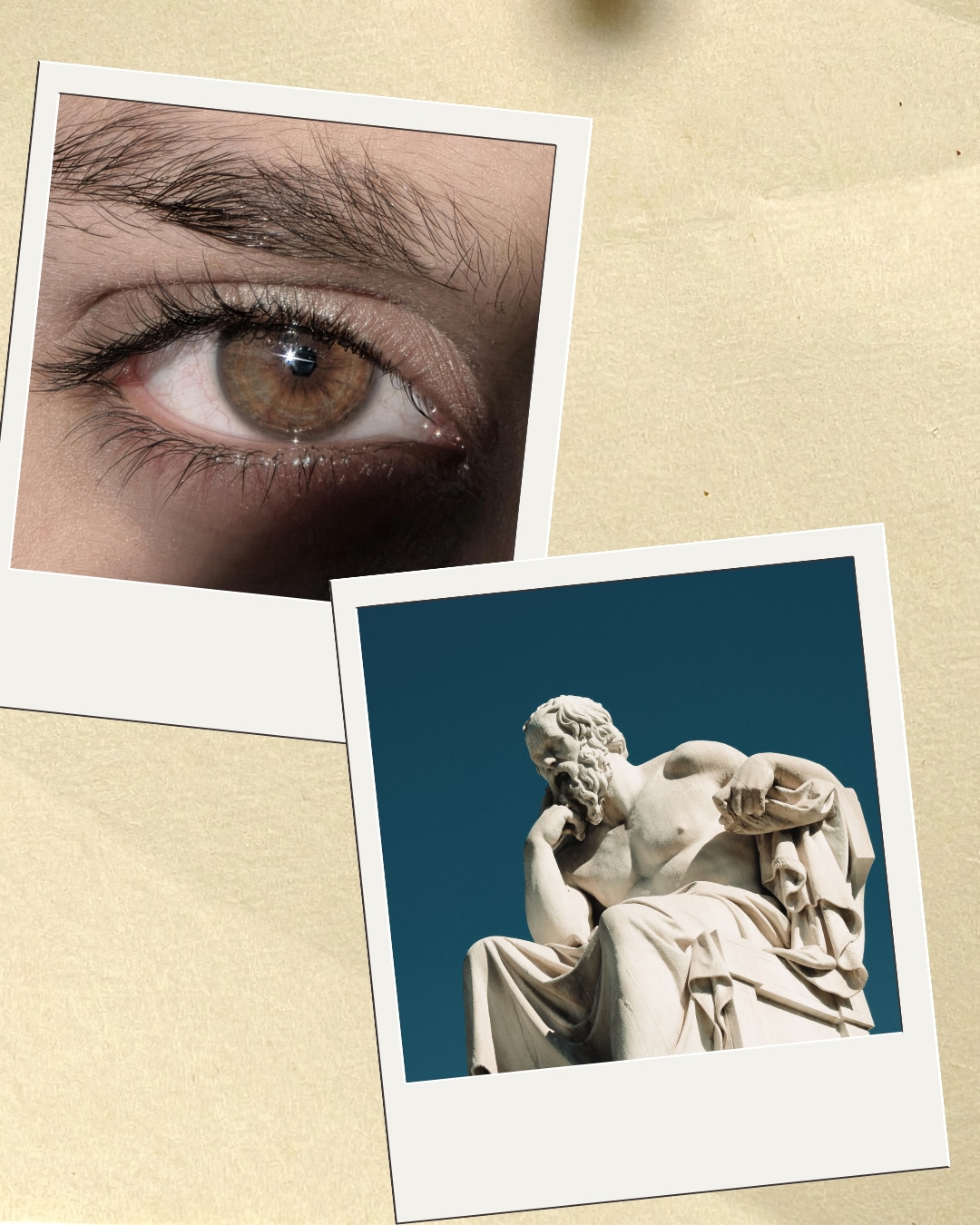
But familiar does not mean meaningless. Greek erotic poetry noticed black or dark eyes as part of attraction. Ancient face-reading traditions also treated the eye as a clue to character, temperament, and desire. The claim was not scientific by modern standards, but it tells us something about culture: people looked at eyes and believed a person’s inner life could be read from the outside.
Blue and Gray Eyes as Bright, Strange, or Divine
Blue and gray eyes seem to have carried a different charge in some ancient Mediterranean texts because they were less common and harder to name. Greek color language did not map neatly onto modern categories. One famous word, glaukos, could point to light blue, gray, green, gleaming, or bright.
That flexible meaning made light eyes useful in myth. Athena was often described with a bright or gray-eyed epithet, and Pausanias described a statue of Athena with blue eyes tied to Poseidon. In that setting, pale eyes were not just a physical detail. They helped create a sense of power, sharpness, weather, sea-light, and otherness.
The same color family could also drift into medicine. Ancient Greek writers used related terms for light irises and for certain diseased-looking eyes. That double meaning is revealing. A pale eye could look divine in one story and troubling in another. Culture did not see eye color as neutral. It turned visible difference into meaning.
The Eye Meant More Than the Color
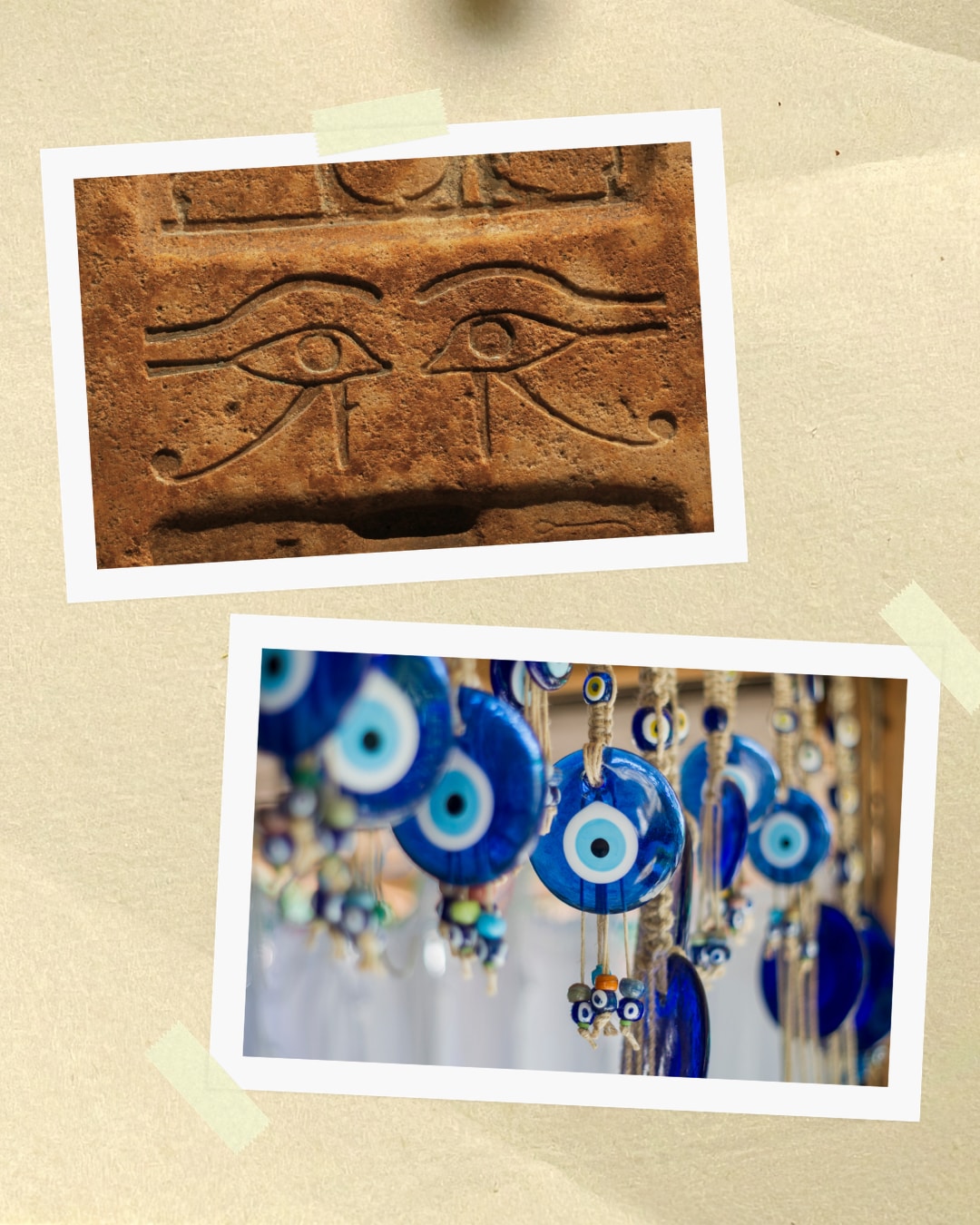
In ancient Egypt, the eye became one of the strongest symbols in visual culture. The wedjat, or Eye of Horus, stood for healing, protection, restoration, and rebirth. It appeared on amulets for the living and the dead. This was not about whether someone had brown, blue, or green eyes. It was about the eye as a sacred sign.
Greco-Roman and ancient Near Eastern traditions also treated the eye as active. A gaze could bless, seduce, judge, threaten, or harm. The “evil eye” belief came from the idea that looking was not passive. The eye was imagined almost like a force moving outward from the person.
That gives the cultural story its twist. Eye color began as biology, but culture made the eye into something larger. Ancient people did not just ask what color an eye was. They asked what the eye revealed, what it desired, and what power it carried.
What Does Eye Color Mean Today?
Eye color still carries its oldest story: pigment, light, ancestry, and chance. It can also hint at health patterns, since lighter eyes are more sensitive to glare and are linked with higher ocular melanoma risk, while dark brown eyes have been associated with higher risk for certain cataracts.
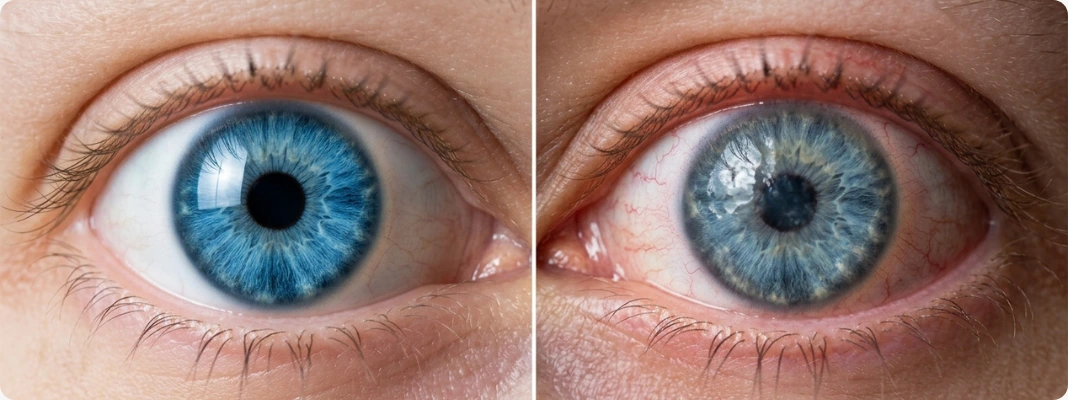
But eye color is not a diagnosis. The real warning sign is change. If one eye suddenly looks different, or if color changes come with pain, redness, blurred vision, light sensitivity, or a new spot, an eye doctor should check it.
In the end, eye color is both inherited and personal. It began as biology, became part of culture, and today can even be changed with properly fitted colored contact lenses. What started as pigment reacting to light has become one of the most visible ways humans carry history in our faces.
References
[1] A contextualised reading of Matthew 6:22-23: ‘Your eye is the lamp of your body.’ HTS Teologiese Studies / Theological Studies. https://www.scielo.org.za/scielo.php?pid=S0259-94222009000100023&script=sci_arttext. Published July 29, 2009. Accessed May 28, 2026.
[2] A Pessimistic Estimate of the Time Required for an Eye to Evolve. Proceedings of the Royal Society B: Biological Sciences. https://royalsocietypublishing.org/doi/10.1098/rspb.1994.0048. Published April 22, 1994. Accessed May 28, 2026.
[3] American Academy of Ophthalmology Issues Warning on Eye Color-Changing Procedures. American Academy of Ophthalmology. https://www.aao.org/newsroom/news-releases/detail/academy-issues-warning-on-eye-color-procedures. Published January 29, 2024. Accessed May 28, 2026.
[4] Ancient human genomes suggest three ancestral populations for present-day Europeans. Nature. https://pmc.ncbi.nlm.nih.gov/articles/PMC4170574/. Published September 18, 2014. Accessed May 28, 2026.
[5] ATHENE. Theoi Greek Mythology. https://www.theoi.com/Olympios/Athena.html. Published n.d. Accessed May 28, 2026.
[6] Black Eyes in Greek Erotic Poetry and the Physiognomical Tradition. Akroterion. https://akroterion.journals.ac.za/pub/article/view/1064. Published June 11, 2025. Accessed May 28, 2026.
[7] Blue-eyed humans have a single, common ancestor. ScienceDaily / University of Copenhagen. https://www.sciencedaily.com/releases/2008/01/080130170343.htm. Published January 31, 2008. Accessed May 28, 2026.
[8] Cheddar Man: Mesolithic Britain’s blue-eyed boy. Natural History Museum. https://www.nhm.ac.uk/discover/cheddar-man-mesolithic-britain-blue-eyed-boy.html. Published n.d. Accessed May 28, 2026.
[9] Decorative Contact Lenses for Halloween and More. U.S. Food and Drug Administration. https://www.fda.gov/medical-devices/contact-lenses/decorative-contact-lenses-halloween-and-more. Published October 22, 2024. Accessed May 28, 2026.
[10] Derived immune and ancestral pigmentation alleles in a 7,000-year-old Mesolithic European. Nature. https://www.nature.com/articles/nature12960. Published January 26, 2014. Accessed May 28, 2026.
[11] European hair and eye color: A case of frequency-dependent sexual selection? Evolution and Human Behavior. https://www.sciencedirect.com/science/article/abs/pii/S1090513805000590. Published September 1, 2006. Accessed May 28, 2026.
[12] Evolution of the Vertebrate Eye: Opsins, Photoreceptors, Retina and Eye Cup. Nature Reviews Neuroscience. https://www.nature.com/articles/nrn2283. Published December 1, 2007. Accessed May 28, 2026.
[13] Eye Color Percentages: Across the Globe, Effect on Health, More. Healthline. https://www.healthline.com/health/eye-health/eye-color-percentages. Updated April 19, 2023. Accessed May 28, 2026.
[14] Eye Colors: Hazel, Green, Amber, Blue, Grey & Brown. Cleveland Clinic. https://my.clevelandclinic.org/health/articles/21576-eye-colors. Updated March 11, 2024. Accessed May 28, 2026.
[15] Eye Evolution and Its Functional Basis. Visual Neuroscience. https://www.cambridge.org/core/journals/visual-neuroscience/article/eye-evolution-and-its-functional-basis/E632F655150C8D0E7367566CC99F4717. Published April 12, 2013. Accessed May 28, 2026.
[16] Eye melanoma – Symptoms and causes. Mayo Clinic. https://www.mayoclinic.org/diseases-conditions/eye-melanoma/symptoms-causes/syc-20372371. Published January 28, 2025. Accessed May 28, 2026.
[17] Iris color and associated pathological ocular complications. Survey of Ophthalmology. https://pmc.ncbi.nlm.nih.gov/articles/PMC4206898/. Published November 2014. Accessed May 28, 2026.
[18] Iris color and cataract: the Blue Mountains Eye Study. American Journal of Ophthalmology. https://pubmed.ncbi.nlm.nih.gov/11004303/. Published October 2000. Accessed May 28, 2026.
[19] Iris Colour and the Risk of Developing Uveal Melanoma. International Journal of Molecular Sciences. https://pmc.ncbi.nlm.nih.gov/articles/PMC7583924/. Published October 10, 2020. Accessed May 28, 2026.
[20] Is eye color determined by genetics? MedlinePlus Genetics. https://medlineplus.gov/genetics/understanding/traits/eyecolor/. Updated July 7, 2022. Accessed May 28, 2026.
[21] The early history of glaucoma: the glaucous eye 800 BC to 1050 AD. Clinical Ophthalmology. https://www.dovepress.com/the-early-history-of-glaucoma-the-glaucous-eyenbsp800-bc-to-1050-ad-peer-reviewed-fulltext-article-OPTH. Published February 2, 2015. Accessed May 28, 2026.
[22] The Sun, UV Light and Your Eyes. American Academy of Ophthalmology. https://www.aao.org/eye-health/tips-prevention/sun. Published May 29, 2024. Accessed May 28, 2026.
[23] Wedjat Eye Amulet. The Metropolitan Museum of Art. https://www.metmuseum.org/art/collection/search/569722. Published n.d. Accessed May 28, 2026.
[24] Your Blue Eyes Aren’t Really Blue. American Academy of Ophthalmology. https://www.aao.org/eye-health/tips-prevention/your-blue-eyes-arent-really-blue. Published June 16, 2023. Accessed May 28, 2026.