
Updated July 3rd, 2026 – Most soft contact lenses available today are made from either hydrogel or silicone hydrogel. Although both materials are flexible and designed to conform to your eye, they differ in water content, oxygen transmission, and overall performance.
Understanding how these materials compare can help you navigate the different types of contact lenses and discuss the most appropriate option for your comfort, eye health, and wearing routine with your eye care professional.
In 1959, Czech chemists Otto Wichterle and Drahoslav Lím published a paper entitled “Hydrophilic Gels for Biological Use” in the journal Nature. By 1961, Wichterle succeeded in making the world’s first four hydrogel contact lenses. In 1965, the National Patent Development Corporation (NPDC) purchased the American rights to manufacture hydrogel contact lenses. The NPDC then sublicensed these rights to Bausch + Lomb. In 1971, the US Food and Drug Administration (FDA) approved the first use of Soflens, the hydrogel material manufactured by Bausch + Lomb.
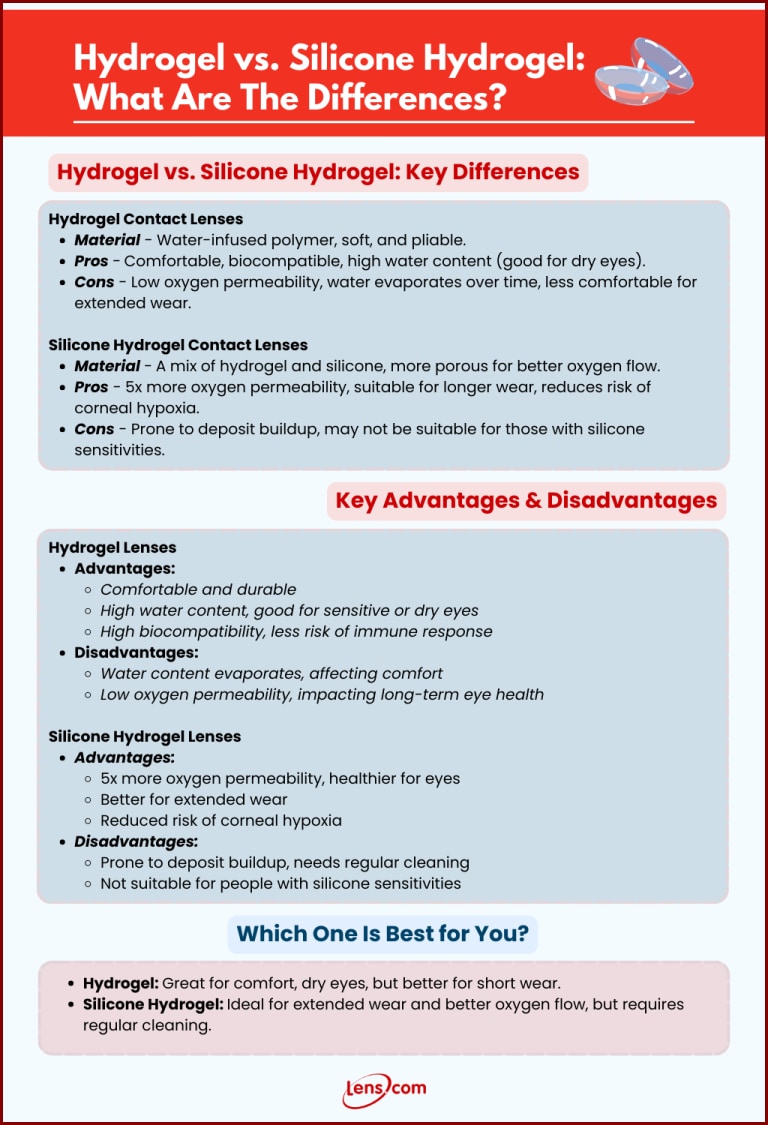
Monthly, biweekly, and 1 day silicone hydrogel contact lenses are made of a water-infused polymer known as hydrogel. Hydrogel is a thin and pliable material, allowing it to conform to the shape of the eye. In the 1970s, doctors started to prescribe hydrogel contact lenses more often than other types of contact lenses due to their comfort and ease of use. This led to hydrogel contact lenses rising in popularity.
Advantages of Hydrogel Contact Lenses:
Disadvantages of Hydrogel Contact Lenses:
Manufacturers were able to improve the hydrogel polymers used in contact lenses over the two decades after the FDA first approved hydrogel contact lenses in the US. This improvement resulted in the introduction of silicone hydrogel contact lenses. In 1998, Ciba Vision (now known as ALCON) introduced the first silicone hydrogel contact lenses in Mexico. In 2002, the US started marketing silicone hydrogel contact lenses.
The improvement of hydrogel polymers led to silicone hydrogel contact lenses. From the name itself, silicone hydrogel is a polymer that contains both hydrogel and silicone. Silicone is a gel-like polymer that has a high degree of flexibility, making it a superb material for contact lenses. Like hydrogel, silicone hydrogel contains water. However, unlike hydrogel, silicone hydrogel is more porous and has increased oxygen permeability.
High Oxygen Permeability:
Reduced Risk of Corneal Hypoxia:
Potential Drawbacks:
Hydrogel contact lenses offer comfort and high water content, making them a good choice for those with dry eyes, though they may be less suitable for extended wear due to gradual water evaporation. You can order Biotrue ONEday or other hydrogel contacts online through Lens.com and explore affordable options for sensitive eyes.
Silicone hydrogel lenses, on the other hand, allow higher oxygen flow, reducing the risk of corneal hypoxia and enabling longer wear. Many wearers buy 1-Day Acuvue TruEye or other silicone hydrogel contacts for their breathability and convenience during extended wear. Another brand, PureVision, produces high-tech silicone hydrogel Balafilcon A contact lenses.
Ultimately, neither hydrogel nor silicone hydrogel is universally “better.” The ideal lens material depends on your unique eye needs and comfort. That also applies if your prescription calls for contact lenses for reading, since your eye care professional can help determine the appropriate lens design and material for you.
This guide serves as an informational resource and is not a substitute for professional medical advice.
Have a question? Call us at
1-800 LENS.COM (536-7266)
Online 24/7
© 1995-2021 Lens.com. All Rights Reserved. Lens.com is a contact lens replacement company, and a direct to consumer marketer of contact lenses.
As a contact lens replacement center, we can only sell you contact lenses that you have a valid prescription for, and are wearing successfully.