
U.S. prices checked October 22, 2026. All figures are in U.S. dollars.
Contact lenses can cost a few hundred dollars a year for reusable products and more than $1,000 for premium daily disposables. For both eyes, the monthly single-vision examples in our October 2026 retail sample worked out to about $155 to $252 for 12 months. Daily single-vision examples came to about $542 to $1,110 for a 365-day lens-use equivalent, before promotions and other expenses.
Your prescription, replacement schedule, and pack size determine how many lenses you need. Add eye care, cleaning supplies for reusable lenses, and order charges to estimate your complete budget. Then account for discounts or benefits your purchase qualifies for.
How much do contacts cost per month and per year?
The table below summarizes 36 listed-price observations for 12 products at Lens.com, Costco Contacts, and Walmart Contacts. These are ranges within that sample, not national averages. They exclude promotions, rebates, membership cost, care products, examinations, fitting, shipping, taxes, and fees.
Swipe tables horizontally to see all columns on a small screen.
| Lens category | Annual lens-use estimate | Monthly equivalent |
|---|---|---|
| Monthly single vision | $155-$252 | $13-$21 |
| Monthly toric | $223-$287 | $19-$24 |
| Monthly multifocal | $283-$399 | $24-$33 |
| Two-week single vision | $270-$465 | $23-$39 |
| Daily single vision | $542-$1,110 | $45-$93 |
| Daily toric | $753-$1,280 | $63-$107 |
| Daily multifocal | $1,062-$1,435 | $89-$120 |
Rounded sample ranges. Daily and two-week figures represent 365 days of lens consumption; monthly figures cover 12 calendar replacement cycles. Monthly equivalents divide the annual estimate by 12 and do not describe a monthly payment plan. Costco purchases require membership. The source observations and calculation method appear at the end of this guide.
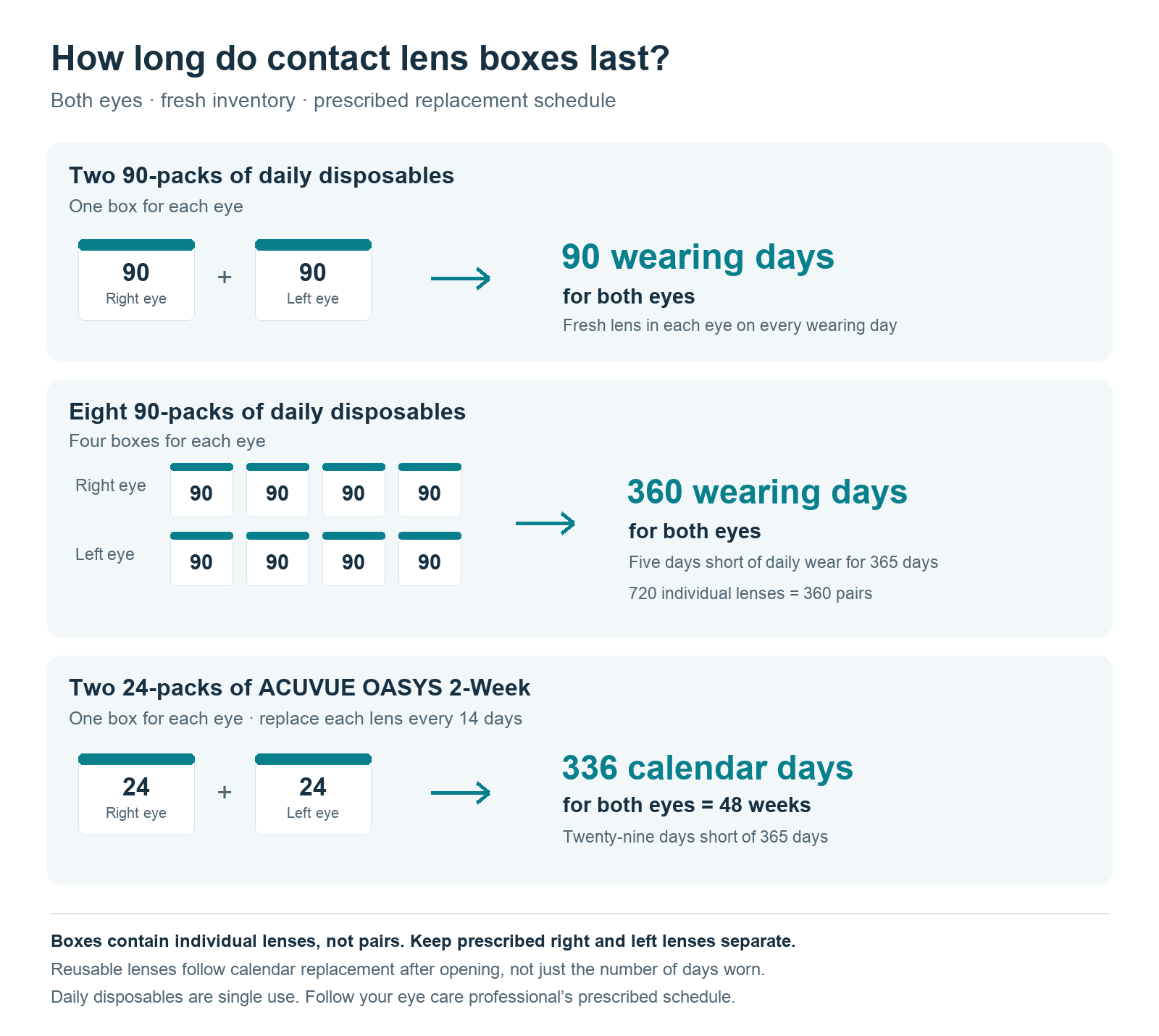
Lens-use cost and the amount needed to buy whole boxes are different. An eight-box order of daily 90-packs supplies 360 days for both eyes. A strict 365-day plan needs more lenses or existing usable stock. Larger orders can leave unopened lenses for later use within their expiration dates and your valid prescription.
What goes into your complete budget?
| Budget item | What to include |
|---|---|
| Prescribed lenses | Whole boxes needed for each eye, accounting for usable stock. |
| Professional care | Comprehensive examination, contact evaluation or fitting, and any separately charged follow-up. |
| Care supplies | The prescribed cleaning system and replacement cases for reusable lenses. |
| Order charges | Shipping, processing, applicable tax, and any incremental membership cost. |
| Immediate savings | Eligible coupons or instant discounts that reduce the order total. |
| Later benefits | Eligible rebates or insurance reimbursement received after purchase. |
What do popular contact lenses cost at Lens.com?
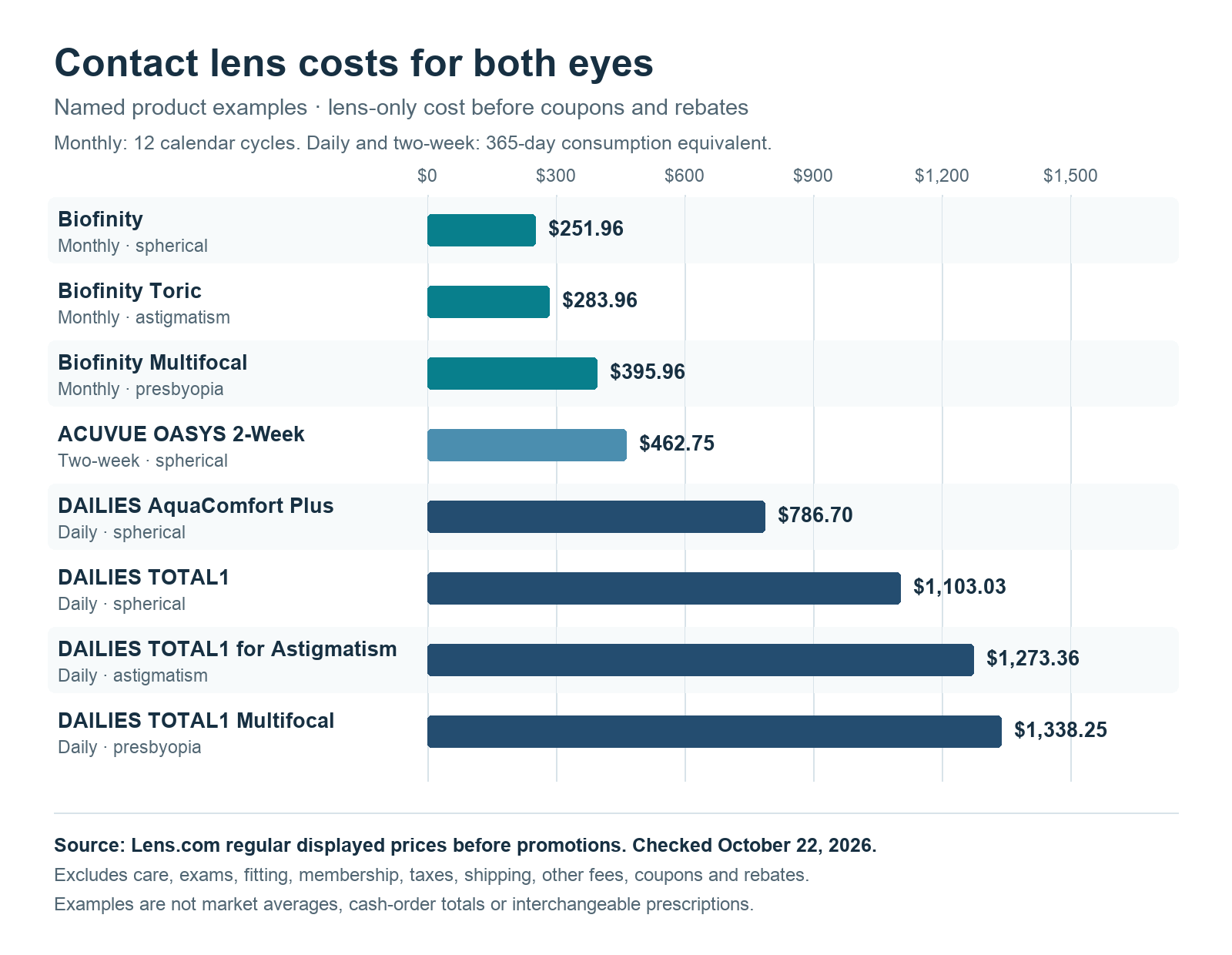
These examples use Lens.com’s regular displayed box prices before first-order promotions or later rebates, checked October 22, 2026. The annual column values the lenses used, rather than rounding up to an actual whole-box order. Check the product page and final order summary for current pricing and terms.
| Prescribed product | Box size | Replacement | Regular box price | Both-eye annual lens-use estimate |
|---|---|---|---|---|
| Biofinity | 6 lenses | Monthly | $62.99 | $251.96 |
| Biofinity Toric | 6 lenses | Monthly | $70.99 | $283.96 |
| Biofinity Multifocal | 6 lenses | Monthly | $98.99 | $395.96 |
| ACUVUE OASYS 2-Week | 24 lenses | Two-week | $212.99 | $462.75 |
| PRECISION1 | 90 lenses | Daily disposable | $85.99 | $697.47 |
| DAILIES AquaComfort Plus | 90 lenses | Daily disposable | $96.99 | $786.70 |
| ACUVUE OASYS 1-Day with HydraLuxe | 90 lenses | Daily disposable | $115.99 | $940.81 |
| DAILIES TOTAL1 | 90 lenses | Daily disposable | $135.99 | $1,103.03 |
| PRECISION1 for Astigmatism | 90 lenses | Daily disposable | $116.99 | $948.92 |
| DAILIES TOTAL1 for Astigmatism | 90 lenses | Daily disposable | $156.99 | $1,273.36 |
| DAILIES TOTAL1 Multifocal | 90 lenses | Daily disposable | $164.99 | $1,338.25 |
| ACUVUE OASYS MAX 1-Day Multifocal | 90 lenses | Daily disposable | $173.99 | $1,411.25 |
Daily: price per lens multiplied by 730. Two-week: price per lens multiplied by 730 and divided by 14. Monthly: price per lens multiplied by 24. No promotions, rebates, care, exams, fitting, shipping, taxes, or fees are included. Lenses differ in fit and design; ask your prescriber about suitable alternatives.
How do daily, weekly, two-week, and monthly costs compare?
Replacement schedule tells you when to discard a lens. Daily wear means removing lenses before sleep; it does not mean the lens must be replaced every day. Daily disposables are single-use lenses. Reusable lenses need their prescribed care routine between wears.
Daily disposable lenses
Use a fresh lens in each eye on every wearing day. A daily 90-pack supplies one eye for 90 days. Two boxes, one for each eye, cover 90 days for both eyes. Single-use dailies do not need routine cleaning or overnight storage, which removes those care expenses.
Weekly replacement lenses
Weekly lenses add another option between daily disposables and longer replacement schedules. Alcon’s PRECISION7 is replaced after one week and removed, cleaned, disinfected, and stored after daily wear. Enter the price and exact pack count of your prescribed weekly product in the calculator below.
Two-week replacement lenses
Replace each lens every 14 days on the prescribed schedule. Two 24-packs, one for each eye, cover 24 cycles, or 336 days. Even 26 pairs cover only 364 days. Starting with fresh lenses, a strict 365-day schedule opens a 27th lens per eye on day 365. Whole-box purchasing may leave unused stock.
Monthly replacement lenses
A six-pack contains six individual lenses. Two boxes per eye cover 12 monthly replacement cycles, so both eyes need four boxes. Include solution and cases in the budget. See our monthly contact lens cost guide for a closer look at this replacement schedule.
Follow your prescribed replacement period after opening, even when you skip wearing days. Overnight wear is a separate clinical decision, not a way to stretch the life of your contacts.
How much more do toric and multifocal contacts cost?
Toric contacts correct astigmatism and use designs that help maintain the prescribed orientation on the eye. Multifocal contacts provide multiple focusing powers for presbyopia. Both designs can cost more than the spherical version of a product family.
In the Lens.com regular-price examples above, Biofinity’s monthly spherical, toric, and multifocal lenses work out to $251.96, $283.96, and $395.96 for 12 months in both eyes. That is an observed difference within one family, not a fixed surcharge for every toric or multifocal lens.
Materials, optics, comfort features, available parameters, and retailer pricing also affect cost. Ask your eye care professional about suitable choices before comparing a different brand or schedule. A lower price does not make another product interchangeable with the one prescribed.
What other contact lens costs should you budget for?
Your complete budget includes more than replacement lenses. A comprehensive eye examination checks vision and eye health. A contact lens evaluation or fitting assesses the lens type, prescription, and fit on your eyes. Ask whether the quoted fee includes fitting, trial lenses, and any follow-up visits, or whether those services cost extra.
For a published provider example, Warby Parker lists glasses-and-contacts eye exams starting at $130, with prices varying by location and vision benefits. That is a starting price from one provider, not a national average. A first-time wearer may need an initial fitting and follow-up visits; an established wearer should ask what a renewal evaluation includes. Follow your eye care professional’s advice about when to return for examinations.
Eligible online prescription renewal is a separate service. Lens.com currently lists its online prescription renewal test at $15.99. It can help eligible wearers renew an existing prescription, but it does not replace a comprehensive in-person eye examination or a first contact lens fitting.
Reusable lenses also need the care system prescribed for them. Budget for solution and case replacement, avoiding double-counting cases included with solution. Single-use daily disposables are discarded after use, so they do not need routine cleaning or overnight storage.
Care-product costs depend on the product, how you use it, and its discard instructions. For example, Biotrue’s original multipurpose solution must be discarded 90 days after opening. An occasional wearer may need to replace an opened bottle before using all of it.
Finally, check shipping, processing charges, and applicable taxes. Apply order-level fees once per order, rather than once per box. The final order summary gives a more useful purchasing figure than the advertised box price alone.
Are daily contacts cheaper if you wear them occasionally?
Daily disposables can be economical for occasional wear because you use a fresh lens in each eye only on the days you wear contacts. Reusable lenses follow their prescribed replacement schedule after opening. A monthly lens does not become a lens you can wear on 30 separate occasions spread across several months.
Here is a hypothetical example. Suppose a daily 90-pack costs $60 and you plan to wear contacts on 104 days during the year. You need 104 lenses per eye. Starting with no usable inventory, you would buy two boxes for each eye, or four boxes costing $240.
Those boxes contain enough lenses for 180 wearing days in both eyes, leaving unused lenses for later wear within their expiration dates and your valid prescription. The value of the 208 lenses used during the example year is about $138.67, but the whole-box purchase costs $240. Both figures are useful, and they describe different things.
Compare suitable options with your prescriber. Include care expenses for reusable lenses and follow the replacement instructions even when you skip wearing days.
How much would your own contact lens supply cost?
Use your quoted price and prescribed replacement schedule to calculate the lenses needed for each eye. Add care and examination costs if you want a more complete budget. Benefits default to zero so the estimate does not assume you qualify for a promotion or reimbursement.
Estimate your contact lens budget
Enter the price and pack size of your prescribed lenses. See your whole-box purchase, care budget, and possible cost after eligible benefits.
Your estimate
| Eye | Lenses needed | Boxes to buy | Available supply | Unopened lenses left after scheduled openings |
|---|
Whole-box cost can exceed the value used during the period because unopened lenses carry forward. This tool prices one pack size per eye; it does not optimize combinations of smaller and larger packs. Your prescriber determines which lenses and replacement schedule suit your eyes.
How do insurance, FSA, HSA, and rebates affect your cost?
Check your vision plan’s contact lens allowance, fitting coverage, network rules, and claim requirements. Do not assume a routine medical insurance benefit covers the same services as a vision plan, or that the full advertised allowance applies at every retailer.
Lens.com is considered out of network by most major vision insurers. If your plan covers out-of-network purchases, you can order, then submit your invoice and the required claim form for reimbursement. Your plan determines eligibility and the reimbursement amount.
Prescription contacts and qualifying care supplies can generally be paid with eligible FSA or HSA funds, subject to account rules. This changes how you pay; it does not reduce the invoice by the amount spent from the account. Keep receipts and do not seek reimbursement twice for the same expense.
Also separate immediate discounts from benefits received later. A coupon or instant quantity discount may reduce what you pay at checkout. A mail-in rebate usually requires an eligible purchase and a completed claim before you receive the reward.
Manufacturer rewards and retailer rebates have different terms. ACUVUE’s manufacturer rewards, for example, are restricted to participating purchase channels. Do not assume a manufacturer’s promotion applies to every website or can be combined with a retailer rebate.
A practical comparison shows two totals: what you pay now and your net cost if eligible later rebates or insurance reimbursements are received. Compare discount and insurance routes separately when their terms prevent combining them.
How can you lower your contact lens costs safely?
Compare the same prescribed product, pack size, and quantity across sellers, then check the final order total. Ask your prescriber whether another suitable brand or replacement schedule could lower your costs. Keep replacement and care instructions unchanged while comparing prices.
For detailed shopping tactics, read how to save and spend less on contact lenses. When you are ready to buy, compare the current terms for your prescribed contact lenses rather than choosing from a headline box price alone.
What about specialty and colored contact lenses?
Rigid gas permeable, scleral, hybrid, and orthokeratology lenses need a separate comparison from disposable soft contacts. A specialty quote may include custom lenses, measurements, fitting, and follow-up care. Ask which services and replacements are included before comparing it with a per-lens price.
Colored lenses vary by product and replacement schedule. In the U.S., decorative lenses require a prescription even when they have no vision-correcting power. Choose a properly prescribed product and compare that exact lens across retailers.
Frequently asked questions about contact lens costs
Does a 90-pack last three months for both eyes?
A 90-pack contains 90 individual lenses. It supplies one eye for 90 wearing days. Wearing daily disposables in both eyes requires two 90-packs for 90 days, with the correct prescription for each eye.
How many boxes of monthly contacts do I need for a year?
With six individual monthly lenses in each box, two boxes cover 12 replacement cycles for one eye. Both eyes need four boxes, assuming continuous monthly replacement and no usable inventory.
Can I buy a cheaper brand with my existing prescription?
Compare retailers for the prescribed product. Ask your prescriber about a different brand or replacement schedule if cost is a concern. Retailers generally cannot substitute another brand; the FTC describes a limited exception for identical private-label lenses.
Do I have to buy contacts from my eye doctor?
You can shop elsewhere using a valid contact lens prescription. Your prescriber must give you a copy after the fitting is complete. A seller can receive that copy or verify the prescription information with the prescriber.
Does an online vision test replace an eye examination?
No. Eligible prescription renewal does not replace the eye-health assessment provided by a comprehensive in-person examination. It is also different from an initial contact lens fitting.
How we checked the prices and calculated the estimates
We checked 12 exact products across three U.S. retailers on October 22, 2026, producing 36 listed or catalog box-price observations. Lens.com’s regular reference prices and selected pack sizes were checked in Chrome. Costco product pages supplied listed prices; Walmart Contacts catalogs supplied prices with packs checked against their product pages.
These observations do not represent every lens or retailer. Lens.com first-order promotions and delayed rebates, Costco instant quantity savings and membership cost, insurance benefits, care, professional services, shipping, tax, and fees are excluded from the comparison figures. No delivered checkout total or lowest-price ranking is claimed. Prices and eligibility can change.
| Exact product and pack | Lens.com regular | Costco listed | Walmart catalog |
|---|---|---|---|
| Biofinity 6 lenses per box | $62.99 | $38.87 | $62.86 |
| Biofinity Toric 6 lenses per box | $70.99 | $55.85 | $71.86 |
| Biofinity Multifocal 6 lenses per box | $98.99 | $70.87 | $99.86 |
| ACUVUE OASYS 2-Week 24 lenses per box | $212.99 | $124.49 | $213.86 |
| PRECISION1 90 lenses per box | $85.99 | $68.88 | $68.89 |
| DAILIES AquaComfort Plus 90 lenses per box | $96.99 | $66.87 | $97.86 |
| ACUVUE OASYS 1-Day with HydraLuxe 90 lenses per box | $115.99 | $93.49 | $111.86 |
| DAILIES TOTAL1 90 lenses per box | $135.99 | $103.59 | $136.86 |
| PRECISION1 for Astigmatism 90 lenses per box | $116.99 | $92.85 | $93.45 |
| DAILIES TOTAL1 for Astigmatism 90 lenses per box | $156.99 | $123.99 | $157.86 |
| DAILIES TOTAL1 Multifocal 90 lenses per box | $164.99 | $130.99 | $165.86 |
| ACUVUE OASYS MAX 1-Day Multifocal 90 lenses per box | $173.99 | $134.99 | $176.86 |
For daily lenses, the annual lens-use estimate equals box price divided by lenses per box, multiplied by 730. For two-week lenses, divide that result by 14. Monthly estimates use 24 lenses for both eyes over 12 calendar replacement cycles. The calculator counts exact days for the chosen period and rounds actual purchase quantities separately for each eye.
Box rounding, usable inventory, and pack choices determine what must be bought. Monthly equivalents are budgeting averages, not subscription prices. Different products in a category may serve different prescriptions and fit requirements.
Sources
- Current Lens.com, Costco Contacts, and Walmart Contacts product and catalog pages, linked in the pricing tables; checked October 22, 2026.
- CDC: Contact lens types and FDA: Types of contact lenses.
- Alcon: PRECISION7 weekly replacement and care instructions.
- FTC: The Contact Lens Rule.
- Warby Parker: Contact lens examination and provider starting price.
- Lens.com: Online prescription renewal, vision insurance, and shipping costs.
- Biotrue: Solution instructions.
- IRS: Publication 502 and Publication 969.
- ACUVUE: U.S. FAQ and manufacturer reward terms.
Similar Articles
-

What Is HydraGlyde Moisture Matrix?
-

Can I Wash My Face While Wearing Contact Lenses?
-

Buyer’s Guide to Colored Contact Lenses: Pros & Cons, Costs, Most Popular Colored Contacts
-

Why Do My Eyes Get Watery While Wearing Contact Lenses?
-

What Is Hydraclear Plus (As in ‘Acuvue Oasys w/Hydraclear’)? A Complete Guide