
Table of Contents
Busy day and an expired prescription? Whether you need to renew clear lenses or compare colored eye contacts, that is why more people are trying an online eye exam or at home eye exam, especially as World Optometry Day puts eye care in focu These tools can be convenient, but they are not all the same for prescription contact lenses, eyeglasses, and other vision aids.
Some online services can help eligible adults renew a prescription from home, including prescriptions for contact lenses for farsightedness when the current correction still seems appropriate. More specialized prescriptions, such as aphakic contact lenses, usually require closer guidance from an eye care professional because fit, lens power, and eye health needs can be more complex.
Can You Really Take an Eye Exam Online?
Yes, you can take an online eye exam, but only in a limited way. In most cases, it is really an online vision test or prescription renewal tool that helps eligible adults check visual clarity and update a glasses or contact lens prescription from home. It can be convenient if you already have a prescription and just need a simple renewal before ordering lenses, including eligible options such as HSA contact lenses or or searches for colored contacts near me, but it is not the same as a full eye health exam.
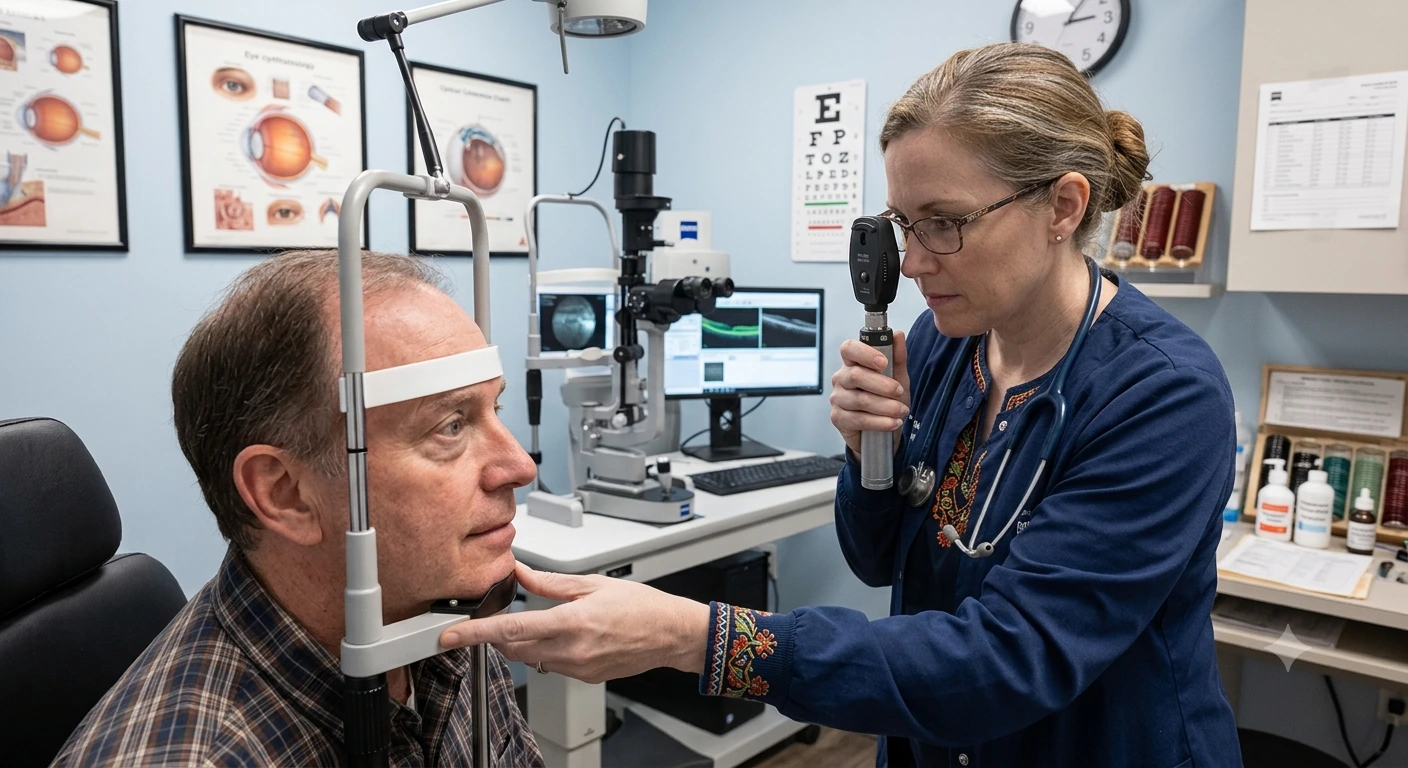
An in-person exam evaluates more than visual sharpness. It may include checks for eye pressure, peripheral vision, eye movement, and signs of conditions that an online test cannot detect. When you need a full exam, contact lens fitting, or local professional care, searching for prescription contact lenses near me can help you review nearby eye care and purchasing options.
What Is an Online Eye Exam?
An online eye exam is a digital vision check you take from home using a phone, computer, or both. In most cases, it is designed to measure how clearly you see and whether your current prescription still seems appropriate for glasses or contacts. Our service is positioned as an online vision exam for glasses and contacts that you can complete remotely, with doctor review afterward.

Online Eye Exam Vs Online Vision Test
People often use these terms interchangeably, and that is part of why the topic can feel confusing. In everyday use, an online eye exam, online vision test, online eye test, and eye test online usually refer to the same type of service: a remote test focused on vision clarity and prescription renewal. The key thing to know is that this is not the same as a full, in-person eye health exam. A comprehensive exam checks much more than whether you can read letters on a screen.
A simple way to think about it is this: an online test mainly looks at vision performance, while a full exam also looks at eye health. Visual acuity testing checks how clearly you can see. That can help identify common refractive errors such as nearsightedness, farsightedness, astigmatism, and presbyopia. But a complete eye exam goes further and evaluates your vision and overall eye health.
Online Vision Screening Vs Telehealth Eye Visit
A vision screening online is usually an automated test. You follow prompts on your screen, read letters or symbols, and complete a guided process that checks vision clarity and may support prescription renewal. A telehealth eye exam, on the other hand, is usually a live visit with an eye care professional. That type of visit is more about discussing symptoms, reviewing concerns, and deciding whether you need in-person follow-up. It is a different service from an automated prescription-renewal test.
That distinction matters because some readers search for a virtual eye exam expecting a doctor to examine every part of the eye through a screen. In reality, remote services are not all built the same way. Some are self-guided digital tests. Others are clinician-led telehealth visits. They can both be useful, but they serve different purposes.
What An Online Exam Is Designed To Do
The main job of an online exam is convenience. It is best understood as a limited, focused tool for people who want to check vision and possibly renew a prescription from home. Our remote vision test that checks how clearly you see and helps renew a glasses or contact lens prescription. That makes it practical for eligible adults who already wear correction and want a simpler renewal process.
What it is not designed to do is replace every part of a full eye appointment. A complete eye exam can include additional testing and broader health evaluation that a remote prescription check does not cover. So if you are comparing an online eye exam for glasses or an online eye exam for contacts with a comprehensive office visit, the right expectation is this: digital tools can help with convenience, but they are not a substitute for full eye health care.
Not sure which eye is OD and which eye is OS when you type in your details? Know how to read contact lens prescriptions (OD vs. OS) so you enter each eye correctly before you start the test.
How Online Eye Exams Work
Most online vision exams follow a fairly simple process. You use a digital device, complete a guided vision test from home, and then have your results reviewed if the service includes prescription renewal. At Lens.com, our four-step process can provide a prescription for glasses or contacts when appropriate.

What You Usually Need Before You Start
Before starting an at home eye exam, make sure you have a compatible device, a stable internet connection, and your current or previous prescription if you are renewing one. It also helps to set up in a quiet room where you can follow the required screen distance and instructions without distractions.
The Step By Step Process
While the exact interface varies by provider, the process usually looks something like this:
- Set up your device and room. You may be asked to use a smartphone and computer together and position yourself at a specific distance from the screen.
- Enter your prescription details if required. Some services ask for your current or previous prescription before the test begins. This helps frame the renewal process.
- Follow the on-screen prompts. A typical renewal prescription from a home vision test asks you to read letters or symbols, cover one eye at a time, and respond as the test gets more challenging. That mirrors the basic logic of visual acuity testing, which checks how well you can see shapes and details.
- Complete the test and submit results. Once finished, your information is sent for review if the service includes doctor evaluation.
The experience is meant to feel straightforward, but accuracy still depends on following instructions carefully. That includes using the right distance, the right device setup, and honest answers during the test.
Not sure which eye is OD and which eye is OS when you type in your details? Use how to read contact lens prescriptions (OD vs. OS) so you enter each eye correctly before you start the test.
How Doctor Review And Prescription Renewal Work
The digital test is not the final step by itself. The process includes doctor review after you complete the exam. If your results meet the service requirements and renewal is appropriate, you may receive a valid prescription for glasses or contacts. That is what makes this kind of prescription renewal online service different from a simple self-check with no clinical review behind it.
This is also why a remote test works best for straightforward renewals, not every vision needed. A service like this may help you renew glasses prescription online or support contact lens prescription renewal online when you are an eligible returning wearer and your situation fits the service criteria. But if the review suggests you need more evaluation, the right next step may still be an in-person exam. In other words, a digital exam can be a convenient first stop for the right person, but it is not a catch-all replacement for full eye care.
Who Is Eligible for an Online Eye Exam?
Eligibility is where a lot of people get tripped up. An online eye exam can be useful, but it is usually designed for a fairly specific type of patient. In general, the best candidates are adults who already have a current or recently expired prescription, have stable vision, and are looking for a simple prescription renewal online rather than a first-time diagnosis or a full medical eye exam.

People Who May Be Good Candidates
If you are wondering whether an online eye exam for glasses or virtual vision test prescription renewal makes sense, these are the people most likely to qualify:
- Adults with a current or recently expired glasses or contact lens prescription
- People who want a simple renewal, not a first eye exam
- People with healthy eyes and no new symptoms
- People whose prescription has been fairly stable
- People with standard, uncomplicated refractive needs rather than unusually strong or irregular prescriptions
That pattern shows up across major online vision exam pages. Online renewals are generally for people ages 18 to 55 who are in good health and whose prescription falls within standard ranges. While AAO says online vision testing should be limited to healthy adults ages 18 to 39 with a mild or moderate eyeglass prescription and no symptoms of eye disease.
Wondering if online prescription renewal is even available where you live? Confirm what states allow online eye exams so you know whether remote testing is an option in your area.
Who Should Not Use One
An at home eye exam is usually not the right choice if your situation is more complex than a routine renewal. That includes people with new or worsening symptoms, known eye disease, strong or complicated prescriptions, and anyone who needs a first-time contact lens fitting. AAO says online vision testing should be limited to healthy adults with no symptoms of eye disease.
It is also not ideal for first-time contact lens wearers. A comprehensive in-person exam does more than check what power you need. Cleveland Clinic notes that if you want contact lenses, your eye care specialist may need specific measurements of the eyeball itself. That is part of why a basic online contact lens exam or contact lens prescription renewal online is very different from a first-time contact lens fitting.
Age, State, and Prescription Restrictions
Most online services do not work like a walk-in exam that is open to everyone. Eligibility often depends on your age, your prescription type, and where you live. Online testing is commonly limited to adults, often in the 18 to 55 range, and state laws can affect whether online prescription renewal is available.
Prescription type matters too. These tools are usually built for simple renewals, not for every kind of visual correction. Online renewal works best when the prescription is within standard range. In plain language, renewing glasses prescription online works best when your vision history is straightforward. It is much less ideal when your prescription is high, complex, or tied to a medical issue.
Are Online Eye Exams Accurate?
Sometimes, yes. Are they as complete as an in-person eye exam? No. Online tools can be helpful for the right person when the goal is a limited renewal, but they are not built to do everything a full eye exam does. UnitedHealthcare puts it plainly: technology is improving, but an online vision exam will not be as accurate as an exam done by your optometrist.
What They Can Measure Fairly Well
Most online tools are really a type of online vision test rather than a full health exam. While a visual acuity test checks how clearly you can see and is often the first step in identifying common refractive errors such as nearsightedness, farsightedness, astigmatism, and presbyopia. That is the part many digital tools are trying to capture. The FDA has also cleared at least one web-based, self-guided online visual acuity product for home use in a defined adult population, which shows that some digital testing systems can measure distance vision in a structured way.
That means a well-designed online eye test may be reasonably useful for checking vision clarity and helping with a limited online glasses prescription renewal in eligible adults.
What Can Affect Your Results At Home
Accuracy at home depends a lot on setup. Digital vision tools rely on correct device use, the required test distance, and following the on-screen instructions exactly. The FDA’s classification for digital visual acuity testing notes that the visual stimulus is shown on a digital display at a predetermined distance and the patient self-administers the test. Cleveland Clinic also explains that standard visual acuity testing depends on controlled distance and step-by-step instructions, such as covering one eye and reading smaller letters in order.
That is why home conditions matter. If your screen setup is off, your distance is wrong, or you rush through the prompts, your results can be less reliable. Some eye care sources specifically warn that poorly calibrated screens, lighting conditions, and user error can affect online test results. So while online eye exam accuracy can be good enough for some renewals, it still depends on using the tool exactly as directed.
Why Accurate Enough Is Not The Same As Comprehensive
This is the most important distinction in the whole topic. A test can be accurate enough for measuring vision screening online or refractive change and still miss important parts of eye health. A comprehensive eye exam checks eyesight, vision, and eye health, and can include many components beyond a basic vision chart. However, it has limitations, and draws a clear line between a simple vision screening and a detailed eye exam.
So, yes, a digital eye exam or renew prescription from home vision test may help the right adult renew a simple prescription. But it cannot replace the parts of an in-person visit that look for disease, pressure problems, retinal changes, or other issues that can affect long-term eye health. That is why the best way to think about online eye exams vs in person is not either-or. It is more like convenience for limited renewals versus comprehensive care for your full eye health.
Online Eye Exam vs In-Person Eye Exam
When people compare an online eye exam vs in person, the biggest difference is scope. A remote test is mainly about vision clarity and, in some cases, limited prescription renewal. An in-person eye exam is broader. It checks how well you see, but it also checks important parts of eye health that cannot be evaluated through a standard self-guided screen test at home.
What Both Types Can Check
Both an online vision test and an in-person exam can help answer a basic question many people have: “Am I still seeing clearly with my current prescription?” That is why digital tools can be helpful for eligible adults who want a simple renewal from home. Our online test is built around that convenience, and standard exam guidance also treats visual acuity and refraction as core parts of prescription testing.
| Exam Element | Online Vision Renewal Test | In-Person Comprehensive Test |
|---|---|---|
| Visual acuity | Yes, this is a core part | Yes |
| Prescription testing | Often yes | Yes |
| Dilation | No | Yes, when needed |
| Retina and optic nerve exam | No | Yes |
| Front of eye exam | No | Yes |
| Peripheral vision | Usually no | Yes |
| Eye movement | Usually no | Yes |
| Eye pressure | No | Yes |
What An In-Person Eye Exam Can Check That Online Tests Cannot
A full office visit can examine structures and functions that a basic digital eye exam at home cannot reach. That includes dilating the pupils when needed, checking the retina and optic nerve, looking closely at the front of the eye with magnification, measuring intraocular pressure, checking side vision, and watching how the eyes move and align. Those steps matter because you can have a normal-feeling prescription and still need medical follow-up for something that has little to do with a simple vision chart.
This is also why a remote renewal is not the same thing as a complete eye health visit. Our online test is designed for convenience and prescription renewal, not as a replacement for every part of in-office care. If you need more than a straightforward renewal, an in-person exam is the better fit.
Why This Difference Matters For Long-Term Eye Health
Seeing clearly is important, but it is only one part of protecting your eyes. A person might pass a simple online eye test and still miss changes that show up in the retina, optic nerve, eye pressure, or peripheral vision. That is the real reason this comparison matters. Digital convenience can be great for the right situation, but long-term eye health still depends on regular comprehensive care when it is due.
The best way to think about it is simple. Use an online eye exam when you are an eligible adult who needs a limited renewal from home. Book an in-person exam when you are due for a full check of your vision and eye health, or when something about your eyes feels different from normal.
Still deciding whether a remote test or a clinic visit makes more sense for you right now? Compare online vs in person eye exams so you can choose the option that fits your vision needs.
What a Comprehensive Eye Exam Checks
A comprehensive eye exam does much more than answer whether your glasses power has changed. It combines vision testing with a broader review of how your eyes work and how healthy they are. Standard exam guidance describes a complete eye exam as a multi-part evaluation that can include visual acuity, visual fields, movement and alignment, pupil checks, eye pressure, slit-lamp examination, and a closer look at the optic nerve and retina.
Vision and Prescription
This is the part most people already recognize. The exam checks how clearly you see at distance and may include refraction, which helps determine the prescription for glasses or contact lenses. In plain language, this is the section that answers whether your current correction is still working or whether your prescription needs to change.
A quick checklist of the vision side of the exam often includes:
- Visual acuity, or how clearly you can read letters or symbols
- Refraction, which helps fine-tune your prescription
- Sometimes color vision or other targeted tests, depending on your needs
These are important, but they are only one part of a full appointment.
Eye Pressure, Retina, Optic Nerve, and Dilation
This is where a comprehensive exam goes beyond a simple online vision test for glasses prescription or renewal check. In-person care can include eye pressure testing, pupil dilation when needed, and an internal view of the retina and optic nerve. The exam may also use a slit lamp to look closely at the cornea, the front chamber of the eye, and the lens.
These are not small add-ons. They are part of what makes a full exam a health visit, not just a prescription visit. If you only think about whether things look blurry, it is easy to miss why these steps matter. They help your eye doctor look past the vision chart and assess the actual structures of the eye.
Nervous about dilation or unsure when it is truly needed? Identify whether getting your eyes dilated always required so you understand why doctors recommend it in certain cases.
Eye Alignment, Movement, and Peripheral Vision
A comprehensive exam also checks how your eyes work together. That can include movement and alignment testing, side vision, and pupil response. These parts of the exam help show whether your eyes are tracking properly, whether there are blind spots or gaps in the visual field, and whether both eyes are working together as they should.
For easy reference, here is a simple overview of what a full exam may check:
| Part Of The Exam | What It Helps Assess |
|---|---|
| Visual acuity | How clearly you see |
| Refraction | Your glasses or contact lens prescription |
| Visual fields | Your side vision and possible blind spots |
| Eye movement and alignment | How well the eyes track and work together |
| Pupil response | How the pupils react to light |
| Eye pressure | Pressure inside the eye |
| Slit-lamp exam | The front structures of the eye |
| Retina and optic nerve exam | The back of the eye and important nerve tissue |
Not sure how often you should book a full in-person exam versus just renewing a prescription? Learn how often you need to get a comprehensive eye exam so you can match your schedule to your risk factors.
When to Book an In-Person Eye Exam Instead
An online eye exam can be a helpful convenience tool, but it is not the right choice for every situation. If your vision concerns go beyond that, an in-person eye exam is the better next step. A full exam checks much more than prescription strength, and that broader view matters when symptoms, risk factors, or a more complex prescription are involved.
First-Time Glasses Or Contact Lens Wearers
If you have never worn glasses before and are just now noticing blur, headaches, eye strain, or trouble focusing, it makes more sense to start with an in-person exam. A full visit can confirm whether you need correction, measure your prescription carefully, and look for other reasons your vision feels off. That is especially important when the problem is new rather than a simple renewal.
For first-time contact lens wearers, in-person care matters even more. Contact lenses are not just about power. They also need to fit the shape and surface of your eye well. We advise first-time buyers to visit an eye care professional first, because a thorough exam and fitting are the first steps to getting the right lenses safely.
Thinking about contacts for the first time and wondering what “fitting” actually means? Understand how a contact lens fitting works so you know what happens before you buy lenses online.
Blurry Vision, Flashes, Floaters, Headaches, or Eye Pain
A simple online vision test is not the right response when symptoms are sudden, unusual, or getting worse. If you have blurry vision that is new, headaches tied to visual strain, eye pain, flashes of light, or a sudden increase in floaters, book in-person care instead of relying on an at home eye exam. Sudden flashes and floaters can signal a retinal tear or detachment, and sudden severe vision changes or severe eye pain deserve urgent evaluation.
A good rule is simple. If your main question is “Has my prescription changed a little?” a remote renewal may be reasonable if you qualify. If your question is “Why does my eye hurt?” or “Why did my vision suddenly change?” skip the shortcut and get a full exam.
Not sure whether to book with an optometrist or go straight to an ophthalmologist when symptoms feel serious? Decide whether you should see an ophthalmologist versus an optometrist so you pick the right next step.
Diabetes, Glaucoma Risk, or Known Eye Disease
If you have diabetes, glaucoma risk, or an eye condition that already needs monitoring, a comprehensive in-person exam is the safer choice. These situations call for eye health checks that a standard digital eye exam at home does not cover, such as eye pressure testing, retina and optic nerve evaluation, and sometimes dilation. Comprehensive exams are designed to assess both vision and overall eye health, not just visual acuity.
Diabetes is a good example. People with diabetes should have a comprehensive dilated eye exam at least once a year because important retinal changes may not cause symptoms early on. Glaucoma risk is another reason not to rely on a basic home test, since glaucoma assessment can involve eye pressure checks, optic nerve evaluation, and visual field testing.
Complex Prescriptions, Astigmatism, or Multifocal Needs
Remote renewal tools work best when your prescription is stable and straightforward. Online renewals are generally meant for healthy adults whose prescriptions fall within standard ranges. If you have a high prescription, a more complex visual history, or specialty needs, an in-person visit usually gives you a better and more complete assessment.
This matters for people with stronger astigmatism, multifocal needs, or lens issues that depend on more than just sphere power. A full office visit gives your doctor more ways to fine-tune vision and check comfort, fit, and eye health at the same time. That fit-first approach also matters for decorative designs such as reptile contact lenses, which still require a valid prescription and proper fitting even when worn only for appearance.
Can You Renew Contact Lens Prescription Online?
Sometimes, yes. We offer an online eye exam that can provide a prescription for glasses or contacts, and if your prescription is expired, you may be able to use its online vision test from home. The key point is that this kind of service is for renewal, not for every eye care situation. Whether you qualify depends on your age, health, prescription type, and state rules.

Glasses Prescription Renewal
If your goal is to renew glasses prescription online, the process is usually more straightforward than contact lens renewal. The prescription from our online vision test can be valid for up to two years, depending on the state where you live.
That makes a remote renewal appealing for eligible adults who already wear correction and simply need an updated online glasses prescription without leaving home. It is a convenience option, not a replacement for full medical eye care.
Contact Lens Renewal and Why Fit Still Matters
Contact lens prescription renewal online can also be possible, but contact lenses come with an extra layer that glasses do not. They sit directly on your eyes, so fit matters just as much as power. That is why a contact lens prescription includes brand and lens-specific details, and why sellers must verify a valid prescription before dispensing lenses.
For returning wearers with stable, uncomplicated prescriptions, an online contact lens exam may be enough to support a renewal if the service and your state allow it. Once you have a valid prescription, you can compare cheap prescription contact lenses for your exact prescribed product. Online renewals are renewal options for eligible adults, not a first-time fitting. Once you have a valid prescription, searching for same day contacts near me can help you check faster purchasing options for your exact prescribed lenses.
For first-time wearers, in-person care is still the right move. A proper fitting includes eye measurements, trial lenses, settling time, and evaluation of how the lens sits on the eye. In other words, contacts are not just a number. They are a medical device that has to match your eyes correctly.
How Long Prescriptions Are Usually Good For
Prescription length depends on the type of correction, your state, and your doctor’s judgment. Glasses and contact lens prescriptions typically last 1 to 2 years, depending on the state in which the prescription was issued. While many contact lens prescriptions are valid for one year, prescriptions from its online vision test may be valid for up to two years depending on state rules.

For contact lenses in particular, federal rules set a minimum expiration period of one year unless there is a legitimate medical reason for a shorter duration, and state law can require longer. That is why some people can renew from home, while others may be told to book an in-person exam first.
The practical takeaway is simple. If you are an established wearer with a routine prescription, prescription renewal online may be a convenient option through Lens.com. If your prescription is complex, your symptoms are new, or you have never been fit for contacts before, book the in-person exam first and use online ordering after you have a valid prescription in hand.
Not sure how long your contact lens prescription is valid in your state? Check how long a contact lens prescription is good for by state so you know when you need an exam or renewal.
How to Prepare for an Online Eye Exam
A little prep can make your online eye exam smoother and help you get more reliable results. Since a remote vision test depends on your screen setup, your distance from the device, and how closely you follow instructions, it is worth taking a minute to get things right before you start. Our online vision test is designed to be simple, but it still works best when your device, room, and information are ready to go.
Devices, Lighting, and Internet Setup
Start with the basics. Make sure you have a compatible device, a stable internet connection, and enough battery life to finish the exam without interruptions. Many remote tests work best when you use your phone and computer as instructed, so do not improvise the setup if the test asks for a specific device combination.
Lighting matters too. Use a room that is bright enough to see the screen clearly, but avoid glare on the monitor. If the room is too dark, too bright, or full of reflections, the letters and prompts may be harder to judge accurately. For any at home eye exam, clean screen visibility and a steady connection are two of the easiest ways to avoid avoidable mistakes
Space Requirements and Screen Positioning
Before you begin, make sure you have enough room to sit or stand at the distance the test requires. Our process is built around guided at-home setup, so the distance and positioning instructions are part of the exam itself. Follow them carefully rather than guessing.
A good rule is simple: choose a quiet space where you can focus, position your screen exactly as directed, and avoid multitasking. If you keep moving around, tilt the screen, or rush through the prompts, your online eye exam accuracy may suffer. Small setup details can make a real difference when you are taking a vision test from home.
What Information To Have Ready
Most people can save time by having a few details ready before starting:
- Your current or previous prescription, if you have one
- Your contact lens or glasses details, if you are renewing an existing prescription
- Basic personal information the exam may ask for
- A few uninterrupted minutes to complete the test carefully
If you are renewing because your current supply is running low, having your exact contact lens details ready can also make it easier to compare fast shipping contact lenses once your prescription is current. Prescription timing matters, and some parts of the process may depend on how recent your prescription is and what your state allows.
Online Eye Exams and Why Comprehensive Eye Care Still Matters
On World Optometry Day, it is worth celebrating both convenience and good eye care habits. Digital tools have made it easier than ever to take an online vision test, handle prescription renewal online, and manage some routine vision needs from home. That can be genuinely helpful when you are an eligible adult with a simple renewal need and no red-flag symptoms.
At the same time, the biggest takeaway is still straightforward. An online eye exam can be useful for limited situations, but it is not a full replacement for a comprehensive in-person eye exam. Regular eye exams still matter for long-term eye health because they cover much more than prescription changes alone.
Need a quick prescription renewal from home, or ready to shop with a valid prescription? Start by booking our online vision test, or browse our contact lenses that fit your prescription and routine. If you’re specifically shopping for colored lenses and timing matters, you can also explore colored contacts fast shipping options.
FAQs about Online Eye Exam
Yes, in a limited sense. A modern online eye exam can help eligible adults complete a remote vision test and, when appropriate, renew a prescription from home. Our process is designed as an online vision exam for glasses and contacts with doctor review afterward.
No. A remote exam is mainly for vision testing and prescription renewal. It is not the same as a full in-person exam that checks for broader eye health issues. Online exams do not perform critical health assessments for glaucoma, cataracts, retinal issues, high eye pressure, and related concerns.
In general, you complete the test at home using the required device setup, follow the on-screen prompts, and then have your results reviewed. We have four easy steps that can lead to a prescription for glasses or contacts if renewal is appropriate.
These services are usually best for adults with a current or recent prescription, healthy eyes, and straightforward renewal needs. State eligibility rules and prescription limits can affect whether a remote exam is available to you.
They can be useful for limited prescription renewal in the right person, but they are not a replacement for a full in-person exam. Accuracy depends on following the setup instructions carefully and using the service for the kind of renewal it is designed to handle.
No. Remote exams do not check for glaucoma, cataracts, retinal disease, diabetic retinal problems, high eye pressure, and other medical eye issues that require in-person assessment.
Eye exam frequency depends on age, medical history, and vision needs. For many adults, an exam every one to two years is common, but people with risk factors or vision correction may need more frequent care.
Contact lens wearers usually need exams more often than people who do not wear contacts. People who wear contact lenses should generally get comprehensive eye exams more often.
Sometimes, yes. We offer a remote vision test that may help eligible returning wearers renew a prescription for contacts from home. But it is meant for renewals, not first-time fittings or every prescription type.
Book in-person care if you are a first-time glasses or contact lens wearer, have new symptoms, have a known eye condition, or need more than a simple renewal. Online exams are not a substitute for annual in-person exams that can catch issues such as glaucoma.
Coverage varies. Many vision insurance plans may reimburse the cost of the vision test, and it is considered out of network by most major vision insurers, so coverage depends on your plan.
Yes, as long as you have a valid prescription. If your prescription is expired, you may be able to take an online vision test from home and then order contacts once you have a valid prescription again.
Disclaimer: This content is for general informational purposes only and is not a substitute for professional advice, diagnosis, or treatment.
References
Visibly Digital Acuity Product — 510(k) Summary (K220090). Visibly, Inc. (U.S. Food and Drug Administration). https://www.accessdata.fda.gov/cdrh_docs/pdf22/K220090.pdf. Date Accessed March 18, 2026.
The Contact Lens Rule: A Guide for Prescribers and Sellers. Federal Trade Commission. https://www.ftc.gov/business-guidance/resources/contact-lens-rule-guide-prescribers-sellers. Date Accessed March 18, 2026.
Complying with the Eyeglass Rule. Federal Trade Commission. https://www.ftc.gov/business-guidance/resources/complying-eyeglass-rule. June 2024.
Ophthalmic Practice Rules (Eyeglass Rule). Federal Trade Commission (Federal Register). https://www.federalregister.gov/documents/2024/07/26/2024-15620/ophthalmic-practice-rules-eyeglass-rule. Date Accessed March 18, 2026.
Promoting Eye Health. Centers for Disease Control and Prevention. https://www.cdc.gov/diabetes/hcp/clinical-guidance/promote-eye-health.html. May 15, 2024.
Comprehensive Primary Eye Care: A Comparison Between an In-Person Eye Exam and a Tele-Eye Care Exam. Nicolas Blais et al. PubMed Central (National Library of Medicine). https://pmc.ncbi.nlm.nih.gov/articles/PMC10775700/. Date Accessed March 18, 2026.
Assessing the reliability of tele-refraction for real time consultation with a remote optometrist. N Kapur et al. PubMed Central (National Library of Medicine). https://pmc.ncbi.nlm.nih.gov/articles/PMC11195954/. Date Accessed March 18, 2026.
The Accuracy of a Web-Based Visual Acuity Self-assessment Tool Performed Independently by Eye Care Patients at Home: Method Comparison Study. Janneau Claessens et al. JMIR Formative Research. https://formative.jmir.org/2023/1/e41045. Date Accessed March 18, 2026.