
Table of Contents
Updated July 13, 2026 – If you’ve recently been diagnosed with astigmatism, you may have questions about which contact lenses can correct your refractive error. Contacts for astigmatism are also known as toric lenses, and they are designed to provide stable, clear vision by staying properly aligned on the eye.
If you prefer the convenience of a fresh pair each day, daily contacts for astigmatism may be worth discussing with your eye care professional. In this article, we answer six common questions about toric contact lenses and how they work.
Definition of Astigmatism
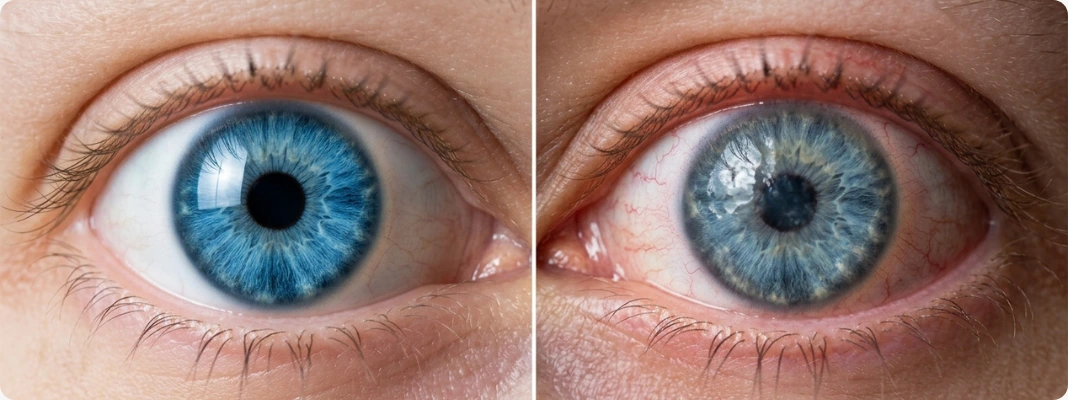
Astigmatism is when your eye’s cornea or lens is shaped irregularly, causing light to scatter and blur your vision. Instead of focusing light on a single point on the retina, it spreads the light unevenly, leading to distorted or blurry sight. It’s like trying to focus a camera with a slightly warped lens. Most people with astigmatism are born with it, but it can also develop later in life. Luckily, it’s easily corrected with glasses, contact lenses, or surgery. If toric lenses are recommended, you can also compare affordable contacts for astigmatism that fit your prescribed parameters.
7 Facts About Astigmatism
1. Astigmatism is the imperfection of the curvature of the cornea.

Under normal circumstances, the cornea is shaped like a dome. Think of the cornea like a ball or globe, with perfectly symmetrical curves on all sides. With astigmatism, the cornea has asymmetrical curves, which leads to blurry vision from all distances.
2. There are two types of astigmatism.
The two types of astigmatism are:
- Corneal astigmatism – Corneal astigmatism means the cornea has an asymmetrical curvature. It is the more common type of astigmatism.
- Lenticular astigmatism – Lenticular astigmatism means it is the lens that has an asymmetrical curvature. It is less common than corneal astigmatism.
3. Astigmatism has varying degrees of severity.
The different levels of severity for astigmatism are measured in diopters, and they are:
- Mild astigmatism (less than 1.00 diopter) – Mild astigmatism is considered normal, and individuals who have it often don’t need corrective lenses or surgery to see clearly.
- Moderate astigmatism (1.00 to 2.00 diopters) – The symptoms of moderate astigmatism are already noticeable. Individuals who have moderate astigmatism may be able to function without corrective lenses, but eye care professionals (ECPs) will often recommend the use of corrective lenses.
- Severe astigmatism (2.00 to 3.00 diopters) – Severe astigmatism causes serious symptoms like headaches and eye strain. Individuals who have severe astigmatism will find it difficult to function without wearing corrective lenses.
- Extreme astigmatism (greater than 3.00 diopters) – Individuals with extreme astigmatism are unable to see clearly at all. As such, extreme astigmatism requires treatment in the form of corrective lenses or LASIK surgery.
Astigmatism ranges from mild to extreme, and the appropriate correction depends on your prescription and eye care professional’s recommendation. If toric lenses are prescribed, comparing contact brands for astigmatism can help you review options available across different prescription ranges and replacement schedules.
4. Astigmatism has a variety of symptoms that can make it difficult to diagnose
Astigmatism is a common refractive error, and its main symptom is blurred vision. However, astigmatism has several other symptoms which can include:
- double vision
- depth perception problems
- night vision problems
- excessive squinting
- headaches
- eye strain
Mild astigmatism can be easy to miss. Because the vision is only very slightly blurred, it doesn’t have much of an effect on the individual. Meanwhile, doctors can mistake headaches and eye strain as symptoms of other illnesses, so they don’t refer the patient to an eye care professional. As such, it is possible for individuals to have astigmatism and not even know it, especially if it’s only mild astigmatism.
5. There are several ways to diagnose astigmatism.
There are a few different ways to diagnose astigmatism and determine its severity:
- Visual acuity test
The ECP will ask you to read letters on a standard eye chart (the Snellen chart) from 20 feet away to determine your visual acuity, which is denoted in fractions (normal is 20/20 vision).
The numerator (top value) is the standard distance of the test, which is 20 feet. The denominator (bottom value) is the smallest size of letters you were able to read. If you have 20/40 vision, that means you need to be 20 feet away to read what patients with normal vision were able to read from 40 feet away.
- Refraction test
The ECP will place an instrument called a phoropter in front of your eyes. The phoropter contains a series of lenses that measure how the eyes focus light. The prescription values identified during refraction help determine the optical correction needed in vision correcting contacts if contact lenses are prescribed.
- Keratometry
The ECP will measure the curvature of the anterior (front) surface of your cornea by using an instrument known as a keratometer or ophthalmometer. The keratometer focuses a circle of light onto the cornea and measures its reflection to determine the exact curvature of your cornea. ECPs also use keratometers to determine the proper fit for contact lenses.
Shop Better Affordable High Quality Toric Contact Lens at Lens.com
6. There are several treatment options available for individuals with astigmatism.
Depending on how severe your astigmatism is, you can choose from the following treatment options:
Eyeglasses – Eyeglasses are ideal if you have mild to moderate astigmatism. Eyeglasses for astigmatism have curved lenses to counter the effect of astigmatism.
Contact lenses – Contact lenses for astigmatism are also a great treatment option.
For moderate astigmatism: Your ECP may prescribe you soft contact lenses that are specially designed for astigmatism, called toric contact lenses. Unlike regular contact lenses, contact lenses for astigmatism toric have different powers across different meridians of the lens.
If you’re looking for a well-known and widely trusted brand, toric lenses like Acuvue Oasys for Astigmatism can be a choice for you. Many shoppers look to buy Dailies AquaComfort Plus Toric online since they’re comfortable, breathable and can give consistent performance.
You can also find cheaper options like Acuvue Oasys for Astigmatism to get the best value without compromising quality.
For severe astigmatism: Your ECP may prescribe you rigid gas-permeable (RGP) contact lenses. Some specialized RGP options are available as custom contact lenses with specific prescription and fit parameters.
Refractive surgery – Commonly known as LASIK or laser eye surgery, refractive surgery permanently changes the shape of your cornea to correct astigmatism. This treatment option is advisable if you have severe to extreme astigmatism, but anyone with astigmatism can choose to get refractive surgery.
7. There is a genetic component to astigmatism.
While the exact cause of astigmatism remains unclear, experts agree that astigmatism is linked to genetics. The mismatched curvature of the cornea is a genetic trait like your eye color, hair color, and skin color. Astigmatism is a trait that can be passed down from generation to generation.
Get the Right Contact Lens for Astigmatism
Our goal is to educate people about the nature of astigmatism, its effects on daily function, how it’s diagnosed, and the treatment options available. If you have some degree of astigmatism, you may want to consult with your ECP about wearing toric contact lenses. We have a wide range of toric contact lenses available at Lens.com.
Summary