- On Earth, your eyes can only see about 2.9 miles.
- Look up, and you can see millions of light-years away, theoretically even as far as the edge of the observable universe.
Sounds crazy, right? Let’s look at what makes it possible.
Picture 16 soccer fields lined up end to end. Together, they would stretch for approximately one mile (1.6 kilometers). Now imagine being able to recognize someone’s face from one end of that distance to the other.
In 1972, a German student named Veronica Seider reportedly demonstrated this remarkable ability. According to Guinness World Records, researchers at the University of Stuttgart found that Seider had visual acuity approximately 20 times better than average, allowing her to identify people from more than a mile away.
Imagine standing more than a mile from someone and still being able to tell who they are. That sounds like an extraordinary answer to the question, “How far can the human eye see?”
Except it isn’t.
A person with completely ordinary eyesight can look into the night sky and see something millions of light-years away. And in one exceptional case, an astronomical explosion approximately 7.5 billion light-years away became bright enough to be visible to the naked eye.
So what does having exceptionally sharp eyesight actually change? And if Veronica Seider could identify a person more than a mile away, how can the rest of us see a galaxy from another part of the universe?
The answer starts with what we mean by “see.”
Visual Acuity vs. Visual Detection: What’s the Difference?
Suppose a friend is walking away from you.
At first, you can see their eyes, nose, mouth, and clothes. As they get farther away, those details become harder to distinguish. Eventually, you might still recognize the person without being able to make out their face. Farther still, you might see only a human-shaped figure.

At every stage, you can technically still see the person. What changes is how much detail you can resolve.
This is where visual acuity comes in. Visual acuity describes your ability to distinguish fine details. With 20/20 vision, details separated by roughly one arcminute can normally be resolved under suitable conditions. One arcminute is only 1/60 of one degree.
This distinction explains part of what made Seider’s reported eyesight so unusual. Her advantage was not that light somehow traveled farther to her eyes. She was reportedly able to distinguish details at distances where those same details would blur together for most people.
But this gives us another question.
If ordinary human eyesight can detect objects at enormous distances, what stops us from simply looking across an entire country?
How The Earth’s Curvature Limits Our Vision
Stand on a beach and stare toward an empty ocean. Assuming your eyes are about 1.7 meters above sea level, the geometric horizon is only about 4.7 kilometers, or 2.9 miles, away.
That limit has very little to do with visual acuity.
The problem is that Earth is round.
As the planet curves away beneath your line of sight, the surface eventually blocks whatever lies beyond it. A perfectly visible object could be sitting just past your horizon and still be hidden from view.
This creates a strange situation. On the ground, the answer to “how far can you see?” can be only a few miles, even though the same pair of eyes can detect stars many light-years away.
So there is an easy way to see farther across Earth.
Go up.
The Relationship Between Elevation and Viewing Distance
Earth’s radius is about 6,371 kilometers, so even relatively small changes in your height can noticeably extend the horizon.
From about 100 meters above sea level, the geometric horizon is roughly 36 kilometers, or 22 miles, away. Reach an altitude of 1,000 meters, and it is around 113 kilometers, or 70 miles, away.
Your eyesight has not improved. You have simply climbed high enough to see over more of Earth’s curvature.
This is why the horizon appears farther away from a mountain, skyscraper, or airplane than it does from a beach.
But there is another trick.
You are not the only thing that can be tall.
How Object Height Affects Long-Distance Visibility
Imagine that a huge mountain lies beyond your normal horizon.
You might not be able to see the ground at the mountain’s base because Earth curves between you and it. Yet the summit rises high enough above the surface to remain visible.

This is why very tall objects can sometimes be seen from much farther away than the distance to your own horizon. Your viewing height matters, but so does the height of whatever you are looking at.
The same idea explains the classic observation of a ship disappearing over the horizon. As it moves farther away, the lower part of the vessel is hidden first while higher structures can remain visible for longer.
Of course, geometry is only part of the problem.
Put enough air between you and an object, and the atmosphere begins interfering too.
Atmospheric Conditions and Their Effects on Human Vision
Think about a mountain range on a clear morning. Its edges can look sharp and dark against the sky. On a hazy afternoon, the same mountains might become pale silhouettes or disappear almost completely.
The mountains have not moved, and their apparent size has barely changed.
What changed is the light traveling between them and your eyes.

Particles, water droplets, smoke, dust, and other material in the atmosphere scatter light and reduce contrast. At long distances, an object can become difficult to distinguish from its background even when it is theoretically large enough to see.
Atmospheric refraction can complicate things further. Because air density changes with altitude and temperature, light traveling through the atmosphere can bend slightly. This means the apparent position of a distant object or horizon does not always match a simple geometric calculation exactly.
So far, the things limiting our view have included acuity, Earth’s curvature, object height, contrast, and the atmosphere.
Then we look up at night, and the rules seem to change.
The Science of Light: Why We Can See Distant Stars
A person standing 10 miles away is much closer to you than any star.
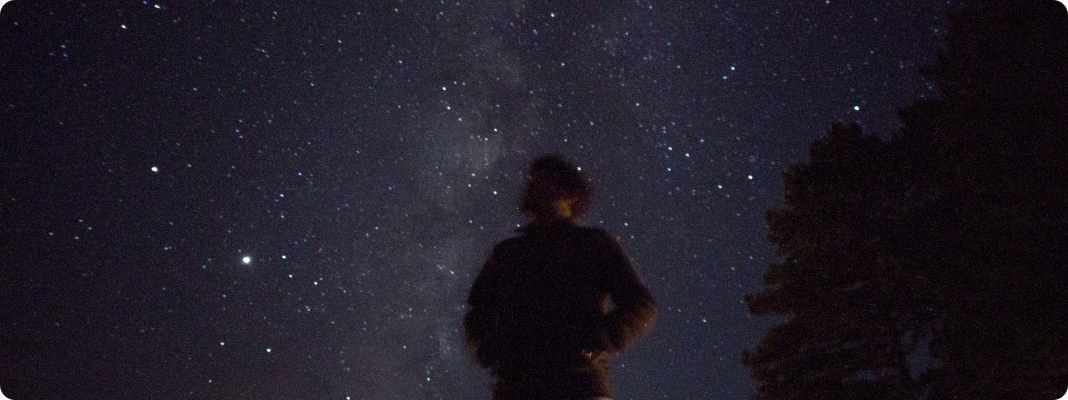
Yet you cannot normally see that person, while stars are obvious on a clear night.
The reason is that stars produce enormous amounts of light.
Distance makes an object appear smaller and dimmer, but physical size is not the only thing that determines whether your eye can detect it. Brightness and contrast matter too.
Take Sirius, the brightest star in the night sky. It is around 8.6 light-years from Earth. Even from that enormous distance, enough of its light reaches us for the star to stand out against a dark sky.
A star also demonstrates something strange about seeing distant objects. When you look at something far enough away, you are not only looking across space.
You are looking backward in time.
Looking Farther Means Looking Further Into the Past
Light does not travel instantaneously. It moves through a vacuum at about 299,792 kilometers per second, which is fast enough to circle Earth more than seven times in a second.
But space is enormous.
A light-year is the distance light travels during one year. When astronomers say a star is 100 light-years away, that means the light reaching your eyes tonight began its trip about 100 years ago.
That principle becomes much stranger when we leave the Milky Way.
Under a sufficiently dark sky, you can see the Andromeda Galaxy without a telescope. NASA places it about 2.5 million light-years from Earth and describes it as visible to the unaided eye from a dark-sky location.
When you look at Andromeda, the photons entering your eyes began traveling toward us roughly 2.5 million years ago.
The galaxy looks like a faint smudge.
But that smudge is an entire galaxy.
And it isn’t even necessarily the farthest galaxy a person can see.
The Limits of Naked-Eye Astronomy
The Triangulum Galaxy, also called M33, lies about 3 million light-years from Earth. NASA notes that under exceptionally clear and dark skies, keen-eyed observers can see it without optical aid.

Now our original question seems to have a spectacular answer.
How far can the human eye see?
About 3 million light-years.
Except that still isn’t the answer.
Because something happened in 2008 that made Andromeda and Triangulum look practically nearby.
On March 19, 2008, NASA’s Swift satellite detected a gamma-ray burst known as GRB 080319B.
Gamma-ray bursts are extraordinarily energetic cosmic explosions. This particular event produced an optical flash that reached an apparent magnitude of about 5.8 and was bright enough to be visible to the unaided human eye for roughly 30 seconds under suitable conditions.
Its distance?
About 7.5 billion light-years.

Guinness World Records recognizes GRB 080319B as the farthest object ever visible to the naked eye.
That is not 7.5 billion miles.
It is 7.5 billion light-years.
The light from that event had already been traveling through space for billions of years before Earth existed in anything resembling its current form.
And yet, for a brief period in 2008, enough visible light from that unimaginably distant event reached our part of the universe that human eyes could have detected it.
This reveals something important about the limits of vision.
Dark Adaptation and Our Seemingly Infinite-Reaching Eyesight
Imagine two lights.
One is a tiny flashlight extremely close to you, but its beam is so faint that you cannot see it. The other is an enormously bright star trillions of kilometers away, yet its light is obvious.
Which one is “within the range” of your eyesight?
Distance by itself cannot answer that question.
Your retina responds to photons reaching it. It does not know whether those photons traveled one meter, one mile, or billions of light-years before arriving.
As long as enough light reaches your eye and produces a detectable signal against the background, something can potentially be visible.
And the human eye is surprisingly good at working with very little light.
Enter a dark room after standing in bright sunlight and you may initially see almost nothing. Stay there for a while, though, and objects slowly begin appearing.
This happens because your visual system adapts to darkness.
Rod photoreceptors in the retina are extremely sensitive under dim conditions, allowing us to detect much weaker light than we can immediately after exposure to a bright environment.
Researchers have pushed this sensitivity to an extreme. In a 2016 experiment involving more than 30,000 trials, researchers found that dark-adapted participants could detect the presence of single photons at rates slightly better than chance.
A photon is the smallest discrete packet of light.
So the organ you use to read this sentence is sensitive enough, under carefully controlled conditions, to respond to light at almost the smallest scale nature allows.
That brings us back to Veronica Seider.
What Made Veronica Seider’s Eyes So Remarkable?
At this point, it is worth returning to Veronica Seider and adding an important qualification to her story.
Guinness World Records reports that, in 1972, the University of Stuttgart described Seider as having visual acuity about 20 times better than average and being able to identify people from more than a mile away. The claim has been repeated widely ever since. However, detailed scientific records explaining how her eyesight was tested are not readily available, so it is better to treat the story as a reported record rather than a precisely documented measure of the limits of human vision.
Even if we take the Guinness account at face value, though, Seider’s reported ability illustrates an important distinction. Recognizing a person a mile away is not the same visual task as noticing that something is there.
Human vision operates at several levels. You might detect a tiny object without knowing what it is, recognize its general shape without seeing fine details, or resolve details well enough to identify it. Visual acuity mainly concerns that last ability: how closely spaced two details can be before they blur together.
So exceptionally sharp eyesight does not give someone a fixed viewing range that extends 20 times farther than everyone else’s. It means that, under suitable conditions, they can distinguish finer details at a given distance.
That is why a person with ordinary eyesight and a person with unusually high visual acuity can both look up and see the same distant star or galaxy. The difference is not necessarily how far the light traveled before reaching their eyes. It is how much detail their visual systems can extract once that light gets there.
And that brings us back to the larger point of this article: the maximum distance of human vision is not determined by eyesight alone.
What Is the Maximum Distance the Human Eye Can See?
There is no single maximum distance.
On Earth, curvature, atmosphere, object size, and visual acuity can limit how far we see. In space, though, distance itself is not the deciding factor. If visible light from an extremely distant source reaches your retina strongly enough to be detected, your eye can respond to it regardless of how far that light has traveled.
That is why we can see Andromeda from about 2.5 million light-years away, and why GRB 080319B was briefly visible from about 7.5 billion light-years away.
Theoretically, even a detectable visible photon arriving from near the edge of the observable universe could be seen. The real limit is not distance itself, but whether enough visible light reaches your eyes.
References
- Broadband Observations of the Naked-Eye γ-Ray Burst GRB 080319B. Nature. https://www.nature.com/articles/nature07270 Published September 11, 2008. Accessed September 24, 2026.
- Definitions of SI Base Units. National Institute of Standards and Technology. https://www.nist.gov/si-redefinition/definitions-si-base-units Published May 29, 2019. Updated August 13, 2025. Accessed September 24, 2026.
- Direct Detection of a Single Photon by Humans. Nature Communications. https://www.nature.com/articles/ncomms12172 Published July 19, 2016. Accessed September 24, 2026.
- Earth Fact Sheet. NASA Goddard Space Flight Center, National Space Science Data Center. https://nssdc.gsfc.nasa.gov/planetary/factsheet/earthfact.html Published n.d. Updated November 15, 2024. Accessed September 24, 2026.
- Farthest Object Visible to the Naked Eye Ever. Guinness World Records. https://www.guinnessworldrecords.com/world-records/101433-farthest-object-visible-to-the-naked-eye-ever Published n.d. Accessed September 24, 2026.
- Hubble Pinpoints Record-Breaking Explosion. NASA Science. https://science.nasa.gov/missions/hubble/hubble-pinpoints-record-breaking-explosion/ Published April 10, 2008. Accessed September 24, 2026.
- Light Adaptation and Dark Adaptation of Human Rod Photoreceptors Measured From the A-Wave of the Electroretinogram. The Journal of Physiology / PubMed. https://pubmed.ncbi.nlm.nih.gov/10381594/ Published July 15, 1999. Accessed September 24, 2026.
- Measuring a White Dwarf Star. NASA Science. https://science.nasa.gov/missions/hubble/measuring-a-white-dwarf-star/ Published November 2, 2011. Accessed September 24, 2026.
- Messier 31 (The Andromeda Galaxy). NASA Science. https://science.nasa.gov/mission/hubble/science/explore-the-night-sky/hubble-messier-catalog/messier-31/ Published n.d. Accessed September 24, 2026.
- Messier 33 (The Triangulum Galaxy). NASA Science. https://science.nasa.gov/mission/hubble/science/explore-the-night-sky/hubble-messier-catalog/messier-33/ Published n.d. Accessed September 24, 2026.
- Smallest Visible Object. Guinness World Records. https://www.guinnessworldrecords.com/world-records/smallest-visible-object Published n.d. Accessed September 24, 2026.
- Solar Calculator Glossary. NOAA Global Monitoring Laboratory. https://gml.noaa.gov/grad/solcalc/glossary.html Published n.d. Accessed September 24, 2026.
- Visibility. NOAA Center for Satellite Applications and Research. https://www.star.nesdis.noaa.gov/portfolio/detail_Visibility.php Published n.d. Accessed September 24, 2026.
- Visual Acuity. Webvision, NCBI Bookshelf. https://www.ncbi.nlm.nih.gov/books/NBK11509/ Published May 1, 2005. Updated June 5, 2007. Accessed September 24, 2026.
- What Is a Light-Year? NASA Science. https://science.nasa.gov/exoplanets/what-is-a-light-year/ Published n.d. Accessed September 24, 2026.