

Table of Contents
“Plastic” usually means “recyclable” in people’s minds. With contact lenses, that assumption falls apart fast.
The answer is – you can’t recycle contact lenses in normal curbside bins, but there are real recycling programs and better ways to deal with the waste. The trick is knowing what’s realistic and what’s greenwashing.
Can Contact Lenses Be Recycled at All?
Yes, but only under pretty specific conditions.
Most curbside systems are not built to handle tiny, flexible pieces of plastic. Contact lenses slip through sorting equipment, contaminate other materials, and end up as trash anyway.
Recycling becomes possible when:
- You use a special take-back scheme, like Bausch + Lomb’s ONE by ONE program in the US or Every Contact Counts in Canada, which ship lenses and small packaging to TerraCycle for processing.
- You buy a paid TerraCycle “Zero Waste Box” for contact lenses and packaging and send it back when full.
Outside of those channels, “recycling contact lenses” is mostly wishful thinking.
What Exactly Counts as “Contact Lens Waste”?
When you open a box of lenses, you create several different waste streams:
- The soft lenses themselves
- Individual blister packs that hold each lens
- Foil lids that seal the blisters
- The cardboard retail box and any paper leaflets
- Lens cases and solution bottles if you wear reusables
Each behaves differently in the waste system, which is why advice has to separate “lenses” from “packaging” instead of lumping everything together.
Why the Recycling Bin Is the Wrong Place for Used Lenses
Soft lenses are made from hydrogels or silicone hydrogels, medical-grade plastics designed to be stable in your eye and in solution. They do not biodegrade into something harmless; they fragment into smaller plastic pieces.
Two issues for recyclers:
First, size. Lenses are tiny and flexible. In sorting plants, small items fall through screens, ride along on paper, or get trapped in machinery.
Second, contamination. Used lenses are wet, handled, and stuck to other material. From a recycler’s point of view, they look like low-value contamination that fouls up clean bales of plastic.
The result is even if your local program accepts certain plastics by resin code, lenses themselves usually get screened out or dumped as residue. Curbside recycling is simply not designed for them.
Please Stop Flushing Contact Lenses
Flushing is where the environmental damage really spikes.
Arizona State University researchers ran a nationwide survey and lab tests and found that 15–20% of US contact lens wearers flush lenses down sinks or toilets. With roughly 45 million wearers, that works out to 1.8–3.36 billion lenses flushed each year. In mass terms, that is around 20–23 metric tons of plastic entering wastewater annually in the US alone.
In treatment plants, those lenses don’t vanish. They break into microplastic fragments that lodge in sewage sludge.
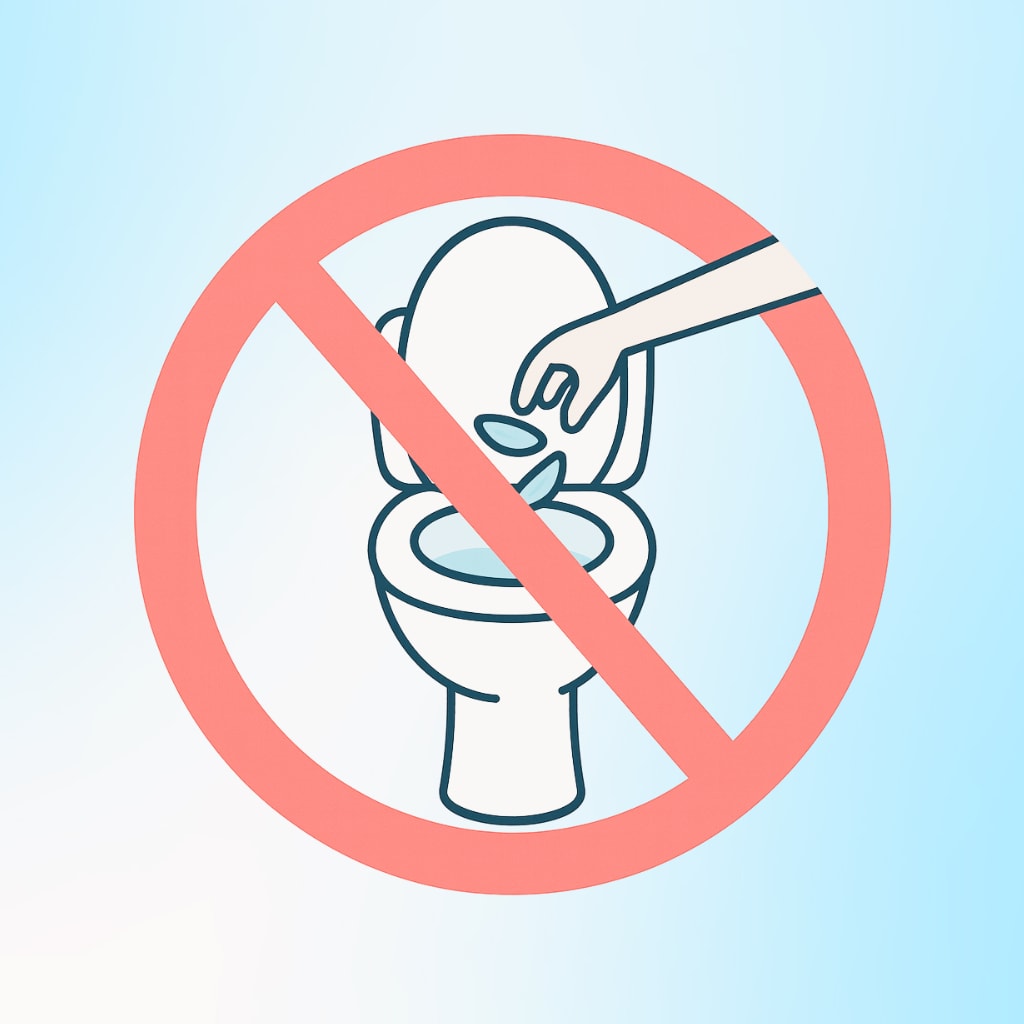
When that sludge is spread on farmland, the fragments move into soil and eventually into waterways (ASU News).
If you change nothing else, change this:
Used lenses either go into a proper take-back program or into the trash. Never into a sink or toilet.
Do Lenses Shed Microplastics While You Wear Them?
There is a newer twist that a lot of older recycling articles never mention.
A 2023 study in Environmental Science & Technology used high-content screening to test lenses exposed to sunlight and typical wear conditions. The team estimated that a single pair of lenses could release about 90,698 microplastic particles over a year of wearing them ten hours per day.
A 2025 review of microplastics in the ocular environment picks up the same figure and calls for deeper research into what direct exposure means for eye health.
Right now, no one has a definitive answer on long-term health impact. What we can say is that contact lenses are part of the microplastics picture even before you throw them away.
Recycling Programs That Actually Exist Right Now
This is where things move from theory to something you can actually do.
Bausch + Lomb ONE by ONE (US)
Bausch + Lomb runs the ONE by ONE Recycling Program in partnership with TerraCycle. It accepts lenses and a surprising amount of related packaging from any brand, including:
- Used lenses
- Blister packs and foil lids
- Lens cases
- Small solution bottles and caps, and single-dose vials
As of November 2025, B+L reports that the program has collected more than 690,000 pounds of used contact lens, lens care, and eye care material in the US. That equals roughly 114 million individual units.
Drop-off happens through participating eye care practices, usually via a TerraCycle box in the waiting area.
Every Contact Counts (Canada)
In Canada, Bausch + Lomb runs Every Contact Counts, a sister program:
Since its 2019 launch, Canadian clinics and consumers have sent in over 70,000 pounds of used lenses, blister packs, and foils, representing about 5.2 million units.
Again, any brand of soft lens is welcome. Collection points are optometry practices and optical retailers.
ACUVUE, TerraCycle and Regional Schemes
In the UK and parts of Europe, ACUVUE and TerraCycle run contact lens recycling through participating opticians. Wearers collect used lenses, blister packs and lids at home and drop them into marked boxes in practice reception areas.
Other regions (for example Australia) have their own optometry-based schemes, usually focused on lenses and blister packs, with TerraCycle or local recyclers handling the material.
TerraCycle Zero Waste Box for Lenses
For households with no clinic nearby and a strong desire to recycle, TerraCycle sells a Contact Lenses and Packaging Zero Waste Box. You buy the box, fill it with lenses, blister packs, cases, and similar waste, then ship it back for processing.
It works, but the price means it is practical for only a minority of wearers or for workplaces that collect for multiple people.
Shop Quality Affordable Contacts at Lens.com
What You Can Put in Normal Household Recycling
This is where most people can make quick progress with almost no effort.
The outer cardboard packaging for your lenses and any paper instructions behave like any other cardboard and paper. Flatten them, keep them clean and dry, and they usually belong in your curbside recycling stream.
Large solution bottles and caps are sometimes accepted in plastics streams, as long as they meet your program’s rules on plastic type and minimum size. Many cities publish guides that list which bottle sizes and resin codes they actually recover.
The tiny stuff is the problem. Individual blister cups, foil lids, loose lenses, and the smallest bits of plastic usually fall through sorting equipment and end up as trash or contamination, even if the resin code matches a listed plastic.
So if you don’t have access to a specialist program, the realistic pattern looks like this:
- Recycle cardboard boxes and paper with your usual paper and card.
- Recycle only those larger bottles and items your local program clearly accepts.
- Put lenses, blister scraps and any tiny pieces in regular trash, never in drains.
Dailies vs Monthlies - What Does This Mean for Waste?
Daily disposables are convenient and hygienic for many wearers, though they do come with more individual packaging.
Based on recent industry analysis that combines several peer-reviewed sources, full-time daily disposable wear generates noticeably more packaging waste per year than full-time reusable lens wear. Estimates put the increase around a quarter more by weight.
That doesn’t mean every wearer should switch to monthlies. Some eyes simply do better with daily lenses. Some people are more compliant with hygiene when they throw away a lens every night instead of maintaining a cleaning routine.
The practical way to use this information:
- If you already wear reusables successfully, you are likely producing less lens-related waste.
- If you rely on dailies for comfort or eye health, focus on correct disposal, cardboard recycling, and clinic take-back schemes rather than piling on guilt.
What Big Brands Are Doing About Plastic and Waste
Recycling programs are only part of the picture. Manufacturers are also changing how they handle plastic upstream.
Bausch + Lomb’s ONE by ONE and Every Contact Counts programs have now kept over 690,000 pounds of eye-care waste out of US landfills and over 70,000 pounds out of Canadian landfills.
CooperVision’s taken a different route in parallel. Through its net plastic neutral initiative with Plastic Bank, it funds collection and recycling of ocean-bound plastic equivalent to the plastic used in participating lenses and packaging. As of April 2025, that collaboration has collected about 10.26 million kg of plastic, calculated as the equivalent of roughly 513 million plastic bottles kept out of the ocean.
On top of that, CooperVision has shifted some blister packaging to ISCC PLUS-certified renewable polypropylene, which cuts cradle-to-gate CO₂ emissions compared with fossil-based PP.
Other manufacturers, like Johnson & Johnson Vision (ACUVUE) and Alcon, publish goals around reducing factory waste, increasing recycling of production scrap, and cutting energy and water use.
Worth stressing that plastic-neutral schemes and greener packaging do not change what you should do with a used lens today, but they signal that manufacturers are responding to pressure on plastic and waste.
A Decision Guide for Your Used Lenses
Step 1: No flushing, under any circumstance
That rule applies everywhere, regardless of where you live. The ASU data and follow-up coverage make it clear that flushing pushes tonnes of plastic into wastewater every year.
Used lenses either go into a collection pot for recycling or straight into the trash.
Step 2: Check for a clinic-based program near you
Before your next Lens.com reorder, ask your eye care provider:
- Do you participate in Bausch + Lomb’s ONE by ONE program or a similar contact lens recycling scheme?
- If you are in Canada, do you participate in Every Contact Counts?
You can also search for “contact lens recycling TerraCycle” along with your city name to see whether nearby clinics are listed as public drop-off locations.
If you find one, set a small jar or pot near your bathroom sink. Rinse used lenses and blister packs, drop them in, and take the jar to the clinic once it fills up.
Step 3: No program near you?
Then the realistic approach is simple:
Use normal trash for lenses and tiny plastic scraps. Recycle only what your local rules support, usually cardboard boxes and larger plastic bottles. If you are highly motivated and can justify the cost, consider a TerraCycle Zero Waste Box shared among family, colleagues, or a local practice.
How Lens.com Customers Can Buy Contacts With Recycling in Mind
Lens.com does not run its own take-back scheme, and it does not control how cities handle recycling. What we can do is help you think through your choices.
When you plan your next order, it helps to:
Talk with your eye care professional about whether your current lens type still makes sense for your eyes and lifestyle. For some people, a reusable option with a good care routine can reduce packaging waste without hurting comfort or safety. For others, dailies remain the better option and the focus needs to stay on correct disposal and local recycling schemes.
Combine orders where it makes sense, especially for households with multiple wearers, so fewer shipping boxes move around.
Make cardboard and paper recycling automatic. Flatten every box that arrives, toss it straight into your paper and card stream, and treat that as part of the contact lens routine.
Most of all, treat lenses like what they are: medical devices made from stubborn plastic, not tiny items that “don’t count” because they look insignificant.