
Table of Contents
Ever find yourself wondering if low vision means the same thing as blindness? You are not alone.
Since February low vision awareness month is a big moment for education, this guide breaks down what is low vision, how it compares to blindness and legal blindness, and why the right support can make everyday life easier.
Low Vision Awareness Month in February: Why It Matters
Low Vision Awareness Month matters because it puts a spotlight on something many people live with quietly: vision impairment that makes daily tasks harder, even when someone already has glasses, contacts, treatment, or surgery.
Quick Facts To Know
- February is Low Vision Awareness Month, and the goal is to raise awareness of vision rehabilitation and practical support.
- Globally, at least 2.2 billion people have near or distance vision impairment, and at least 1 billion cases could have been prevented or are still unaddressed.
- The encouraging part: vision rehabilitation services can help people make the most of the sight they have and stay independent.
What Low Vision Awareness Month Can Do For You
Use this month as a simple reset, especially if you have been brushing off changes like struggling with screens, glare, or faces.
A good starting point is knowing your options:
- Get a comprehensive eye exam if your vision has changed or daily tasks feel harder.
- Ask about vision rehabilitation if you are told your vision loss cannot be fully corrected with standard treatment.
- Learn the terms so you can advocate for yourself, especially the difference between low vision, legal blindness, and total blindness.
If you want a quick primer before we get into definitions, read our guide on low vision explained: causes, symptoms, and solutions.
What Is Low Vision and How Is It Different From Blindness and Legal Blindness
When people ask what is low vision, they are usually trying to figure out one thing: is this something a stronger prescription can fix, or is it a bigger vision change?
Here is the simplest way to think about it.
Low Vision
Low vision means your sight makes everyday tasks harder, and it cannot be fully fixed with standard options like glasses, contact lenses, medicine, or surgery.
Blindness
In everyday conversation, people use “blindness” to describe very limited vision. Medically and legally, the meaning depends on the definition being used, and many people who are “legally blind” still have some usable vision.
Legal Blindness
Legal blindness definition in the United States is used for eligibility, not as a description of what someone can or cannot do day to day.
Most commonly, it means either:
- Best corrected vision of 20/200 or worse in the better seeing eye, or
- A visual field of 20 degrees or less in the better seeing eye
A Common Mix Up To Avoid
If your vision gets noticeably better with an updated prescription or treatment, that is typically not “low vision” in the clinical sense. Low vision is the vision loss that remains even when you are wearing the right correction.
Want a clearer way to tell correctable blur from true vision impairment? Read this guide comparing refractive error and visual impairment.
What Is Considered Low Vision: Visual Acuity, Visual Field, and Real Life Examples
You will often hear low vision described with two things: visual acuity and visual field loss. Both matter, because you can have a “decent” letter chart score and still struggle in real life, or the opposite.
Visual Acuity: How Sharp Your Central Vision Is
This is the classic eye chart number, like 20/20.
A simple way to understand it: if you have 20/70 vision, what you see clearly at 20 feet is what someone with typical vision can see clearly at 70 feet.
Visual Field: How Much You Can See Without Moving Your Eyes
Your visual field includes what you can notice to the sides. Losing peripheral vision can create a tunnel vision effect, even if your central vision is still fairly sharp.
What Qualifies As Low Vision
There is no single global cutoff used everywhere, but many clinicians consider low vision when vision loss is strong enough to limit daily activities and does not improve with standard correction. Some references use 20/70 as a marker for moderate vision impairment and 20/200 as severe, and a visual field of 20 degrees or less is also commonly used in definitions.
Real Life Examples That Often Show Up With Low Vision
Central Vision Loss Examples
- Reading feels slow even with bright light
- Faces look blurry unless you are very close
- Details in the center of what you are looking at seem missing or faded
Peripheral Vision Loss Issues
- Bumping into door frames or objects on your side
- Feeling unsure in crowded places
- Missing steps or curbs unless you look directly at them
Low Light and Contrast Issues
- Trouble seeing at dusk or in dim restaurants
- Glare feels intense and lingering
- Difficulty telling similar colors apart
Want an easy refresher on what the 20/ number format actually means in real life? Read this quick guide to 20/40 vision and how to interpret visual acuity numbers.
Add Your Low Vision Symptoms: Signs People Notice First Text Here
Most low vision symptoms show up as “I can still see, but I cannot see well enough to do normal things comfortably.” The National Eye Institute lists common day to day trouble areas like reading, driving, recognizing faces, telling colors apart, and seeing screens clearly.

What People Usually Notice First
- Reading feels slower or more tiring, even with good light
- Faces look unclear unless you are very close
- Trouble seeing at night or in low light
- Glare feels harsh and hard to recover from
- You miss things off to the side, or bump into objects more often than usual
Quick Self Check
If any of these are happening, it can help to jot down what you notice before your next eye visit.
- When did it start
- Is it in one eye or both
- Is it worse in dim light or bright light
- Does it affect reading, driving, screens, or faces the most
- Does it come and go, or is it steady
A Simple Symptom Guide
| What You Notice | What It Can Feel Like | A Practical Next Step |
|---|---|---|
| Central vision loss | The center looks blurry, faded, or missing | Schedule an eye exam and mention central blur or blind spot |
| Peripheral vision loss | Side vision feels reduced, like tunnel vision | Ask about a visual field test, especially if you feel less aware of your surroundings |
| Night vision problems | Dim rooms feel unusable | Note when it happens and tell your eye doctor |
| Glare and contrast trouble | Headlights, sun, or bright screens feel overwhelming | Mention glare sensitivity and contrast issues during your exam |
| Trouble with daily tasks | Reading, driving, screens, faces, colors feel harder | Ask whether vision rehabilitation and low vision aids could help |
Wondering why your vision feels different lately? Read common reasons eyesight can change over time and when to book an eye exam.
What Causes Low Vision? The Most Common Conditions
Low vision causes are usually linked to eye diseases that affect the retina, the optic nerve, or the clarity of the lens inside the eye. The National Eye Institute lists the most common causes as age related macular degeneration, cataracts, diabetic retinopathy, and glaucoma.
The Most Common Causes, In Simple Terms
- Macular degeneration often affects central vision, so reading and faces can become harder
- Cataracts can make vision look cloudy or hazy, and glare can feel worse
- Diabetic retinopathy can damage the retina over time and lead to blurred or spotty vision
- Glaucoma can damage the optic nerve and often affects peripheral vision first
What Each Condition Can Change
| Condition | What It Can Affect Most | A Common Way It Shows Up |
|---|---|---|
| Age related macular degeneration | Central vision loss | Blurry or missing spot in the center of what you look at |
| Glaucoma | Peripheral vision loss and sometimes night vision | Side vision narrows over time, you may not notice at first |
| Diabetic retinopathy | Retina and central clarity | Blurry vision, patches, or fluctuating clarity |
| Cataracts | Overall clarity and glare resistance | Hazy vision, glare sensitivity, trouble in low light |
Other Causes Worth Knowing About
The National Eye Institute also notes that eye and brain injuries and certain genetic disorders can cause low vision.
If you want a simple reminder of why routine exams matter, read how regular eye exams can help catch glaucoma, cataracts, diabetic retinopathy, and macular degeneration early.
Can Low Vision Be Corrected? What Helps and What Usually Does Not
Here is the honest answer: low vision is usually permanent, meaning glasses, contacts, medicine, or surgery cannot fully “cure” it. That said, some treatments can improve your vision, make daily tasks easier, or help protect the vision you still have.
What Helps Most Often
- Treating the underlying eye condition when possible, such as managing cataracts, glaucoma, or diabetic eye disease.
- Making everyday changes that improve visibility, like brighter lighting, reducing glare, and increasing text size and contrast on devices.
- Getting vision rehabilitation, which focuses on skills, tools, and support to help you stay independent.
What Usually Does Not Help On Its Own
If you are already using your best prescription and vision is still limiting everyday life, simply “stronger glasses” may not solve the problem. That is when it is worth asking your eye doctor about low vision evaluation and rehabilitation options.
Quick Guide: What Can Help And What To Expect
| Option | When It Can Help | What To Keep In Mind |
|---|---|---|
| Updated glasses or contact lens prescription | When blur is from a correctable refractive error | Low vision remains even with your best correction |
| Medical treatment or surgery | When it treats the condition causing vision loss or slows progression | It may improve function, but low vision is often still present |
| Device and home adjustments | When you need better contrast, lighting, or magnification | Small changes can make a big difference quickly |
| Vision rehabilitation | When vision loss affects daily activities | It teaches techniques and connects you with tools and support |
Curious about how doctors separate everyday prescription changes from true visual impairment? Read our guide on the difference between refractive error and visual impairment.
Low Vision Aids That Make Daily Life Easier
If low vision is affecting your routine, you do not have to just “push through.” The National Eye Institute highlights practical changes and low vision aids like brighter lighting, glare control, magnification, and device settings that boost contrast and text size.
Everyday Low Vision Aids That Are Worth Trying
- Lighting upgrades at home or work for clearer tasks like cooking and reading
- Anti glare sunglasses for comfort outdoors and in bright environments
- Magnifying devices for labels, mail, and close work
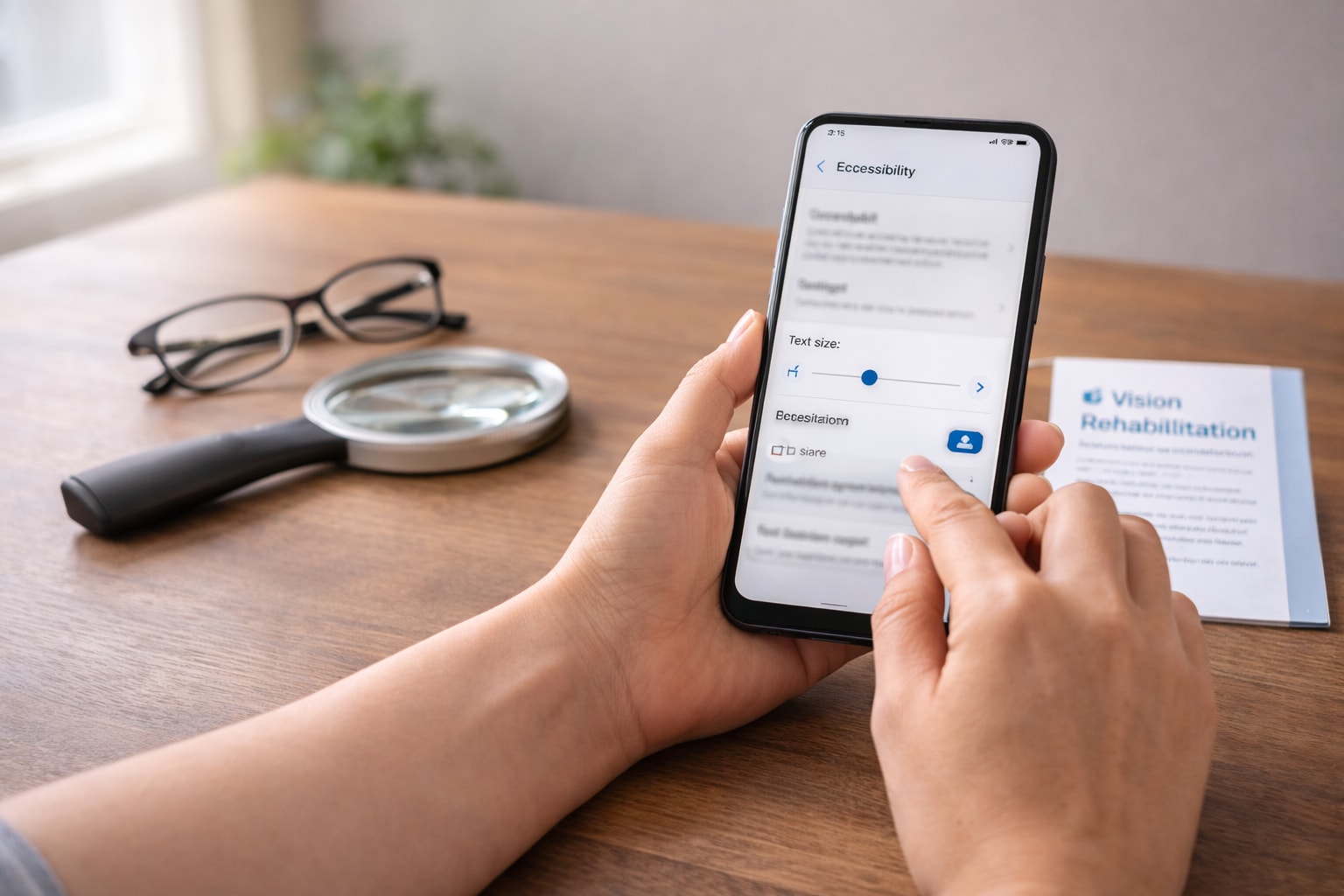
- Phone and computer accessibility settings, including larger text, higher contrast, and read aloud options
Where Vision Rehabilitation Fits In
Vision rehabilitation is not about restoring sight. It is about learning skills, using tools, and getting support so you can keep doing daily activities more independently.
The NEI lists examples such as assistive products, technology like magnifiers and screen readers, independent living skills training, and emotional support.
Quick Cheat Sheet: Match The Aid To The Problem
| If You Struggle With | What May Help | Why It Helps |
|---|---|---|
| Reading small print | Magnification and better task lighting | Makes details larger and easier to see |
| Glare outdoors or from headlights | Anti glare sunglasses and lighting adjustments | Reduces discomfort and improves contrast |
| Screens and digital text | Larger text, higher contrast, screen readers | Reduces strain and improves readability |
| Moving around safely | Home setup guidance and mobility training through rehab | Builds safer routines and confidence |
How To Get Started Without Overthinking It
- Tell your eye doctor which tasks are hardest for you, like reading, screens, glare, or walking in crowds.
- Ask directly about vision rehabilitation and what services are available in your area.
- Try one or two aids first, then build from there once you feel the difference.
Want a hopeful, practical read on how people use tools like magnifiers and special lenses to stay independent with age related vision changes? Check out this overview of low vision aids and support options for age related macular degeneration.
When to See an Eye Doctor and What to Track Before Your Visit
If you notice vision loss that feels new, worse, or simply not “normal for you,” it is worth scheduling an eye exam. Low vision is diagnosed with a comprehensive eye exam, and getting checked earlier can help clarify the cause and your next steps.
Go In Quickly If You Notice Any Red Flags
These symptoms can signal an urgent eye problem, so do not wait and see.
- Sudden vision loss or a sudden major change in vision
- A new shower of floaters, flashes of light, or a curtain like shadow in your vision
- Eye injury, especially with pain or vision changes
Severe eye pain, severe headache, nausea, or vomiting along with vision changes
Quick Guide: What To Do Based On What You Notice
| What You Notice | Why It Matters | What To Do |
|---|---|---|
| Sudden vision loss or sudden major change | Can be a medical emergency | Seek urgent medical care right away |
| Flashes, many new floaters, or a curtain like shadow | Can be a sign of retinal tear or detachment | Contact an eye doctor urgently |
| Slow, steady decline in clarity | Common with many eye conditions | Schedule a comprehensive eye exam soon |
| Trouble reading, driving, faces, glare, or night vision even with best correction | Fits common low vision symptoms | Ask about low vision evaluation and vision rehabilitation options |
What To Track Before Your Appointment
Bringing clear notes makes your visit more productive.
Write Down:
- The top 3 tasks that are hardest right now (reading, screens, night driving, faces, glare)
- When you first noticed the change and whether it is getting worse
- Whether the problem is in one eye, both eyes, or changes day to day
- Anything that triggers it, like bright sunlight, low light, screen time, or headaches
- Any history that matters: diabetes, high blood pressure, eye injury, eye surgery, or family history of eye disease
Curious about how often eye exams are recommended and what they can catch early? Read why regular eye exams matter and how often to schedule them.
Living With Low Vision: Small Changes That Add Up
If you are adjusting to low vision, the goal is not perfection. It is making daily life easier, safer, and less exhausting with a few practical shifts, plus the right low vision aids and vision rehabilitation support when you need it.
Start With These High Impact Changes
At Home
- Add bright, focused task lighting where you read, cook, and take medications
- Use contrast on purpose, like a dark cutting board for light foods or a light mat for dark objects
- Keep “always in the same place” spots for keys, phone, glasses, and medications
On Screens
- Increase text size and turn on bold text if it helps
- Use high contrast or dark mode if glare bothers you
- Try zoom and read aloud features for long reading sessions
For Glare and Comfort
- Use a hat or visor outdoors to block overhead glare
- Close blinds during peak sun hours and add softer lamps in the evening
- Ask your eye doctor what glare control options make sense for your eyes
Small Changes Cheat Sheet
| Challenge | Small Change | Why It Helps |
|---|---|---|
| Reading feels slow | Add task lighting and try magnification | Improves clarity and reduces strain |
| Visual field loss or bumping into things | Keep walkways clear and use consistent object placement | Reduces trip hazards and surprises |
| Glare feels intense | Use window control, hats, and comfort focused settings | Improves comfort and contrast |
| Screens are tiring | Increase text size and use read aloud tools | Makes digital content more accessible |
| Finding items is frustrating | Use labels, bins, and a simple home system | Saves time and lowers stress |
Want more practical ideas for low vision aids like magnification and accessibility features on devices? Read our guide on low vision support options, including tech features that make daily tasks easier.
Low Vision Is Not Always Blindness and Support Can Make Life Easier
Low vision can feel confusing at first, especially when people use words like blindness and legal blindness interchangeably. The big takeaway is that low vision is a spectrum, and many people still have usable sight while needing extra tools, strategies, or vision rehabilitation to do daily tasks more comfortably.
If you have noticed changes in reading, screens, glare, or side vision, do not brush it off. An eye exam can help explain what is happening and what options can help you stay independent.
Want to keep your routine simple if you already have an up to date prescription? You can reorder with confidence when your eye doctor has confirmed contact lenses are right for you, then shop for prescription contact lenses and restock what you need in just a few clicks.
Low Vision Awareness Month FAQs
1. What is the low vision definition in simple terms?
Low vision definition usually means vision loss that makes everyday tasks harder and is not fully corrected with standard glasses, contact lenses, medicine, or surgery. Many people with low vision still have usable sight, but they may need tools and training to do daily activities more comfortably.
2. Low vision vs blindness, what is the difference?
Low vision vs blindness is mainly about severity and how vision is described or defined. Many people who are legally blind still have some vision, while low vision can range from mild functional difficulty to very limited sight.
3. What qualifies as low vision?
What qualifies as low vision depends on how much vision loss affects daily life and whether standard correction helps enough. Clinicians may look at both visual acuity and visual field loss, plus real world challenges like reading, recognizing faces, or navigating safely.
4. Is low vision curable?
In many cases, low vision is not curable in the sense of fully restoring normal sight with a stronger prescription. Treatments can sometimes improve vision or slow progression depending on the cause, and vision rehabilitation can make a big difference in daily function.
5. What are the best low vision aids for everyday tasks?
The best low vision aids depend on what you struggle with most, like reading, glare, screens, or getting around safely. Common options include better lighting, magnifiers, glare control, and accessibility settings like larger text or read aloud features on devices.
Disclaimer: This information is for general informational purposes only and is not a substitute for professional advice, diagnosis, or treatment.
References
Low Vision. National Eye Institute (NIH). https://www.nei.nih.gov/eye-health-information/eye-conditions-and-diseases/low-vision. November 25, 2025
Low Vision Awareness Month. National Eye Institute (NIH). https://www.nei.nih.gov/about/education-and-outreach/vision-rehabilitation-resources/low-vision-awareness-month. November 25, 2025
Blindness and vision impairment. World Health Organization. https://www.who.int/news-room/fact-sheets/detail/blindness-and-visual-impairment. August 10, 2023
Low Vision: Causes, Characteristics, Treatment & Prevention. Cleveland Clinic. https://my.clevelandclinic.org/health/diseases/8585-low-vision. March 07, 2024
Low Vision. American Association for Pediatric Ophthalmology and Strabismus (AAPOS). https://aapos.org/glossary/low-vision. November 07, 2024
Similar Articles
-

Are Preservative-Free Eye Drops Good for Your Eyes?
-

Bausch and Lomb Ultra vs. Biofinity: Which Monthly Lens Offers Better Comfort and Performance?
-

What You Need to Know About Eye Allergies
-

Is the Cure for Age-Related Blindness Finally Here? New Study Sparks Hope
-

Is Your Child Ready for Contact Lenses?