
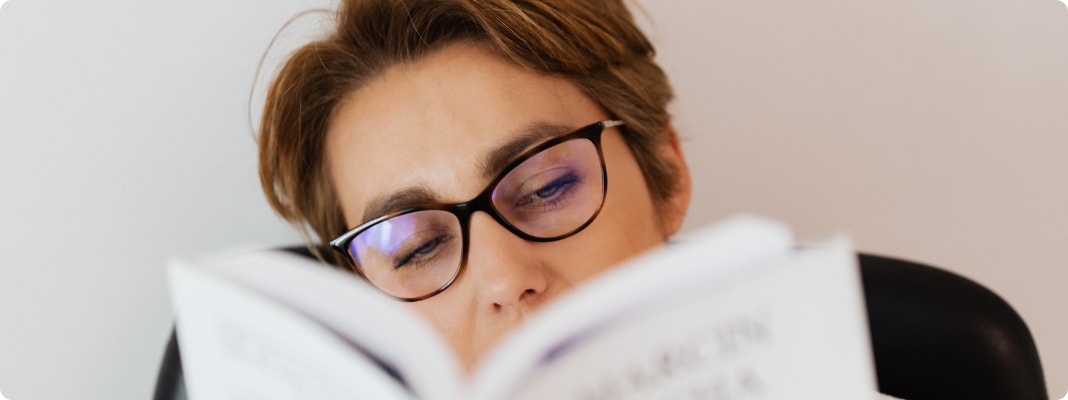
Have you ever found yourself squinting at a menu in a dimly lit restaurant or holding a book at arm’s length just to read? You may be wondering, “Do I need reading glasses?” These changes often happen as near vision becomes harder with age, but reading glasses are not the only option for managing close-up tasks.
In this blog post, we’ll discuss reading glasses, how our eyes change as we age, and the telltale signs that it might be time to invest in a pair. We’ll also touch on alternatives such as the best multifocal contact lenses, or progressive contact lenses, which may help some wearers see clearly at near, intermediate, and distance ranges.
Understanding Reading Glasses

Reading glasses are corrective eyewear designed to assist with near-vision tasks such as reading, sewing, or using a smartphone. They work by magnifying close-up objects to compensate for age-related changes in the eye’s ability to focus on nearby objects — a condition known as presbyopia.
Typically, reading glasses feature lenses with a positive diopter power, ranging from +1.00 to +3.00, depending on the individual’s near-vision needs.
Unlike prescription glasses for refractive errors like nearsightedness or farsightedness, reading glasses are mainly for individuals with presbyopia, which usually occurs after the age of 40.
If you find yourself struggling with close-up tasks despite having clear distance vision, reading glasses could be a simple yet effective solution to enhance your near vision clarity and comfort.
How Our Eyes Change as We Age
As we age, our eyes undergo several natural changes that impact our ability to see clearly, especially up close. One of the most common age-related changes is presbyopia, a condition where the lens of the eye loses its flexibility, making it difficult to focus on close objects.
Presbyopia typically begins around the age of 40 and progresses gradually. With presbyopia, the muscles that control the size of the pupil and the shape of the lens may weaken, leading to decreased ability to adjust to changes in lighting and focus quickly.
The clarity of the lens also diminishes over time, resulting in a gradual reduction in contrast sensitivity and an increased susceptibility to glare. These changes can make it challenging to read small print or perform tasks that require detailed near vision.
While these age-related changes are a normal part of the aging process, they can significantly impact daily activities. This highlights the importance of regular eye exams and appropriate vision correction options like reading glasses or multifocal contact lenses.
10 Signs That You Might Need Reading Glasses

1. Blurred Vision When Reading or Doing Close-Up Work
If you find that text or objects up close appear blurry, despite having clear distance vision, it could be a sign of presbyopia and a need for reading glasses.
2. Eye Strain or Discomfort After Reading
Experiencing eye strain, fatigue, or discomfort after engaging in activities that require close-up focus, such as reading or working on a computer, may indicate a need for reading glasses.
3. Difficulty Focusing on Small Print
If you struggle to focus on small print or notice that it appears fuzzy or unclear, particularly in low-light conditions, it could be a sign of presbyopia.
4. Holding Reading Material Farther Away to See It Clearly
Constantly adjusting the distance between your eyes and reading material to achieve clearer vision suggests a difficulty in focusing at close distances, a common symptom of presbyopia.
5. Needing Brighter Lighting to Read Comfortably
If you find yourself frequently increasing the lighting when reading or performing close-up tasks to improve clarity, it may indicate a decline in near vision.
6. Headaches or Fatigue After Reading
Experiencing headaches, eye fatigue, or discomfort after prolonged periods of reading or performing close-up tasks may signal an underlying vision issue, such as presbyopia.
7. Double Vision or Overlapping Words
Seeing double or noticing words overlapping when reading can be a sign of an inability to focus the eyes properly, often associated with presbyopia.
8. Difficulty Transitioning Between Near and Distant Vision
Struggling to shift focus between near and distant objects, such as moving from reading a book to looking across the room, is a common symptom of presbyopia.
9. Squinting While Reading
If you frequently squint or strain your eyes to see clearly when reading or performing close-up tasks, it may indicate a need for reading glasses to aid in near vision.
10. Feeling Like Words Are Swimming or Moving on the Page
Sensations of words appearing to move or swim on the page, particularly during prolonged periods of reading, suggest difficulty in maintaining clear focus at near distances.
Multifocal Contact Lenses as an Alternative to Reading Glasses
Multifocal contact lenses are a popular alternative to reading glasses for individuals with presbyopia. These lenses feature different optical zones, each designed to provide clear vision at varying distances, including near, intermediate, and distance.
By incorporating multiple prescription powers into a single lens, multifocal contacts allow wearers to see clearly at all distances without the need for reading glasses. They work by utilizing a combination of simultaneous vision and/or alternating vision designs.
Contact lenses for presbyopia are suitable for individuals who prefer the convenience and freedom of contact lenses over glasses. They are available in both soft and rigid gas-permeable materials, catering to a wide range of prescriptions and lifestyle preferences.
Whether you’re a busy professional, an active retiree, or someone who simply prefers the aesthetics of contact lenses, multifocal contacts offer a comfortable and effective solution for managing presbyopia and enjoying clear vision at all distances.
Wrapping Up
Recognizing the signs that indicate a need for reading glasses and addressing them promptly can significantly improve your comfort and quality of life when engaging in close-up activities. Whether it’s experiencing blurred vision, eye strain, or difficulty focusing on small print, acknowledging these symptoms and seeking appropriate vision correction is key to maintaining clear and comfortable vision.
It’s also essential to schedule regular eye exams to monitor changes in your vision and ensure you’re using the most suitable corrective measures. Only your eye care professional can provide valuable guidance on the best options for addressing presbyopia, whether it’s through reading glasses, multifocal contact lenses, or other vision correction methods.
Similar Articles
-

Which Lens Survives Your Day-to-Day Grind, Air Optix vs Acuvue Oasys Contact Lenses
-

FTC Begins Enforcement of the Contact Lens Rule Making it Easier to Save Money
-

What Are ACUVUE Contacts Made Of? A Complete Material Guide
-

Refractive Error vs. Visual Impairment: What’s the Difference?
-

Monovision Contact Lenses: What You Need to Know