Updated October 2026
A contact lens you replace on the same day each week. A monthly lens with an outer surface that is nearly all water. A daily disposable that corrects both astigmatism and the near-vision changes that come with age. Some of the most interesting advances in contacts are easy to miss because they look like the lenses you already wear. The differences are in the materials, the surface, and the way the lens corrects your vision.
For wearers, those differences could mean another option to discuss when contacts start feeling dry before dinner, a replacement schedule that fits more naturally into the week, or a lens that addresses a prescription older products could not accommodate. We cover newer US launches and established technologies that are still worth knowing about, including PRECISION7, PRECISION1, Bausch + Lomb INFUSE, and the TOTAL30 family. We also look at ACUVUE OASYS MAX 1-Day and MyDay Energys, two products taking different approaches to modern wearing demands.
What’s changing in contact lens technology?
Silicone hydrogel, a material used throughout this guide, allows oxygen to pass through the lens to the cornea. It has been around for years. Much of the newer work focuses on how a lens interacts with moisture and the eye’s surface, alongside improvements in optical design. [19]
Some lenses have a water-rich outer layer. Others incorporate ingredients designed to help maintain moisture during wear. Newer toric designs aim to keep astigmatism correction properly aligned, while multifocal designs address near, intermediate, and distance vision.
There’s also innovation in the routine itself. A weekly replacement lens gives wearers a different option from opening a new pair every morning or maintaining a pair for a month.
The question is which change addresses something you want to improve about wearing contacts. Your eye doctor can help determine whether the design, prescription range, and fit suit your eyes.
How do these newer contact lenses compare?
| Lens family | Replacement schedule | Technology to know | What makes it different |
|---|---|---|---|
| PRECISION7 | Weekly | ACTIV-FLO | A moisture-replenishing system built around a seven-day replacement cycle |
| PRECISION1 | Daily | SMARTSURFACE | A thin, water-rich surface layer on a daily disposable lens |
| Bausch + Lomb INFUSE | Daily | ProBalance | A blend of moisturizers, electrolytes, and osmoprotectants |
| TOTAL30 | Monthly | Water Gradient and CELLIGENT | A highly water-rich outer surface and chemistry designed to resist deposits |
| ACUVUE OASYS MAX 1-Day | Daily | TearStable and OptiBlue | Moisture technology and blue-violet light filtering, with newer toric and multifocal toric options |
| MyDay Energys | Daily | DigitalBoost and Aquaform | A small optical power boost designed for the demands of shifting between screens and other distances |
These are family-level differences, not a comfort ranking. Specific lens versions, prescription ranges, and fit vary. Weekly and monthly replacement describe when to discard a lens, not permission for uninterrupted wear.
What makes PRECISION7 different from other reusable contacts?
PRECISION7 is one of the more distinctive recent launches because it changes the replacement schedule. Alcon announced the lens in November 2024, with broader U.S. availability beginning in January 2025. It is replaced once a week. [4]
The technology behind it is called ACTIV-FLO. It combines a water-loving moisturizing agent embedded in the lens material with a replenishing agent that is released over time to help keep the surface moist throughout the seven-day cycle.
That sustained approach is the interesting part. Alcon designed the system around how the lens performs across a week, and its supporting clinical work underpins a claim of comfort and clear vision at 16 hours, even on day seven. That is a manufacturer performance claim, not a recommended wearing time for every person. [4, 5]
The routine may also appeal to someone who likes a fixed replacement day: a fresh pair every Monday, for example. When prescribed for daily wear, the lenses still need to be removed, cleaned, disinfected, and stored each night.
The family includes PRECISION7 for Astigmatism. Alcon’s current U.S. specifications document a 2026 expansion that includes -2.75 D cylinder, giving eye doctors more prescription combinations to work with. Your doctor can check whether your exact combination is available and suitable. [5]
How does PRECISION1 use a water-rich surface?
PRECISION1 focuses on a fresh lens every day and a thin layer of moisture at the surface.
Its SMARTSURFACE technology creates an outer layer containing more than 80% water. The silicone hydrogel core has a water content of 51%. Those figures describe different parts of the lens, based on laboratory measurements of unworn lenses. [2]
The idea is to combine an oxygen-permeable lens material with a surface designed to stay wettable. Wettability describes how readily liquid spreads over a surface, a useful property for a lens that sits within the tear film.
For the wearer, this is a daily disposable with a specific surface design to ask about when discussing comfort. Each pair is worn once and discarded after removal, so there is no cleaning or storage routine between days.
PRECISION1 is an established member of the modern lens lineup. The original launched in 2019, and PRECISION1 for Astigmatism launched in the U.S. in 2021. The toric version adds Alcon’s PRECISION BALANCE 8|4 design to help keep the correction oriented on the eye. [1, 3]
It earns a place in this guide because the surface technology gives readers a clear example of how modern daily lenses can differ, even when their replacement schedules are identical.
What’s different about Bausch + Lomb INFUSE?
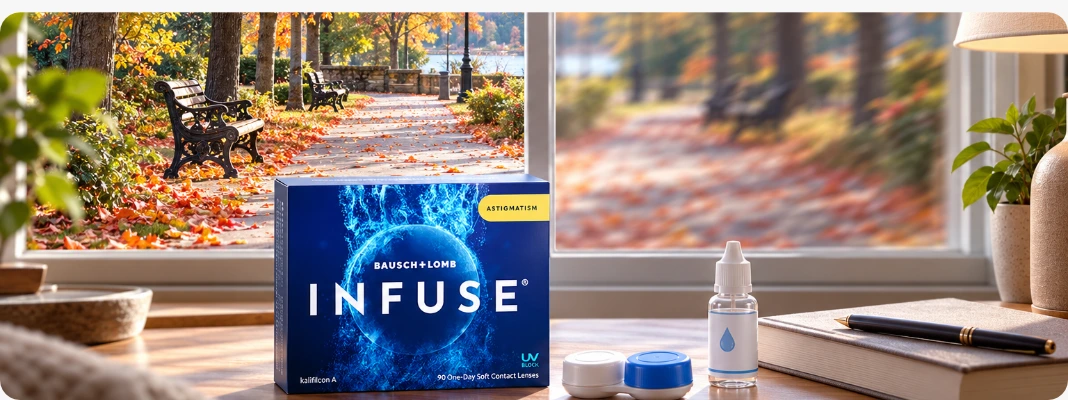
Bausch + Lomb INFUSE approaches lens-related dryness through its material and a blend of ingredients called ProBalance Technology.
That blend includes moisturizers, the electrolyte potassium, and ingredients called osmoprotectants, including erythritol and glycerin. Bausch + Lomb designed the combination to help maintain balance at the eye’s surface and minimize contact lens dryness. [7]
INFUSE uses kalifilcon A, a silicone hydrogel material with 55% water content. Its point of difference is the combination of that material and the infused ingredients, rather than a very high water percentage at a separate outer surface.
The family has also expanded beyond the original spherical lens. INFUSE One-Day Multifocal uses 3-Zone Progressive Design for near, intermediate, and distance vision. INFUSE One-Day for Astigmatism uses OpticAlign, a design that works with blinking to help stabilize the lens. [8, 9]
The original INFUSE launched in 2020, followed by multifocal lenses in 2023 and the U.S. introduction of the astigmatism version in 2024. The newer story is a broader range of daily-disposable options built around the same moisture-focused platform. [6, 9, 10]
These features make INFUSE worth considering if you want to review daily-disposable options with your doctor. Persistent dryness still needs an assessment, a moisture-focused contact lens is not a substitute for diagnosing or treating dry eye disease.
How does the TOTAL30 family bring water-gradient technology to monthly lenses?
TOTAL30 brings a water-gradient design to a reusable monthly lens.
Water Gradient describes a transition in water content from 55% at the lens core to nearly 100% at the outermost surface. That exceptionally water-rich surface is a material property measured in laboratory testing. It does not mean the entire lens is almost all water. [13]
The other technology to know about is CELLIGENT. It uses surface chemistry designed to mimic aspects of the corneal surface and resist the adherence of lipids and bacteria. Laboratory evidence supports those adhesion claims. The lenses still require proper cleaning and disinfection, and the surface design does not establish protection against eye infection. [13]
For monthly wearers, the appeal is a reusable lens designed to maintain a wettable surface through its replacement cycle. Your care routine and your own comfort during trial wear is still key.
The family includes the original TOTAL30, TOTAL30 for Astigmatism, and TOTAL30 Multifocal. The toric design addresses astigmatism, while the multifocal version addresses presbyopia, the age-related change that makes close-up focusing more difficult. [11, 12]
A more recent addition is TOTAL30 Multifocal for Astigmatism, which Alcon launched in the U.S. in February 2026. It combines Water Gradient material with PRECISION PROFILE multifocal optics and PRECISION BALANCE 8|4 stabilization. [14]
That combination is important to people who need both astigmatism and presbyopia correction. It gives eye doctors another monthly lens to evaluate when a wearer’s vision needs become more complex.
What’s new in the ACUVUE OASYS MAX 1-Day family?
ACUVUE OASYS MAX 1-Day combines two technologies: TearStable, designed to support tear-film stability and lens moisture, and the OptiBlue light filter. The latter filters approximately 60% of blue-violet light. [15, 16]
The more recent development is the expansion of the family into additional prescriptions, including astigmatism and multifocal for astigmatism.
The multifocal toric version launched in the U.S. in June 2025. It combines the moisture and filtering technologies with Pupil Optimized Design for presbyopic vision and Blink Stabilized Design to help maintain lens orientation. [16]
For an eligible wearer who needs reading correction as well as astigmatism correction, the practical development is a daily-disposable option combining both. There is also a multifocal version for presbyopic wearers whose prescription does not require that toric design.
One qualification belongs alongside the light-filtering feature: Johnson & Johnson states that filtering HEV light has not been demonstrated to provide health benefits such as retinal protection, reduced eye strain, or improved sleep. The filter should not be described as proven protection from screen damage. [16]
How does MyDay Energys approach screen-heavy days?
MyDay Energys takes an optical approach to the demands of digital-device use.
Its DigitalBoost technology is a single-vision aspheric design with a small +0.3 D power boost. CooperVision designed it to help ease the focusing demands associated with switching between digital devices and other viewing distances. Aquaform Technology helps the lens retain water. [17]
This is a different feature from a blue-violet light filter. The focus is the lens’s optical design and moisture properties. CooperVision says it may help with eye tiredness and dryness associated with digital-device use.
Introduced in the U.S. in 2023, MyDay Energys is a daily disposable. It is worth asking about if you spend much of the day changing focus between a laptop, a phone, and the room around you. A fitting can establish whether the design suits your vision; the same screen-related symptoms can have more than one cause. [17, 18]
How should you choose between newer contact lenses?
Start with the part of your current experience you want to improve. Tell your eye doctor when discomfort starts, which distances look blurry, how much time you spend on screens, and whether you want to change your care routine.
A newer lens may add a useful feature or prescription option, but suitability depends on your eyes, prescription, and fitting. If your current contacts work well, a launch announcement alone is not a reason to change.
A daily lens eliminates overnight storage and disinfection between uses. A weekly or monthly lens means caring for the same pair across its prescribed replacement cycle. The routine needs to fit what you can consistently maintain. [19]
Moisture technologies do not change the wear time or replacement schedule your eye doctor prescribes. A comfort claim is not permission to stretch lens use. For daily-wear prescriptions, remove the lenses before sleeping; clean and disinfect reusable lenses as directed. [21]
Prescription coverage is as meaningful as the named technology. Sphere, cylinder, axis, and reading-add combinations differ between products. A lens family having a toric or multifocal version does not mean it can accommodate every prescription.
Use trial wear to judge how the prescribed lenses perform during your normal day. A water-content figure, a product review, or a promising technology name cannot establish the right fit for your eyes.
Don’t switch brands by copying your current prescription numbers into another product. Lens materials, dimensions, and designs differ. Your eye doctor should approve and fit the new product, and your order should match your current contact lens prescription. [20]
Could a different contact lens improve your routine?
The best innovation is one that addresses a problem you actually have, whether that is surface dryness, an awkward replacement routine, or changing vision needs.
Ask your eye doctor about newer options at your next contact lens appointment. Once your fitting is complete and you have a current prescription for the chosen product, you can explore that prescribed lens through Lens.com.
Contact lenses are prescription medical devices. This guide explains product features and does not replace an eye examination or personalized fitting advice.
References
1. Alcon. Alcon to Launch PRECISION1 Daily Disposable Contact Lenses. August 19, 2019.
2. Alcon. PRECISION1 professional specifications and U.S. consumer product information. Accessed October 22, 2026.
3. Alcon. Alcon Launches PRECISION1 for Astigmatism Contact Lenses in the U.S. January 20, 2021.
4. Alcon. Alcon Debuts PRECISION7, a One-Week Replacement Contact Lens. November 2024.
5. Alcon. PRECISION7 consumer information and PRECISION7 for Astigmatism professional specifications, including the September 2026 parameter expansion. Accessed October 22, 2026.
6. Bausch + Lomb / Bausch Health. Bausch + Lomb Launches INFUSE Silicone Hydrogel Daily Disposable Contact Lenses. August 17, 2020.
7. Bausch + Lomb. INFUSE One-Day professional product information: kalifilcon A and ProBalance Technology. Accessed October 22, 2026.
8. Bausch + Lomb. INFUSE One-Day Multifocal professional product information: 3-Zone Progressive Design. Accessed October 22, 2026.
9. Bausch + Lomb. INFUSE for Astigmatism Silicone Hydrogel Daily Disposable Contact Lenses Introduced in the United States. June 10, 2024.
10. Bausch + Lomb. Contact Lens FAQs and company news archive: INFUSE Multifocal U.S. launch, June 5, 2023. Accessed October 22, 2026.
11. Alcon. Alcon Introduces a Premium, Reusable Toric Lens with Launch of TOTAL30 for Astigmatism. January 5, 2023.
12. Alcon. Alcon Launches TOTAL30 Multifocal Contact Lenses for Patients with Presbyopia. October 2023.
13. Alcon. TOTAL30 professional parameters, Water Gradient and CELLIGENT technology information. Accessed October 22, 2026. Water-content and adhesion claims are qualified by laboratory testing.
14. Alcon. Alcon Launches TOTAL30 Multifocal for Astigmatism. February 17, 2026.
15. Johnson & Johnson Vision. Launch announcement for ACUVUE OASYS MAX 1-Day and ACUVUE OASYS MAX 1-Day Multifocal. September 12, 2022.
16. Johnson & Johnson. ACUVUE OASYS MAX 1-Day Multifocal for Astigmatism launch announcement, technical descriptions and HEV-filtering disclosures. June 23, 2025.
17. CooperVision. MyDay Energys product information: DigitalBoost +0.3 D design and Aquaform Technology. Accessed October 22, 2026.
18. CooperVision. MyDay Energys Contact Lenses Make U.S. Debut. March 1, 2023.
19. U.S. Food and Drug Administration. Types of Contact Lenses. Accessed October 22, 2026.
20. U.S. Food and Drug Administration. Buying Contact Lenses. Accessed October 22, 2026.
21. U.S. Food and Drug Administration. Contact Lens Care. Accessed October 22, 2026.