Myopia is becoming increasingly common, particularly among children and teens. A 2025 global analysis of 276 studies involving more than 5.4 million participants found that childhood myopia prevalence rose from 24.3% in 1990 to 35.8% in 2023. Researchers project that nearly 40% of children and adolescents, more than 740 million worldwide, could have myopia by 2050.
Genetics can influence who develops myopia, but everyday visual habits may also play a role. A 2025 review of 45 studies and 335,524 participants found that each additional hour of daily digital screen time was associated with 21% higher odds of myopia, although the research doesn’t prove that screen use directly causes it.
With regular eye exams, suitable vision correction, contacts for myopia, myopia-control treatments, and healthier daily habits, people can manage nearsightedness and help slow its progression.
What is Myopia?
Myopia, or nearsightedness, is a highly common refractive error where close-up objects stay sharp, but anything in the distance turns into a blurry haze.
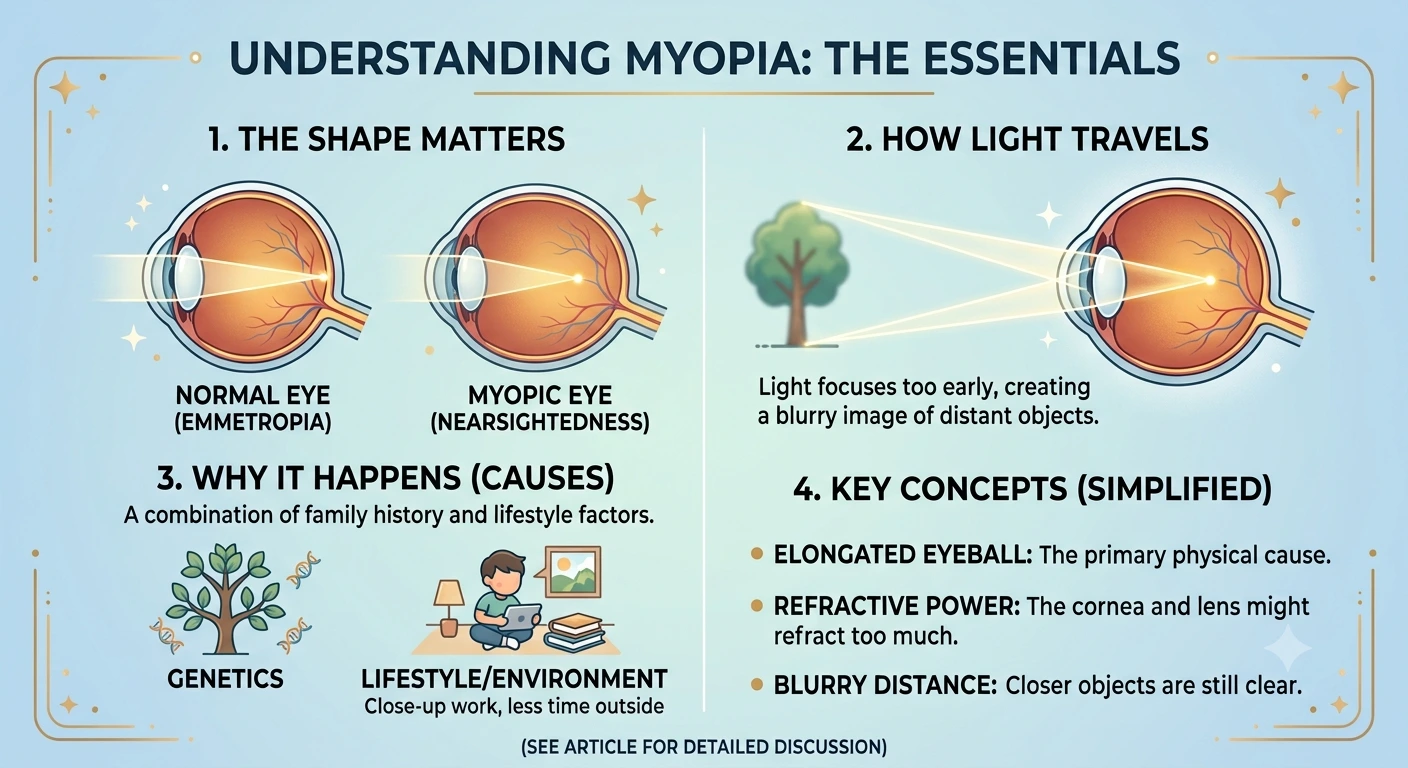
Why does this happen? It boils down to eye anatomy. In a myopic eye, the eyeball is either slightly too long from front to back, or the cornea has a sharper curve. Due to this irregular shape, incoming light doesn’t land perfectly on your retina, the light-sensitive tissue at the back of the eye. Instead, the image focuses just a bit short of the retina.
Myopia typically surfaces during childhood and tends to progress through the teenage years. It only starts stabilizing in early adulthood. Keep an eye out for these classic symptoms:
- Squinting or straining to read road signs or classroom boards
- Creeping closer and closer to screens or TVs
- Frequent eye fatigue, rubbing, or tension headaches
A comprehensive eye exam can help diagnose if it’s myopia and the proper ways to manage it, whether that means a crisp new pair of glasses, contact lenses, or advanced progression treatments.
What Causes Myopia?
Myopia doesn’t stem from a single source. Instead, it develops through a dynamic mix of physical anatomy, genetics, and daily visual habits.
- An Elongated Eyeball: When the eyeball grows slightly too long from front to back, the shape disrupts the eye’s internal focus point. Light rays fall short, clustering just in front of the retina rather than directly on it.
- Cornea or Lens Curvature: A steeply arched cornea, or less frequently, an irregular internal lens, bends incoming light, distorting your distance vision.
- Family History: Genetics play a big role here. A child’s likelihood of developing it increases when one or both parents are nearsighted.
- Extended Near Work: Logging long hours with your eyes locked on close-up tasks, such as intensive studying, reading, or scrolling through digital devices, puts continuous strain on developing eyes. While near work isn’t the sole culprit, it acts as a major modern accelerator.
- Limited Time Outdoors: Natural sunlight is an underrated protector. Children who spend most of their time indoors are statistically more prone to myopia. Regular exposure to bright outdoor light, combined with the chance to focus on distant horizons, actively guides healthy eye growth.
Is Myopia Curable?
There’s currently no true cure for myopia that permanently restores the eye to its original shape. Eyeglasses and contact lenses correct blurry distance vision, while myopia-control contacts, specialized glasses, orthokeratology, and atropine drops may help slow progression.
Refractive procedures such as LASIK or PRK can reduce dependence on glasses by reshaping the cornea, but they don’t shorten an elongated eyeball or erase the underlying myopia. Vision can also change later, and some people may still need corrective lenses after surgery.
How To Correct Myopia
Myopia can be corrected with prescription lenses calibrated to refocus light directly onto the retina. The right option depends on your prescription, eye health, age, lifestyle, personal preferences, and your eye doctor’s advice.

Comprehensive and Regular Eye Exams
- An eye doctor will check your vision, determine the degree of myopia, and test for other eye health concerns.
- Your prescription may change over time. So always have follow-up exams as often as your eye doctor recommends.
- Children with progressing myopia may need additional monitoring and specialized management options.
Eyeglasses
- Prescription glasses provide a simple, noninvasive way to sharpen distance vision.
- You can wear them throughout the day or only for activities such as driving, watching presentations, or seeing the classroom board.
- Keep your prescription current, especially when blurry vision, headaches, or frequent squinting returns.
Contact Lenses
- Nearsighted contacts correct myopia while providing a wider, unobstructed field of vision.
- Options include daily disposable, reusable, soft, and rigid gas-permeable lenses. Your eye doctor will prescribe what kind of contact lens fits your specific requirements.
- Contacts require a professional fitting and consistent hygiene. Wear only the prescribed lenses and follow the recommended replacement schedule.
How To Manage Myopia Effectively?
Managing myopia is a proactive approach to slow it down, not necessarily stopping it. This proactive approach is especially important for children whose eyes are still developing. Because everyone’s eyes are different, an eye doctor will tailor the game plan based on age, lifestyle, eye health, and prescription strength.
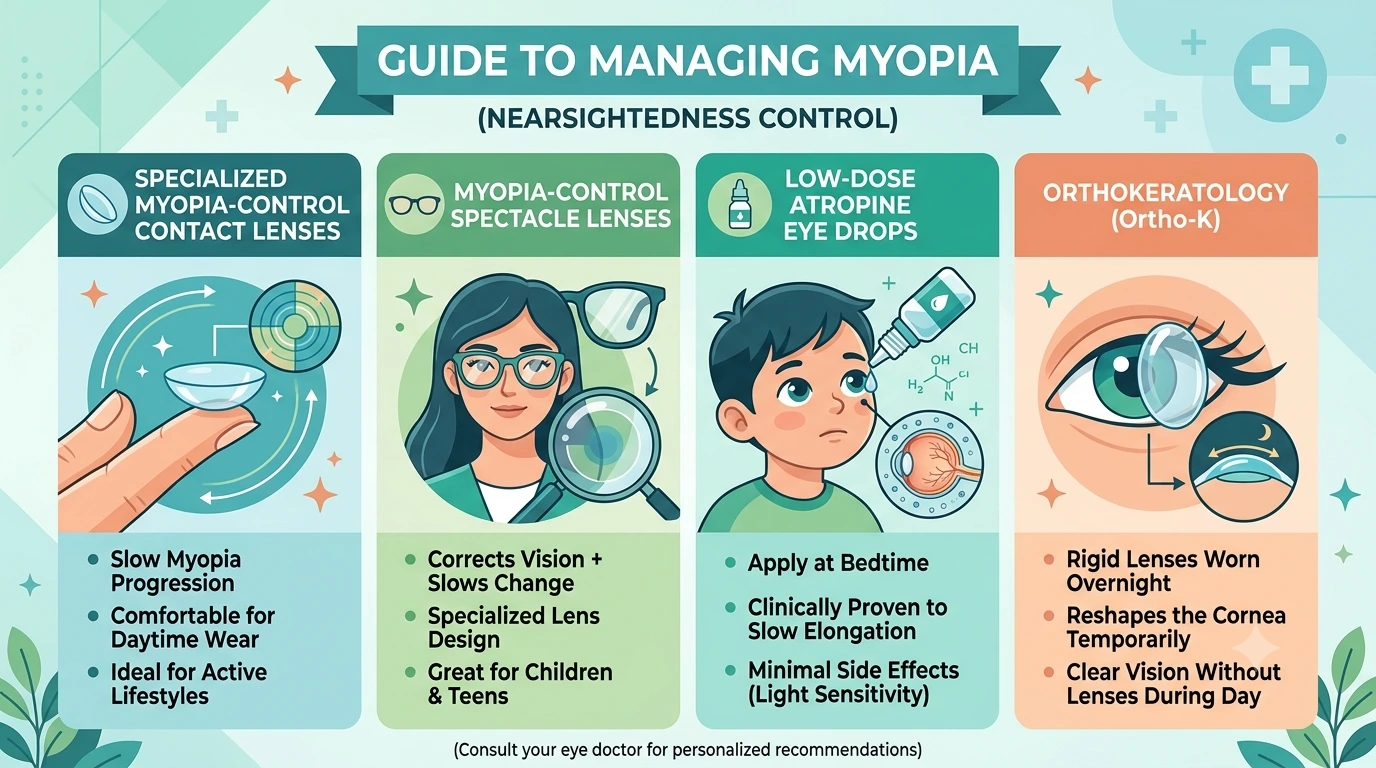
- Specialized Myopia-Control Contact Lenses: These aren’t your standard contacts. These soft, multifocal lenses correct central vision so the wearer can see clearly, while simultaneously altering how light hits the peripheral retina. This subtle visual tweak signals the eyeball to slow its tracking growth.
- Orthokeratology (Ortho-K): Worn exclusively while sleeping, Ortho-K lenses temporarily reshape the surface of the cornea overnight. The result? Crisp, correction-free vision all day long, plus the added bonus of slowing down myopia’s long-term progression.
- Myopia-Control Spectacle Lenses: To the untrained eye, these look just like regular eyeglasses. However, they feature advanced, specialized zones that correct distant blur while carefully managing peripheral focus.
- Low-Dose Atropine Eye Drops: Applied once a day, usually at bedtime, these prescription drops have been shown to significantly put the brakes on rapid myopia changes in children. Because they strictly manage progression rather than correcting immediate blur, they are typically paired with glasses or standard contacts.
Daily Habits That Support Myopia Management
While clinical treatments do the heavy lifting, daily habits provide the ultimate supporting framework. These lifestyle tweaks won’t reverse existing nearsightedness, but they are incredibly effective at cutting down eye fatigue and setting up healthier visual routines.

- Get outside and recharge.
Spending time outdoors is an important part of a healthy visual routine. For people already prescribed daytime contacts, photochromic contact lenses are another option to discuss with an eye doctor if adapting to changing light is useful for their lifestyle. - Master the 20-20-20 rule.
Marathon screen sessions and deep-dive reading streaks demand a lot of visual muscle. To prevent burnout, take a 20-second break every 20 minutes to look at something at least 20 feet away. This 20-20-20- quick reset gives your eye’s focusing system a chance to relax and bounce back. - Keep your distance.
Sneaking screens or books right up to your nose forces the eyes to overwork. Keep digital devices and reading materials a comfortable arm’s length away. Adjust your posture so you aren’t constantly hunching forward to read. - Light up the room.
Dim environments and harsh screen glare are a recipe for eye strain. Position your desk or reading chair in a well-lit space that minimizes deep shadows. - Habits support, doctors prescribe.
Playing outside and taking screen breaks beautifully complement your strategy, but they cannot replace the specialized glasses, contacts, or drops prescribed by your optometrist. Always stick to your scheduled follow-up visits to ensure your eyes are tracking exactly where they should be.
Living Life with Nearsightedness
Effectively managing myopia ultimately anchors back to three things: regular eye exams, an accurate prescription, and a custom treatment plan that aligns with a person’s age, visual demands, and unique lifestyle. While standard glasses and contacts do an excellent job of clearing up immediate distance blur, specialized, proactive treatments offer a powerful tool for slowing down progression during the critical childhood and teenage years.
Building healthy daily habits provides a fantastic supporting framework, but these routines provide the best results when paired side-by-side with professional guidance. Staying consistent with your scheduled follow-up visits ensures you can accurately track visual changes over time, pivot your treatment strategy the moment it’s necessary, and ultimately safeguard your long-term eye health.
Disclaimer: This content is for general informational purposes only and is not a substitute for professional advice, diagnosis, or treatment.
References
Nearsightedness (Myopia). National Eye Institute. https://www.nei.nih.gov/eye-health-information/eye-conditions-and-diseases/nearsightedness-myopia. Published Date (December-04-2024). Date Accessed: July 20, 2026.
Types of Refractive Errors. National Eye Institute. https://www.nei.nih.gov/eye-health-information/eye-conditions-and-diseases/refractive-errors/types-refractive-errors. Published Date (September-04-2025). Date Accessed: July 20, 2026.
Global Prevalence, Trend and Projection of Myopia in Children and Adolescents from 1990 to 2050: A Comprehensive Systematic Review and Meta-Analysis. Jinghong Liang, Yingqi Pu, Jiaqi Chen, et al./British Journal of Ophthalmology. https://pubmed.ncbi.nlm.nih.gov/39317432/. Published Date (September-24-2024). Date Accessed: July 20, 2026.
Digital Screen Time and Myopia: A Systematic Review and Dose-Response Meta-Analysis. Ahnul Ha, Yun Jeong Lee, Marvin Lee, Sung Ryul Shim, and Young Kook Kim/JAMA Network Open. https://jamanetwork.com/journals/jamanetworkopen/fullarticle/2830598. Published Date (February-21-2025). Date Accessed: July 20, 2026.
IMI: Interventions for Controlling Myopia Onset and Progression 2025. Mark A. Bullimore, Kathryn J. Saunders, Rigmor C. Baraas, David A. Berntsen, et al./Investigative Ophthalmology & Visual Science. https://pmc.ncbi.nlm.nih.gov/articles/PMC12448128/. Published Date (September-30-2025). Date Accessed: July 20, 2026.
Atropine for the Prevention of Myopia Progression in Children: A Report by the American Academy of Ophthalmology. Stacy L. Pineles, Robert T. Kraker, Deborah K. VanderVeen, et al./Ophthalmology. https://pubmed.ncbi.nlm.nih.gov/28669492/. Published Date (December-01-2017). Date Accessed: July 20, 2026.
Use of Orthokeratology for the Prevention of Myopic Progression in Children: A Report by the American Academy of Ophthalmology. Deborah K. VanderVeen, Robert T. Kraker, Stacy L. Pineles, et al./Ophthalmology. https://pubmed.ncbi.nlm.nih.gov/30476518/. Published Date (April-01-2019). Date Accessed: July 20, 2026.
Similar Articles
-

The Rarity of Eye Colors Ranked + Facts & Stats About Every Color of Eyes
-

The Most Interesting Facts About Green Eyes – Why They’re So Rare & The Latest Data
-

What Are Water Gradient Contact Lenses and How Do They Work
-

Is Blue Light Bad for Your Eyes?
-

Proclear 1-Day vs. Biotrue ONEday: Which Daily Lens Is For You?