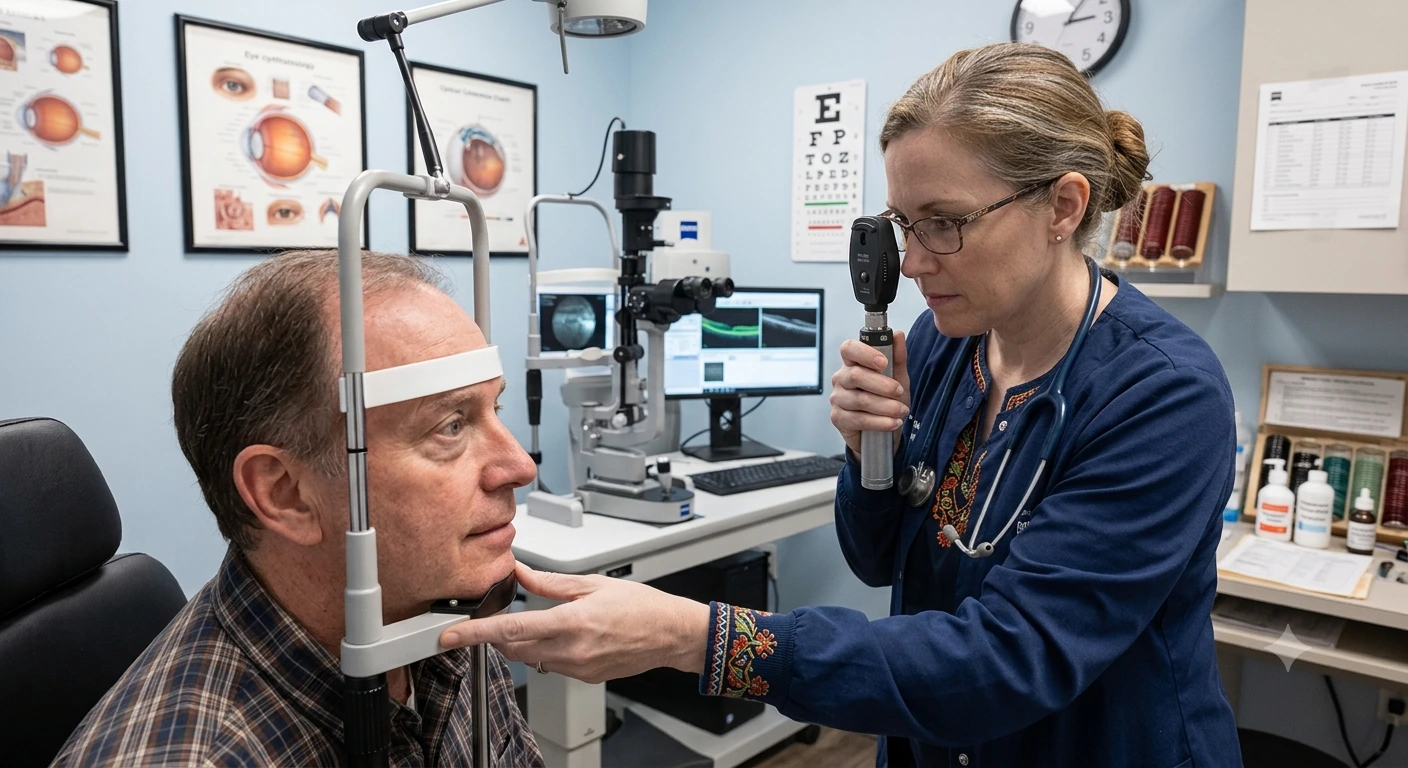

20/20 describes standard distance clarity: at 20 feet, you can resolve the chart detail a person with standard acuity can resolve at 20 feet. It does not mean every aspect of vision or eye health is perfect.
Evidence checked July 10, 2026
Compare Relative Distance Detail
How to Read This Scene
Highway Sign Focus
Watch the smaller destination names, route shields, and lane arrows. Fine lettering loses clarity before the larger sign shapes become difficult to recognize.
Distance equivalents are idealized Snellen-ratio comparisons, not recommended viewing distances. The model removes spatial detail uniformly; it does not reproduce glare, field loss, missing spots, double vision, color changes, contrast loss, or the pattern of any eye condition.
Highway sign scene comparing a 20/20 reference with an approximate 20/40 spatial-detail model.
What Do the Two Numbers Mean?
The first number is the test distance, usually 20 feet in the United States. The second is the distance at which a person with standard acuity can resolve the same high-contrast chart detail.
A larger second number means a larger minimum detail size. For example, 20/40 has twice the minimum angle of resolution of 20/20. The metric system expresses the same ratio as 6/12.
20/10 Through 20/400
Clinical classifications depend on corrected acuity, the better eye, visual field, testing method, and jurisdiction. The labels below are educational context, not diagnoses.
| Rating | Context | Snellen meaning | Possible distance impact |
|---|---|---|---|
| Better than the 20/20 reference | At 20 ft, resolves chart detail a 20/20 viewer resolves at 10 ft. | Fine high-contrast detail may be resolved from farther away. | |
| Better than the 20/20 reference | At 20 ft, resolves chart detail a 20/20 viewer resolves at 15 ft. | Small distant letters may remain especially crisp. | |
| Standard distance-acuity reference | At 20 ft, resolves standard 20-ft chart detail. | Does not guarantee normal near, peripheral, or contrast vision. | |
| Slightly reduced distance acuity | At 20 ft, resolves chart detail a 20/20 viewer resolves at 25 ft. | Very small distant text may lose some crispness. | |
| Reduced distance acuity | At 20 ft, resolves chart detail a 20/20 viewer resolves at 30 ft. | Fine writing or faraway signs may look softer. | |
| Reduced distance acuity | At 20 ft, resolves chart detail a 20/20 viewer resolves at 40 ft. | Small signs, classroom writing, or captions may lose crispness. | |
| Reduced distance acuity | At 20 ft, resolves chart detail a 20/20 viewer resolves at 50 ft. | Distant text and facial detail may be harder to resolve. | |
| Reduced distance acuity | At 20 ft, resolves chart detail a 20/20 viewer resolves at 60 ft. | Many small details across a room may be unclear. | |
| Moderate impairment range if best-corrected | At 20 ft, resolves chart detail a 20/20 viewer resolves at 70 ft. | Moving closer or magnification may help with distant text. | |
| Moderate impairment range if best-corrected | At 20 ft, resolves chart detail a 20/20 viewer resolves at 80 ft. | Signs, faces, and screens may lose substantial detail. | |
| Moderate impairment range if best-corrected | At 20 ft, resolves chart detail a 20/20 viewer resolves at 100 ft. | Large text or a much closer viewing distance may be needed. | |
| Severe impairment range; U.S. statutory threshold may apply | At 20 ft, resolves chart detail a 20/20 viewer resolves at 200 ft. | Fine distance detail is difficult, though large shapes may remain visible. | |
| Severe impairment range | At 20 ft, resolves chart detail a 20/20 viewer resolves at 400 ft. | Large forms and strong edges may remain; this is not total blindness. |
What Different Ratings May Look Like
These are illustrative spatial-detail comparisons. Real experience varies with cause, correction, lighting, contrast, distance, and the task.

What Does 20/40 Vision Look Like?
Small highway lettering may become readable at a closer distance.
What Does 20/100 Vision Look Like?
A waving figure across a busy sidewalk may lose much of its fine detail.
What Does 20/200 Vision Look Like?
Product detail and small labels may be difficult to distinguish.
Important Context About Visual Acuity
20/20 Measures One Part of Vision
It does not measure peripheral vision, eye coordination, depth perception, focusing ability, color vision, contrast sensitivity, night vision, or overall eye health.
20/200 Is Conditional
U.S. statutory blindness uses best-corrected distance acuity in the better eye. A visual field whose widest diameter is no greater than 20 degrees can also meet the definition.
Acuity Is Not Lens Power
A contact lens prescription also includes refraction, fit measurements, lens design, and product details. The same acuity result can occur with different prescriptions or eye conditions.
Changes in Clarity Deserve Context
Schedule an eye exam when distance signs or screens look blurrier than usual, you squint often, night driving feels harder, headaches or eye strain are frequent, or your current correction no longer feels clear.
What Visual Acuity Can and Cannot Tell You
A Snellen score is one measurement of distance detail. These distinctions help place the number in the right context.
The Simulator Is an Illustration, Not an Eye Test
Screen size, viewing distance, lighting, correction, and eye conditions all affect what you see. Only a properly administered test can measure visual acuity.
20/200 Is a Conditional U.S. Legal Threshold
In the United States, 20/200 or less can meet the central-acuity criterion for statutory blindness when it is the best-corrected distance acuity in the better eye. A visual field whose widest diameter is no greater than 20 degrees can also meet the definition.
20/40 Does Not Determine a Prescription
A visual acuity result does not identify the cause of reduced clarity or determine lens power. An eye care professional uses refraction and a broader eye examination.
Acuity Cannot Reproduce an Eye Disease
This simulator only models a uniform reduction in resolvable detail. Eye conditions can affect contrast, glare, color, central or peripheral fields, and vision in very different patterns.
6/6 and 20/20 Describe the Same Ratio
6/6 uses meters and 20/20 uses feet. Both express standard distance acuity through the same Snellen relationship.
Keep Learning
Visual Acuity
Low Vision
Prescriptions and Exams
Sources
Evidence checked July 10, 2026. A named clinician should review the final published page under Lens.com’s medical editorial policy.
- American Optometric Association: Visual Acuity
- American Optometric Association: Low Vision and Vision Rehabilitation
- Social Security Administration: Meaning of Blindness as Defined in Law
- National Eye Institute: Floaters and When to Get Help
- World Health Organization: World Report on Vision