
Table of Contents
Ever picked up a contact lens box and wondered what all those tiny letters, symbols, and dates actually mean? You are not the only one.
Here is why it matters. Contact lens packaging isn’t just branding. It is part of how lenses stay sterile, traceable, and safe to wear. If you know how to spot a properly sealed blister pack and where to find the contact lens expiration date, you can shop with more confidence and avoid the most common buyer mistakes.
Contact Lens Packaging 101: Box vs Blister Pack
What Are Contact Lenses Packaged In?
The Outer Box
This is the carton you receive when you buy contacts online or in store. It usually holds multiple individual lenses, often grouped by pack size. The box is also where buyers commonly find product details like lens type and important tracking information that shows up again on the blister.
Individual Blister Pack
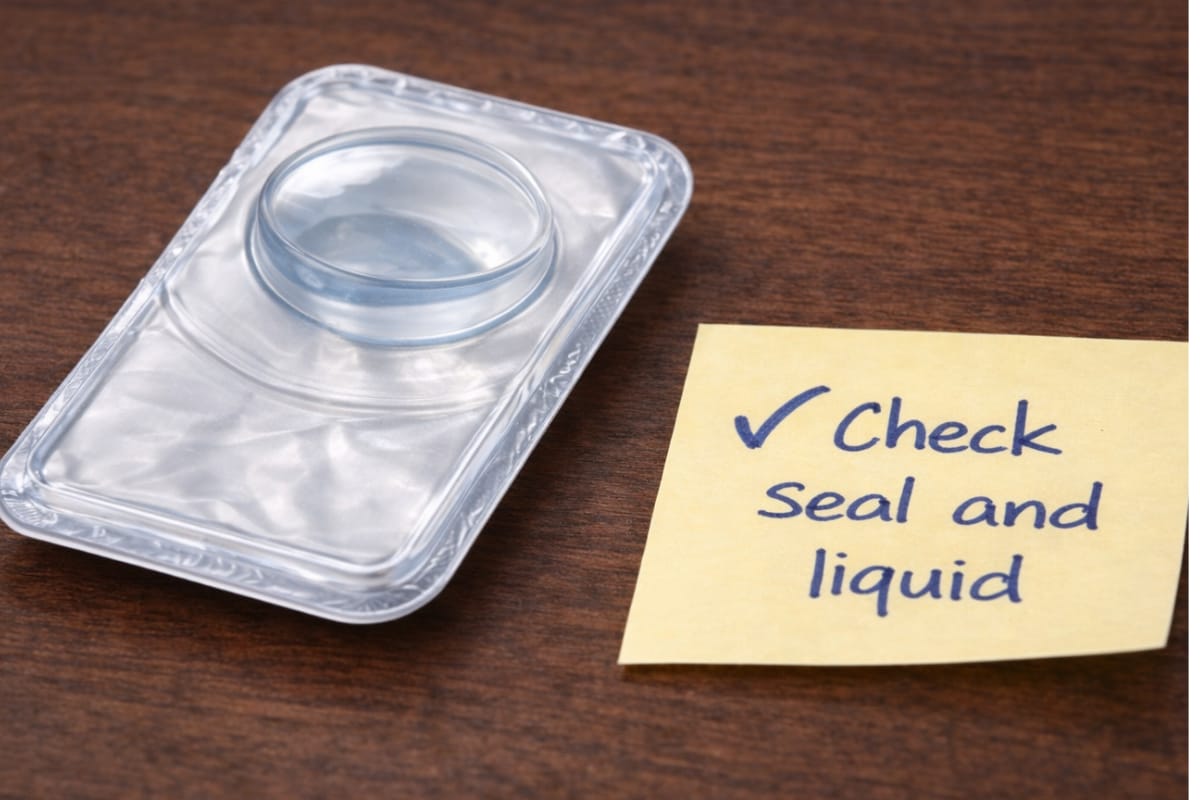
Each lens is sealed in its own plastic cavity with a foil lid and sits in sterile liquid. CooperVision notes that lenses stay sterile and contamination risk stays low as long as the seal is intact.
Quick Buyer Check Before You Open Anything
- Confirm you have the correct brand and lens type
- Check the contact lens expiration date on the box and blister
- Look for any signs of leakage or damage to the blister or foil
If a blister pack becomes accidentally unsealed, it should be discarded and the lens should not be worn. Many manufacturer instructions also warn not to use lenses if the package is damaged or unintentionally opened.
What Are Contact Lenses Packaged In?
If you have ever torn a foil lid too fast or flicked solution everywhere, this part is for you. Here is a simple routine that works:
- Wash and dry your hands
Use soap and water, then dry with a lint free towel. - Check the blister pack first
Look for leaks, cracks, or a foil lid that is lifting. If anything looks off, do not use that lens. - Peel the foil back slowly
Hold the blister steady and peel the foil gently so the lens stays in the liquid. - Lift the lens out gently
Scoop the lens onto your fingertip. Before inserting, check that it is not torn or scratched. - Rinse only if needed and only with the right liquid
If you need to rinse, use fresh multipurpose solution or saline as directed. Avoid tap water.
If you need to rinse a lens, use fresh multipurpose solution or saline as directed. Do not use tap water, and do not rely on leftover blister pack liquid for cleaning.
How To Tell If A Contact Lens Blister Pack Seal Is Broken
A broken seal is not always dramatic. Sometimes it is subtle. Here is what to look for.
Do not use the lens if you see any of these
• Foil lid is lifting, wrinkled, or partially peeled
• Liquid is leaking, low, or missing
• The blister looks punctured, cracked, or crushed
• The foil looks torn or does not appear sealed all the way around
• The lens looks dried out or stuck to the foil
Why This Matters: The lens is considered sterile only while the blister remains sealed. If a blister pack becomes unsealed, the lens should be discarded.
You may also see a common medical packaging symbol meaning do not use if package is damaged.
What To Do Instead
- Set the damaged blister aside
- Open a new lens if you have one
- Contact the seller for a replacement or refund based on their policy
How to Read Contact Lens Packaging Labels
If you can read a contact lens box, you can shop smarter. This section is your plain English guide to contact lens packaging labels, so you know what you are looking at before you buy or open anything.

Table 1: Contact Lens Box Labels And What They Mean
| Label | What It Means | Who Needs It | Why It Matters |
|---|---|---|---|
| PWR or SPH | Lens power in diopters | Most wearers | Affects clarity and comfort |
| CYL | Astigmatism correction strength | Toric lens wearers | Must match your prescription |
| AXIS | Astigmatism correction orientation | Toric lens wearers | Must match your prescription |
| ADD | Extra power for near vision | Multifocal wearers | Helps balance distance and near vision |
| BC | Base curve | Most soft lenses list it | Helps the lens fit correctly |
| DIA | Diameter | Most soft lenses list it | Helps with fit and coverage |
Table 2: EXP, LOT, UDI, and Common Packaging Symbols
| Packaging Item | What It Tells You | Where You Usually See It | Why It Matters |
|---|---|---|---|
| EXP date or hourglass symbol | Use by date | Box and blister | Do not use after this date |
| LOT number | Batch identifier | Box and blister | Helps trace a product if there is an issue |
| UDI code | Device identifier plus production info | Box | Adds traceability for medical devices |
| Sterility symbol | Sterilization status or method | Box or blister | Confirms sterile device packaging |
| Do not use if package is damaged symbol | Safety warning | Box or blister | Do not wear a lens if the seal is broken |
Contact Lens Expiration Date vs Replacement Schedule
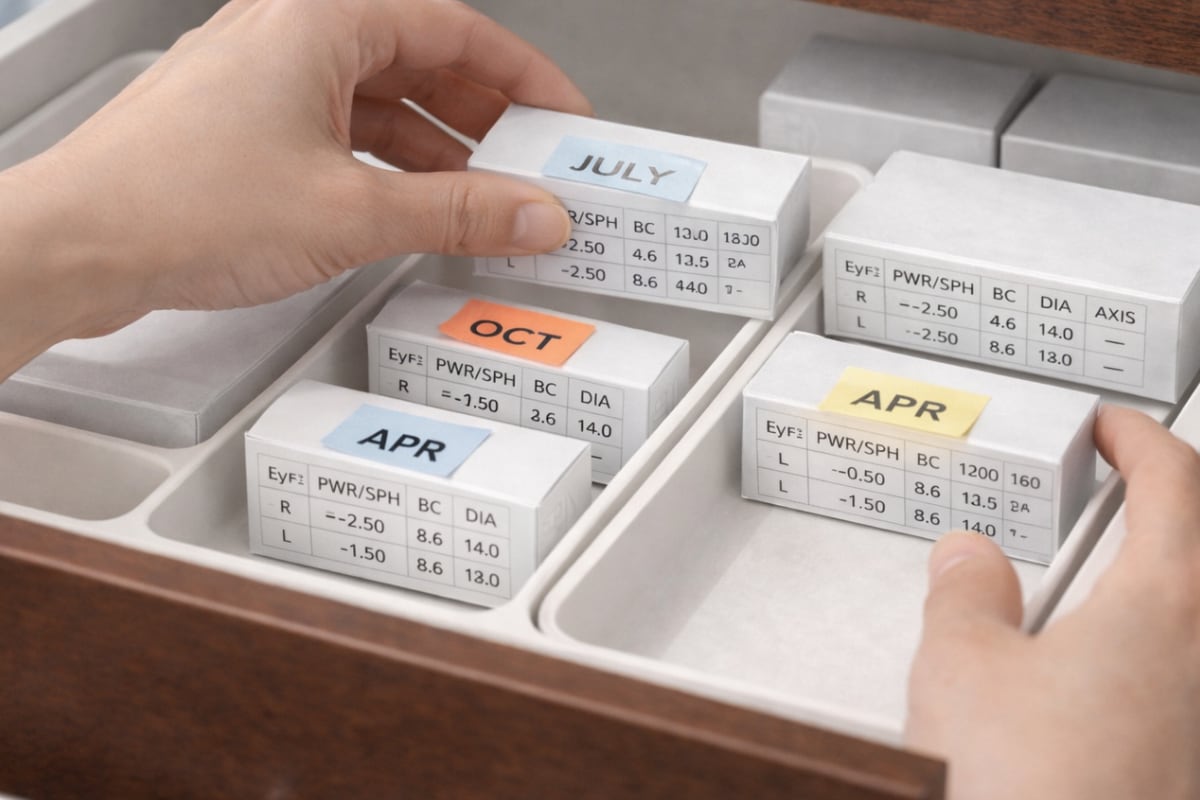
This is one of the biggest points of confusion for buyers. Contact lens expiration date is about the sealed product. Replacement schedule is about how long you wear the lens after you start using it.
What The Contact Lens Expiration Date Actually Means
Think of the EXP date as a safety boundary set by the manufacturer.
- The expiration date is printed on the box and the blister pack.
- It is a use by date, meaning the device should not be used after that date.
If you are organizing your supply at home, this is the date you check first.
Why Do Contact Lenses Expire If They Are Unopened?
Even when lenses are sealed, manufacturers only guarantee sterility and performance up to the printed use by date. The date exists because packaging and sterile conditions are not guaranteed forever.
A Simple Way To Remember It: Sealed does not mean timeless. It means protected until the date on the package.
How Long Do Contact Lenses Last Unopened In The Blister Pack?
For unopened lenses, the safest answer is also the easiest.
- They last until the contact lens expiration date printed on the blister pack, as long as the blister remains sealed.
CooperVision explains that lenses in blister packs are sterile as long as the blister remains sealed, and if a blister pack becomes accidentally unsealed, it should be discarded and the lens should not be worn.
Replacement Schedule Is Different From Expiration Date
Replacement schedule starts when you begin using the lens, and it depends on the type your eye doctor prescribed.
- Single use lenses – you wear them for one day, then throw them away. No cleaning or disinfecting needed.
- Reusable lenses – you remove them at night, clean them, and wear them again the next day. Depending on the brand, replacement schedules can range from 7 to 30 days.
Quick Reminder: A lens can be unexpired but still overdue for replacement if you have worn it past its schedule.
Can You Use Contact Lenses After The Expiration Date?
No. If the package is past the printed use by date, it is time to discard it. The use by symbol means the device should not be used after the date shown.
CooperVision also advises not to wear expired contact lenses, and notes you can find the expiration date on both the carton and blister pack.
What to do instead
- Discard the expired blister pack
- Open a new lens that is within date
- If you are running low, reorder so you are not tempted to stretch your supply
Contact Lens Solution Expiration Date
If you wear reusable lenses, your solution matters just as much as your lenses. A bottle that is expired or handled the wrong way can make cleaning less effective. The FDA is clear that you should not use contact lens solutions beyond the expiration or discard date.

Where To Find The Contact Lens Solution Expiration Date
Look in two places.
- On the box
- On the bottle near the label or on the neck
What You Are Looking For:
• EXP or an expiration date on the packaging
• Any discard guidance on the label after opening, if listed
Tip: Write the date you opened the bottle on the label with a marker. Then you never have to guess.
Can You Use A Contact Lens Solution After The Expiration Date?
The safe answer is NO.
- The FDA advises not to use solutions that are beyond the expiration or discard date.
- The American Optometric Association also advises that solutions should never be used after the expiration date on the packaging.
What To Do Instead
- Throw out the expired bottle
- Open a new bottle
- If you are traveling, pack a small backup bottle so you are not tempted to stretch it
Solution Types On The Shelf And What They Are Actually For
Not every bottle does the same job. This quick table keeps it simple.
| Product Type | What It Is For | What It Is Not For |
|---|---|---|
| Multipurpose solution | Cleaning, rinsing, disinfecting, and storing when used as directed | A substitute for fresh solution reuse is not safe |
| Hydrogen peroxide solution | Deep cleaning and disinfecting with the special case that neutralizes it | Never put directly in your eye and do not skip neutralizing |
| Sterile saline | Rinsing only when labeled for that use | Not for cleaning or disinfecting lenses |
After Opening, How To Store Solution Safely
These habits are simple, but they prevent a lot of problems.
Do This Every Time
- Use fresh solution each time you store lenses
- Avoid topping off, meaning do not mix fresh solution with old solution in the case
- Keep the bottle tip clean and do not let it touch your fingers or any surface
- Close the cap tightly after each use
- Follow the product label directions for storage and discard guidance
If you use a hydrogen peroxide solution, always use the special case that comes with it and follow the directions closely.
Match Your Contact Lens Box Numbers to Your Prescription
Reading contact lens packaging information is not just for fun. It helps you confirm you are ordering the exact lenses your doctor prescribed. The FDA lists details like power, manufacturer, base curve, and diameter as core elements of a contact lens prescription.

How To Read A Contact Lens Box And Match It To Your Prescription
Use this simple order before you click buy.
- Start with the lens name and brand
The FDA warns buyers to be careful about substitutions between brands because lenses can differ in water content and shape. - Match each eye separately
If your right and left eye values differ, treat them like two separate orders. - Confirm the numbers that control vision and fit
Power first, then any astigmatism or multifocal values, then fit values like BC and DIA. - Check the expiration date
Confirm the box and blister packs are within date.
Cheat Sheet Table: Prescription Terms Versus What You See On The Box
This table helps with the most searched label questions like BC DIA meaning contacts and SPH CYL AXIS meaning.
| On Prescription | On The Label | What To Match |
|---|---|---|
| Lens brand and product name | Brand and lens name | Exact match |
| Power | PWR or SPH | Exact match for each eye |
| Astigmatism values | CYL and AXIS | Exact match if prescribed |
| Multifocal value | ADD | Exact match if prescribed |
| Base curve | BC | Match if listed on your prescription |
| Diameter | DIA | Match if listed on your prescription |
LOT Number, UDI Code, And Why Buyers Should Care
These do not change your vision, but they help with traceability.
- LOT number is the batch identifier. It helps identify a specific manufacturing run.
- UDI code is a device identification system used to improve traceability and safety.
When This Is Useful
- If you receive the wrong item
- If packaging arrives damaged
- If a manufacturer issues a product notice
Before You Order Online, Run This Quick Checklist
You can paste this into your notes app and use it every time.
Must Match
• Brand and lens name
• Power for each eye PWR or SPH
• CYL and AXIS if you have astigmatism
• ADD if you wear multifocals
• BC and DIA if listed on your prescription
Also Check
• Contact lens expiration date on the box and blister
• Pack size so you order the supply you actually want
• Store policy for returns if the box is unopened
Storage and Shipping Tips
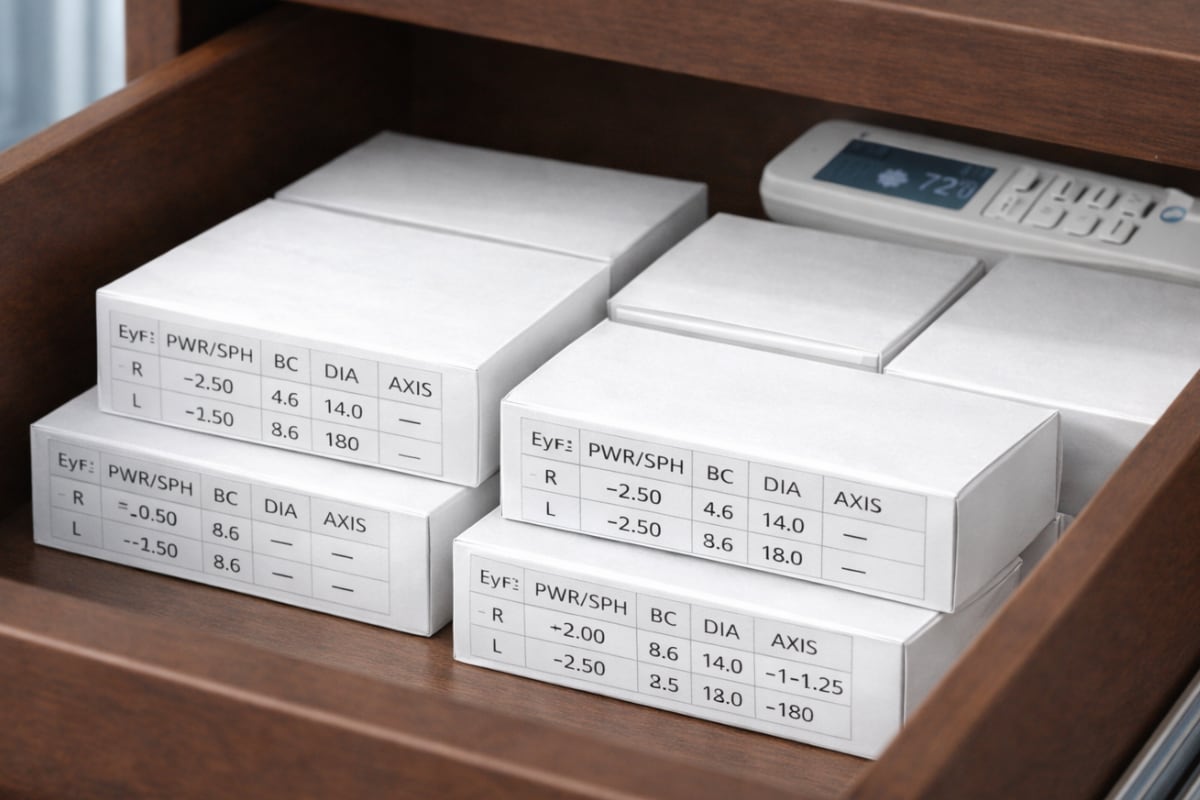
Your contacts stay safest when you treat them like a sealed medical product. The goal is simple: keep packs intact and avoid extreme conditions.
The Correct Way To Store Contact Lenses In Their Packaging
Best Practices For Unopened Boxes And Blister Packs
- Store contacts in a cool, dry place away from direct sunlight
- Keep lenses in their original contact lens packaging until you are ready to use them
- Avoid freezing conditions and do not store lenses where temperatures swing a lot
Many lens instructions for use explicitly say to store lenses at room temperature and not allow them to freeze.
Before You Open A New Blister
- Check the seal and liquid level
- Confirm the contact lens expiration date is still valid
If the pack looks damaged or unsealed, discard it
What To Do If Your Order Arrives Warm, Frozen, Or Delayed
Delivery conditions vary by season, so it helps to know what to do when a box arrives and feels off.
If The Box Feels Hot
- Bring it indoors and store it at room temperature
- Do not leave contacts in a parked car or in direct sun
- Inspect blister packs for leaks or low liquid before use
If A Blister Pack Looks Frozen Or Slushy
- Keep it sealed and let it return to room temperature naturally
- Do not try to open or use a lens from a damaged pack
- Follow the manufacturer rule: store at room temperature and do not allow lenses to freeze
If Shipping Took Longer Than Expected
- As long as blister packs are sealed and within the printed expiration date, they are still considered sterile in the sealed blister
- If the outer box is crushed, focus on the blister packs. If any blister is compromised, discard that lens
What To Do If Packaging Arrives Damaged Or Looks Tampered With
If anything about the packaging looks suspicious, do not wear the lens.
Do Not Use A Lens If
- The foil lid is lifting or partly peeled
- The blister is cracked, punctured, or leaking
- The lens looks dried out or stuck to the foil
- The pack is missing liquid
CooperVision notes sterility depends on the blister pack remaining sealed, and lenses should be discarded if a blister pack becomes accidentally unsealed.
What To Do Next
- Take photos of the damaged packaging
- Set the lens aside and do not attempt to wear it
- Contact the seller and request a replacement or refund based on their p
Read the Label and Shop With Confidence
Once you know how to read contact lens packaging labels, buying and using contacts gets a lot simpler. Check the contact lens expiration date on both the box and the blister pack, and remember that expiration is different from your replacement schedule.
Want to save money and order the right contact lenses? Shop contact lenses that match your box numbers on your prescription.
Contact Lens Packaging, Labels, and Expiration Dates FAQs
1. Can I use contacts if the blister pack looks wrinkled but is not leaking?
2. Do expiration dates apply to both the box and the blister pack?
3. What should I do if I cannot find an EXP date on my contact lens packaging?
4. Are all contact lens blister packs the same size and shape?
5. Do I need to keep the contact lens box after I open the lenses?
References
Buying Contact Lenses. U.S. Food and Drug Administration (FDA). https://www.fda.gov/medical-devices/contact-lenses/buying-contact-lenses. Date Accessed: January 14, 2026.
Contact Lens Solutions and Products. U.S. Food and Drug Administration (FDA). https://www.fda.gov/medical-devices/contact-lenses/contact-lens-solutions-and-products. Date Accessed: January 14, 2026.
UDI Basics. U.S. Food and Drug Administration (FDA). https://www.fda.gov/medical-devices/unique-device-identification-system-udi-system/udi-basics. Date Accessed: January 14, 2026.
Preventing Eye Infections When Wearing Contacts. Centers for Disease Control and Prevention (CDC). https://www.cdc.gov/contact-lenses/prevention/index.html. Date Accessed: January 14, 2026.
ONE by ONE Recycling Program. TerraCycle. https://www.terracycle.com/en-US/brigades/bausch-lomb-one-by-one-recycling-program. Date Accessed: January 14, 2026.
Medical Disclaimer: This content is for informational purposes only and is not medical advice. Contact lenses require a valid prescription and proper fitting before ordering or wearing. If you have pain, redness, discharge, light sensitivity, or vision changes, remove your lenses and contact an eye doctor.