
Table of Contents
Ever glanced at a contact lens prescription and gotten stuck on OD vs OS? Those two abbreviations look small, but they decide which lens goes in which eye.
Mixing them up can mean blurry vision and an uncomfortable first wear, especially when comparing specialty options such as toric daily contact lenses or the best multifocal contact lenses for near and distance vision needs.
Below is a quick, save-worthy cheat sheet so you can match your right and left RX contacts correctly before you order online. You can view an expanded version of a contact lens prescription calculator on our dedicated page, which can also help when reviewing distance-vision contacts for nearsighted prescriptions.
OD vs. OS: What Do They Mean?
We’ll start with OD and OS because these two labels help you keep the right and left eye information straight. This is especially useful when ordering specialty designs such as varifocal contact lenses, where the lens power and near-vision correction must stay matched to the correct eye.
Here’s the simplest way to remember it:
- OD (right eye): “R” for right, this is the lens labeled for your right eye.
- OS (left eye): “S” can help you remember “sinister,” which is Latin for left.
- OU (both eyes): both eyes, often used when the same info applies to each eye.
These labels also apply to prescriptions for multifocal contacts, where the lens power and additional near-vision correction must remain matched to the correct eye.
If your prescription includes CYL and AXIS, use your OD and OS details carefully when reviewing good contact lenses for astigmatism so each box matches the correct eye.

Why OD Vs OS Matters When You Order Contacts Online
Most people do not have perfectly matching eyes. Even if your prescription is close, your lens power or lens type can differ between OD and OS. Swapping them can lead to blur, eye strain, and frustration that feels like “these contacts just do not work,” when the issue is simply the wrong eye. This is an important detail to note when buying prescription contact lenses.
Two Fast Checks Before You Click “Place Order”
- Match each product box to the correct line on your prescription: OD line and OS line.
- If only one eye has astigmatism or multifocal correction, make sure that special lens is attached to the correct eye (OD or OS).
Quick Safety Tip to Prevent Mix Ups
- If your right eye and left eye have different numbers, label your boxes “R” and “L” as soon as you open the shipment.
- Keep the right and left boxes on different sides of a drawer so grabbing the wrong one is less likely.
If the rest of your prescription looks like alphabet soup, this guide to what the numbers on your prescription mean makes it easy to follow.
Where to Find OD and OS on Your Contact Lens Prescription and Packaging
Sometimes the confusing part is not what OD and OS mean, it is simply finding them. This section shows you where they usually appear on your prescription and how to match them to your box or blister packs.
1. Where OD and OS show up on the prescription
Most prescriptions list your details in one of these layouts:
- Two columns labeled OD and OS
- Two rows labeled Right eye (OD) and Left eye (OS)
- Sometimes you will also see OU if both eyes share the same values
What you typically match under each eye:
- Brand or product name
- PWR or SPH (power)
- BC (base curve) and DIA (diameter)
- If needed: CYL and AXIS for astigmatism, or ADD for multifocal
2. Where OD and OS show up on the box and blister pack
Some boxes may not say OD/OS. Most show lens parameters (Power, Base Curve, Diameter), so you match the box to the OD or OS line on your prescription.” You can decide which box is for OD or OS by matching it to your prescription.
Use this quick matching checklist before you open anything:
- Put your prescription next to the boxes.
- Pick up one box and find the PWR or SPH value.
- Match that value to the OD line or the OS line on your prescription.
- Confirm BC and DIA match if they are listed on your prescription.
- If you have toric or multifocal lenses, also match CYL, AXIS, or ADD exactly.
3. If both eyes are the same
If your doctor lists the same numbers for both eyes, you might see OU on the prescription. Even then, it is still smart to keep boxes together with the prescription photo saved on your phone, so reordering is faster.
To spot the EXP and LOT details fast, use this contact lens packaging and expiration date guide for buyers before you open a fresh box.
OD vs OS Calculator
Want a fast way to confirm you are entering the right eye and left eye correctly? Use the OD vs OS calculator below to organize your values and reduce common mix ups at checkout.
Before you start, have these ready
- Your current contact lens prescription
- The brand and product name you were prescribed
- Any extra fields listed for astigmatism or multifocals, like CYL, AXIS, or ADD
Lens.com Prescription Decoder Tool
Enter your prescription details below to get a plain-English breakdown. Select "Glasses" or "Contacts" mode.
Common OD and OS Misconceptions
Before you check out, use this quick myth versus fact table to prevent the most common OD and OS mix ups:
| Myth | Fact | Quick Fix |
|---|---|---|
| OD and OS are from the doctor’s point of view while facing you. | OD means your right eye and OS means your left eye on the prescription, from your perspective. | Label your boxes R and L first, then match OD to R and OS to L. |
| OD means once daily or one day. | OD and OS are eye labels, not a contact lens schedule. | If you see daily on contacts, that is the replacement schedule, not OD. |
| If the numbers look close, swapping OD and OS does not matter. | Even small differences can cause blur and uncomfortable vision, especially for screens or driving. | Enter each eye separately, then reread the order summary before checkout. |
| You can swap contact lens brands as long as the power matches. | Contact lens prescriptions are written for a specific brand and may include fit details like base curve and diameter. | Match the brand and lens name exactly unless your prescriber approves a change. |
Sphere, Cylinder, and Axis Explained
Once OD and OS are sorted, the next place people hesitate is the “numbers” section. The good news is that most prescriptions follow the same pattern, and only some wearers will have CYL and AXIS.
What SPH, CYL, and AXIS Mean and Who Needs Them
Once you know which numbers belong to each eye, you will likely notice more abbreviations that feel a bit technical. We will break down SPH, CYL, and AXIS in plain language and help you figure out if they apply to your lenses.
| Rx Term | What It Means | Who Needs It | Ordering Notes |
|---|---|---|---|
| SPH (Sphere) or PWR | Main lens power that corrects nearsightedness or farsightedness, measured in diopters | Most contact lens wearers | Copy the sign and number exactly for OD and OS |
| CYL (Cylinder) | Extra power used to correct astigmatism | Toric lens wearers | If CYL is listed, you usually need toric contacts and must match OD and OS values precisely |
| AXIS | Direction of astigmatism correction | Toric lens wearers | Appears only when CYL appears and must match exactly for stable vision |
Reminder: Contact lens prescriptions may also list brand, base curve, diameter, and other product identifiers, because the lens is a regulated medical device and must match the prescribed product.
Nearsighted vs Farsighted Prescriptions and What Plus and Minus Mean
- Minus (2.00): A minus sign usually means nearsightedness, so distance vision is blurry without correction.
- Plus (2.00): A plus sign usually means farsightedness, so close up work may be harder, especially with reading or screens.
Sphere, Cylinder, and Axis on Eye Prescriptions
Quick Visual Examples: These sample prescriptions show what nearsighted (minus), farsighted (plus), astigmatism (CYL + AXIS), and multifocal (ADD) often look like on an eye doctor’s printout. Values are examples only.
Nearsighted prescription (minus in Sphere/SPH)
Nearsighted prescriptions usually show a minus (-) number in the Sphere (SPH) box. This corrects blurry distance vision.
| Type | Eye | Sphere | Cylinder | Axis | Prism | Base | Add |
|---|---|---|---|---|---|---|---|
| Distance | OD | -3.75 | — | — | — | — | — |
| Distance | OS | -4.75 | — | — | — | — | — |
Pupillary distance (PD): 63
Farsighted prescription (plus in Sphere/SPH)
Farsighted prescriptions often show a plus (+) number in the Sphere (SPH) box. This can help with near tasks like reading or screens.
| Type | Eye | Sphere | Cylinder | Axis | Prism | Base | Add |
|---|---|---|---|---|---|---|---|
| Distance | OD | +2.25 | — | — | — | — | — |
| Distance | OS | +1.75 | -0.75 | 175 | — | — | — |
Pupillary distance (PD): 63
Astigmatism prescription (Cylinder + Axis)
If you have astigmatism, you’ll usually see values in Cylinder (CYL) and Axis. For contacts, this typically means a toric lens.
| Type | Eye | Sphere | Cylinder | Axis | Prism | Base | Add |
|---|---|---|---|---|---|---|---|
| Distance | OD | -2.50 | -1.25 | 170 | — | — | — |
| Distance | OS | -2.75 | -1.00 | 180 | — | — | — |
Pupillary distance (PD): 62
Multifocal prescription (ADD for near)
Multifocal (sometimes called bifocal or progressive) prescriptions include an ADD value. For contacts, the lens type is usually listed as multifocal.
| Type | Eye | Sphere | Cylinder | Axis | Prism | Base | Add |
|---|---|---|---|---|---|---|---|
| Multifocal | OD | -2.25 | -0.75 | 165 | — | — | +1.75 |
| Multifocal | OS | -2.75 | — | — | — | — | +1.75 |
Pupillary distance (PD): 63 Near PD: 60
Once your eye doctor has established those values, you can compare contact brands for astigmatism that are available in your prescribed power, cylinder, and axis.
If you’re not sure whether you have a contact lens prescription or a glasses prescription, check for BC, DIA, and a contact lens brand or confirm with your eye doctor.
Two Practical Tips That Prevent Entry Mistakes
- Always include the sign. Plus and minus are not interchangeable, and leaving off the sign can flip the correction.
- If your prescription includes CYL and AXIS, copy them exactly for the correct eye, and do not “round” values unless your prescriber has written them that way.
If anything looks unclear on your copy, request a clean reprint from your prescriber before ordering. Under the Contact Lens Rule, patients should receive a copy of their contact lens prescription after a fitting.
If you have astigmatism and see extra columns, this simple explanation of CYL and AXIS on an eye prescription helps you double check your values before ordering.
How to Read the Rest of a Contact Lens Prescription
Once you know OD and OS, the rest is just matching the right letters and numbers to the right eye. A valid contact lens prescription is designed so a seller can fill it completely and accurately, including details like lens power, brand or manufacturer, and fit measurements such as base curve and sometimes diameter. For example, contact lenses for nearsightedness typically have the minus power specified for each eye on the prescription.

What Do All the Letters and Numbers Mean on a Contact Lens Prescription?
A contact lens prescription is basically your eye doctor’s “exact recipe” for safe, clear vision. It tells a retailer which lens product you’re allowed to buy and the exact values that must match at checkout. Keeping it current matters, too, because prescriptions expire and your eyes can change over time.
| Label | What It Means | Why It Matters |
|---|---|---|
| OD | Right eye | Ensures you enter the right lens numbers for your right eye |
| OS | Left eye | Ensures you enter the right lens numbers for your left eye |
| OU | Both eyes | Indicates the same information may apply to both eyes, if listed |
| PWR or SPH | Lens power in diopters | You must match the plus or minus sign and the number exactly |
| BC | Base curve | Helps the lens fit correctly on your eye, match if listed |
| DIA | Diameter | Helps the lens fit correctly, match if listed |
| CYL | Astigmatism correction amount | Needed for toric lenses, must match exactly if listed |
| AXIS | Direction of astigmatism correction | Measured in degrees, must match exactly if listed |
| ADD | Extra near power for multifocals | Needed for multifocal lenses, must match exactly if listed |
| Expiration Date | When the prescription is no longer valid | You need a current prescription to order contact lenses |
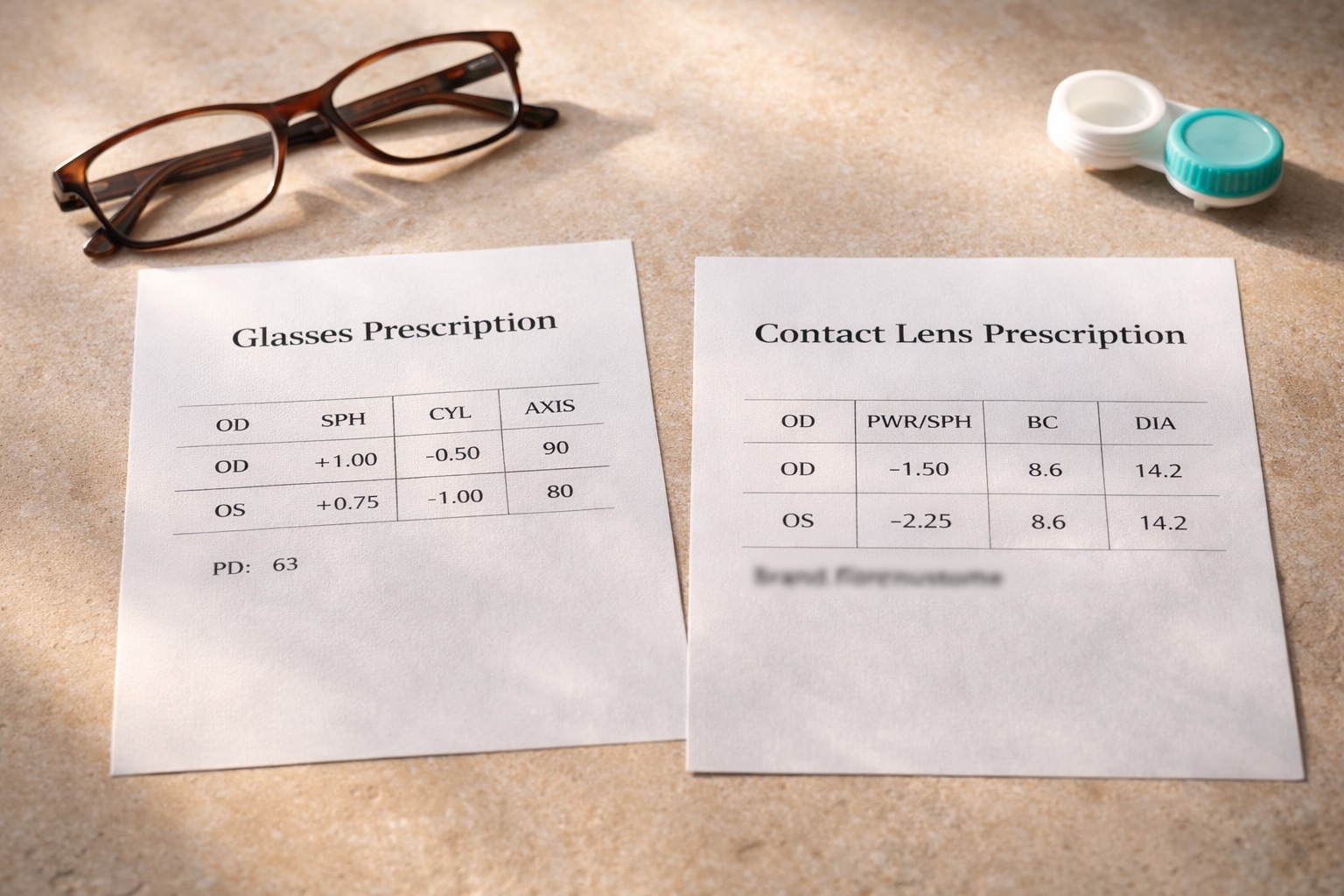
Important Note: If you’re looking at a prescription that lists Prism or Pupillary Distance (PD), you may be holding a glasses prescription, not a contact lens prescription. Contacts usually require BC, DIA, and a specific lens brand, while glasses often include measurements that help position lenses in frames.
For a deeper look at PWR and how it connects to clear distance vision, read what PWR means on a contact lens prescription and why it matters.
Glasses vs Contact Lens Prescriptions
Even when both prescriptions use OD and OS, a contact lens prescription is not the same as a glasses prescription. Contacts sit directly on the eye and require specific fit and product details, while glasses sit away from the face and use different measurements.
Where is the prism power on my prescription?
If your prescription includes Prism, your eye doctor is correcting an eye-alignment issue that can cause double vision (diplopia). Prism in eyeglasses works by bending light so the image lands where your eyes can merge it into a single picture.
Prism prescription (Prism + Base direction)
If your prescription includes Prism, your eye doctor is correcting an eye-alignment issue that can contribute to double vision. Prism is listed as a number (measured in prism diopters) plus a Base direction such as BU (Base Up), BD (Base Down), BI (Base In), or BO (Base Out).
| Type | Eye | Sphere | Cylinder | Axis | Prism | Base | Add |
|---|---|---|---|---|---|---|---|
| Distance | OD | -1.50 | — | — | 1.50 | BO | — |
| Distance | OS | -1.25 | — | — | 1.00 | BI | — |
Pupillary distance (PD): 63
The Simplest Way to Think About It
A glasses prescription tells a lab how to make lenses for frames. A contact lens prescription tells a seller exactly which lens product and fit specs to dispense safely.
What a Contact Lens Prescription Includes That Glasses Usually Do Not
- BC and DIA: These fit measurements are specific to contacts.
- Brand and lens material or manufacturer: Contact lenses are not one size fits all. The brand is part of the prescription.
These product and fit details are especially important when ordering custom contact lenses, since options such as custom RGP or theatrical lenses may have specific base curve, diameter, material, or design requirements.
Why the Power Can Be Different Between Glasses and Contacts
Glasses sit a short distance from your eyes, while contacts sit on the cornea. Because of that distance difference, the numbers can differ even for the same eye.
Quick Do and Do Not List
Before you hit ‘Place Order’, use this quick do and do not list to keep your OD and OS entries accurate.
| DO’s | DON’Ts |
|---|---|
| Use your contact lens prescription when ordering contacts online. | Copy a glasses prescription into a contact lens order form. |
| Match brand, power, and fit numbers exactly for OD and OS. | Swap OD and OS values when both eyes look almost the same. |
| Confirm the plus or minus sign on power before submitting. | Accept a different brand as a substitute without prescriber approval. |
| Enter OD first, then enter OS, then review both again. | Guess BC or DIA values when they are missing or unclear. |
| Save a photo of your prescription for fast and accurate reorders. | Wear a lens if the label does not match your prescription details. |
How to Order Contacts Online Without Mixing Up OD and OS
In the United States, sellers generally must get a copy of your prescription or verify it with your prescriber before shipping, so accuracy at checkout matters.

Step By Step Checkout Routine You Can Reuse Every Time
Use this same routine every time you reorder so OD and OS never get flipped.
1. Open your contact lens prescription.
Make sure it is a contact lens prescription, not a glasses prescription. Check the expiration date so you know it is still valid for ordering. Keep it on screen while you fill out the checkout fields.
2. Confirm the lens brand and product name.
Match the exact brand and product listed on your prescription. If you’re ordering pure hazel contact lenses, confirm that the exact prescribed product, color, and lens parameters match before continuing.
3. Start with OD and enter the right eye first.
Locate the OD line and copy each value exactly as written. Pay special attention to the plus or minus sign on power because that is easy to miss. Enter the numbers slowly so you do not transpose digits.
4. Move to OS and enter the left eye next.
Locate the OS line and copy each value exactly as written. Do not copy and paste from OD unless your prescription truly shows the same values. Treat OS as its own separate entry and double check it.
5. Match PWR or SPH for each eye.
Confirm the power for OD and OS before you move on to other fields. Make sure the sign and the number match your prescription for each eye. If one eye looks blurrier than the other later, this is the first field to recheck.
6. Match CYL and AXIS if you have astigmatism.
If your prescription includes CYL and AXIS, you are likely ordering toric lenses. Enter both values exactly because even small changes can affect clarity and stability. If either field is blank on your prescription, do not guess.
7. Match BC and DIA when they are listed.
Base curve and diameter help identify the specific lens that was fitted for your eyes. If your prescription lists BC and DIA, match them exactly at checkout. If you cannot find them, confirm with your prescriber or the retailer before ordering.
8. Do one final OD and OS review before paying.
Compare the checkout entries line by line against your prescription. Read OD out loud, then read OS out loud, so your brain catches swaps faster. If anything looks off, correct it before you submit the order.
If this is your first online order, bookmark how to buy contact lenses online without common ordering mistakes so you can check out with confidence.
A Quick Order Checklist
Use this quick checklist table to spot errors before you place your order online.
| Step | What To Check | Why It Prevents Mistakes |
|---|---|---|
| 1. Match the brand and lens name | Exact product listed on your prescription | Helps you avoid ordering a similar sounding lens that does not match your prescription |
| 2. Confirm OD values | PWR SPH and any CYL AXIS ADD listed for the right eye | Right eye and left eye often differ, even slightly |
| 3. Confirm OS values | PWR SPH and any CYL AXIS ADD listed for the left eye | Prevents the most common right and left mix up |
| 4. Confirm BC and DIA when listed | Base curve and diameter match your prescription | These are fit details used to dispense the correct lens |
Prescription Verification Note: In the United States, sellers typically must verify your contact lens prescription with the prescriber if you don’t provide a copy. Under the Federal Trade Commission’s Contact Lens Rule, if a prescriber doesn’t respond to a complete verification request within eight business hours, the order may be verified and shipped, so entering OD and OS correctly matters.
How Often Should You Get an Eye Exam?
A current prescription is only one piece of safe contact lens wear. Regular eye exams help your eye doctor confirm that your lens fit, vision, and eye health still look good, even if your numbers feel “about the same.”
A practical schedule that works for most people
- Contact lens wearers: Schedule an eye exam every year (or as your eye doctor recommends) to confirm your prescription, lens fit, and eye health. Annual checks can also catch dryness or irritation early before it affects comfort or safety.
- Adults (low risk): If you have no symptoms and no risk factors, many optometry guidelines suggest a comprehensive eye exam at least every 2 years. See an eye doctor sooner if you notice new blurry vision, headaches, or eye discomfort.
- Adults 40 and up: Get a baseline eye disease screening at age 40, then follow the schedule your eye doctor sets based on your results and risk factors. This matters because conditions like glaucoma can develop with few early symptoms.
- Adults 65 and up: Plan for an eye exam every 1 to 2 years, even if your vision seems stable. Regular exams help monitor age-related changes and catch treatable problems early.
- Kids: Vision checks are recommended around 6–12 months, 1–3 years, and 3–5 years, then continued regularly during the school years (often through routine visits or school screenings). Early detection matters because vision problems can affect reading and classroom learning.
When to Ask Your Eye Doctor
Sometimes the smartest move is pausing the order and getting clarity from your eye doctor. It saves time, avoids returns, and protects comfort and eye health.

Good Reasons To Ask Before You Order
Here are the common situations where asking first can save you time and help you order with confidence.
- You are switching brands, materials, or replacement schedule
- You are unsure whether you need toric lenses for astigmatism or multifocals
- Your prescription is expired or you cannot find the most recent copy
- One eye feels consistently worse, even when OD and OS are entered correctly
- You want to confirm whether a private label lens is truly identical to your prescribed lens
If Anything Feels Wrong After You Start Wearing a New Box
Stop and contact an eye doctor if you have eye pain or discomfort, red or swollen eyes, blurred or decreased vision, or signs of infection. These symptoms can be associated with serious complications, so it is not worth trying to push through.
What to Have Ready Before You Call
If you do need to call your eye doctor or the seller, having a few details ready makes the conversation much easier.
- A photo of your prescription, including OD and OS lines
- The exact lens brand and product name you are ordering
- The numbers you entered at checkout, especially PWR SPH, BC, DIA, and any CYL AXIS ADD
- If you already opened a box, the lot information from the packaging can help with traceability
- A short symptom note if comfort or vision is the issue, including which eye and when it happens
A Simple Habit That Makes Reordering Easier
Save a clear photo of your prescription in a secure folder on your phone so you can match OD and OS quickly next time. The FTC also encourages keeping a copy handy for ordering from any seller.
OD and OS Made Simple for Your Next Contact Lens Order
OD is your right eye and OS is your left eye, and getting that match right is the fastest way to avoid ordering the wrong lens.
Before you reorder, pull up your contact lens prescription, enter OD first, then OS, and double check the plus or minus sign. Remember that contact lenses require a current, valid prescription, so if anything looks unclear, it is worth confirming with your eye doctor before you place the order.
Want to save on your next contact lens order and make sure OD and OS are entered correctly? Shop and reorder your contact lenses and use your prescription to match each eye before checkout.
OD vs OS Eye on Contact Lens Prescriptions FAQs
1. If OD and OS have the same numbers, can I wear either lens in either eye?
If every parameter matches for both eyes, including brand, power, base curve, and diameter, the lenses may be interchangeable, but only if your prescription and box labels truly match. When in doubt, follow the OD and OS assignments exactly or confirm with your eye doctor.
2. What does “plano” mean on a contact lens prescription?
Plano means no vision correction power, but the lens still has fit and design specs that need professional prescribing. Even plano contacts are regulated medical devices and still require a valid contact lens prescription.
3. Can I buy colored or decorative contacts without a prescription?
No. All contact lenses, including decorative and colored lenses, require a prescription and proper fitting.
4. Can my right and left eyes be different brands or lens types?
Yes, it happens, especially if your eyes need different fits or designs, but you should only order exactly what your prescriber wrote for each eye. Mixing brands on your own can change fit and comfort, even if the power looks similar.
5. If my usual lens is out of stock, can an online seller switch me to a different brand?
A seller generally should not swap brands because that can count as altering the prescription, unless it is an identical private label equivalent made by the same manufacturer. If a substitution is suggested, ask your eye doctor first.
6. How long is a contact lens prescription valid?
In the US, the Contact Lens Rule sets a minimum expiration period of at least one year unless your prescriber documents a medical reason for a shorter time, and some states require longer. Always check the expiration date printed on your prescription before ordering.
7. Why does my box show a different name than what my prescription says?
Some lenses are sold as private label or store brand versions that are identical to a name brand lens made by the same manufacturer. Your prescription may list the manufacturer and any identical lens name to support comparison shopping.
8. What if the base curve or diameter on the website does not match my prescription?
Do not place the order as is, because base curve and diameter help determine fit and safety. Choose the exact match or contact the seller or your eye doctor to confirm what you should order.
9. Do I need pupillary distance to order contact lenses?
Most contact lens orders do not require pupillary distance because contact lens prescriptions are designed to be filled using parameters like power, brand or manufacturer, base curve, and diameter. If a site asks for it, double check you are in the contact lens checkout flow and not a glasses form.
10. I opened an OD lens by mistake for my OS eye. What should I do?
Do not wear it if there is any chance it is the wrong lens, since wearing the wrong lens can cause discomfort, blurred vision, or fit issues. Set it aside and confirm the label and prescription before using any lens, and if you already wore it and feel pain or redness, remove it and contact an eye doctor.
Disclaimer: This information is for general informational purposes only and is not a substitute for professional advice, diagnosis, or treatment.
References
Contact Lens Prescription. U.S. Food and Drug Administration (FDA). https://www.fda.gov/medical-devices/contact-lenses/contact-lens-prescription. Date Accessed February 4, 2026.
Buying Contact Lenses. U.S. Food and Drug Administration (FDA). https://www.fda.gov/medical-devices/contact-lenses/buying-contact-lenses. Date Accessed February 4, 2026.
Fairness to Contact Lens Consumers Act (Public Law 108–164). Congress.gov. https://www.congress.gov/108/plaws/publ164/PLAW-108publ164.pdf. Date Accessed February 4, 2026.
How to Read an Eyeglasses Prescription. American Academy of Ophthalmology (AAO). https://www.aao.org/eye-health/glasses-contacts/how-to-read-eyeglasses-prescription. Date Accessed February 4, 2026.
Evaluation of Visual Acuity. Caltrider D; Gupta A; Tripathy K (StatPearls). NCBI Bookshelf (National Library of Medicine, National Institutes of Health). https://www.ncbi.nlm.nih.gov/books/NBK564307/. Date Accessed February 4, 2026.
List of Error-Prone Abbreviations. Institute for Safe Medication Practices (ISMP) (hosted via ECRI/ISMP). https://home.ecri.org/blogs/ismp-resources/list-of-error-prone-abbreviations. Date Accessed February 4, 2026.