
It’s a beautiful, brand-new day. Your alarm goes off, you open your eyes, and for the first few seconds, the world looks like it’s set to low-resolution. That temporary morning haze is a completely normal reaction to what your eyes have been up to while you were fast asleep.
It’s your eyes booting up after hours of rest. From a stagnant tear film to mild overnight fluid buildup, a few subtle changes happen behind closed lids that temporarily scatter light and blur your view. Here is a look at what causes that familiar morning fog, why blinking fixes it, and when lingering blur might mean it’s time to check in with your eye doctor.
What Happens to Your Eyes While You Sleep?
When you go to sleep, your eyes don’t completely switch off. They go into night mode. Because your eyes stay shut all night, two major things happen to cause that familiar morning haze:
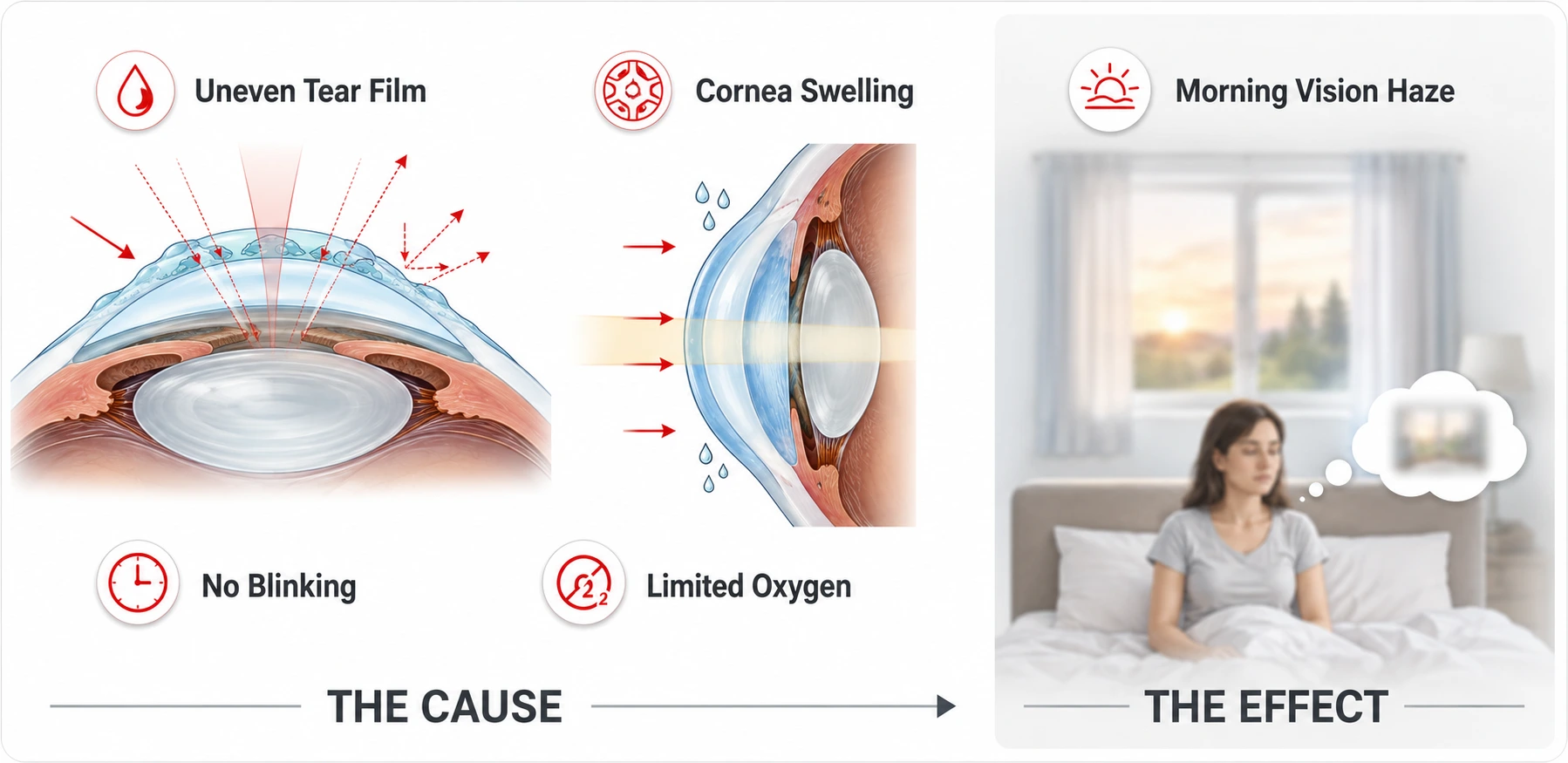
- Your tear film dries out unevenly. Blinking throughout the day constantly coats a fresh, smooth layer of tears across the surface of your eyes to keep your vision sharp and clear. When you sleep, however, you stop blinking. Without those blinks, your tear layer gets a little patchy by morning.
- Your closed eyelids block oxygen from reaching the surface of your eyes. Without that airflow, your eyes’ corneas absorb a tiny bit of fluid overnight to compensate for the lack of oxygen. They swell just enough to slightly distort how light enters your eye.
These make everything look a bit soft around the edges when you wake up.
Why Does Your Vision Take Time to Clear After Waking Up?
Why does it take a bit of time for your vision to clear up after you wake up? Your eyes are busy performing three quick setup steps:
- Restoring the smooth surface of your eyes
Blinking after waking up spreads a fresh, even layer of tears across your cornea, clearing away morning haze so light can enter smoothly. - Waking up the internal focus
Your pupils adjust to daylight, while your eye muscles start shifting focus between close objects (like your alarm or bedside table) and distant ones (like the scenery outside your window). Right after waking, this focusing system can feel slightly sluggish. - Stabilizing the cornea
Fresh air and normal tear movement help your cornea shed overnight fluid and settle into its normal daytime shape.
Give your eyes a moment to adapt to the light and blink naturally. Avoid rubbing them as this can irritate delicate tissues and temporarily distort your cornea further.
These adjustments usually wrap up within seconds or a few minutes. But if your morning vision takes a long time to clear, keeps getting worse, or shows up alongside other symptoms, it’s always smart to check in with an eye care professional.
What Makes Your Vision in the Morning More Noticeable?
Morning blur isn’t the same for everyone. Daily habits and environmental factors might interfere with your eyes’ natural rebooting:

- Dry eyes: An unstable tear film scatters light immediately upon waking. Blinking helps spread fresh moisture.
- Direct fans or AC vents: Sleeping in the path of moving air strips moisture from your eyes all night. Angle airflow away from your head to protect your eye surface.
- Dehydration: Skimping on water intake directly impacts tear quality, making your eyes feel rough, dry, and hazy by morning.
- Incomplete eyelid closure (Lagophthalmos): If your eyelids stay slightly open while you sleep, constant air exposure creates localized dry patches and temporary blur when you wake up.
- Allergies and rubbing: Irritation from allergies alters your tear quality. Rubbing your eyes to fix it only distorts your cornea further.
- Sleep crust and mucus: Normal overnight buildup can spread across the eye’s surface during that first open. A few blinks will clear the debris.
- Pre-bed screen strain: Looking at screens lowers your blink rate. You go to sleep with already-parched eyes that take longer to recover in the morning.
Can Contact Lenses Affect How Your Eyes See in the Morning?
First things first. Never wear contact lenses while sleeping unless your eye doctor specifically prescribed them for overnight use. Napping or sleeping in standard lenses starves your corneas of oxygen, severely increases your risk of serious infections, and virtually guarantees a foggy wake-up.
If your eye doctor does allow you to wear contacts, morning blur can hit a whole lot harder.
- Overnight oxygen deprivation: Sleeping in contacts cuts off oxygen to the eye surface, leading to mild corneal swelling and a distinctly foggy morning view.
- Using the wrong lens type overnight: As mentioned, daily disposables and standard soft lenses should never be worn to bed. Sleeping in them creates a breeding ground for irritation, inflammation, and severe infections.
- Ignoring extended-wear guidelines: Approved overnight lenses still require proper care. Always follow your prescription’s limits and your doctor’s instructions. Remove them at the first sign of pain, redness, or persistent haze.
- Lens-induced dryness: Contacts act like sponges. If your eyes are dry, the lenses dry out too. A dehydrated lens shifts unevenly over the cornea, scattering light and distorting your focus.
When Does Blurry Vision Become a Reason to See an Eye Doctor?
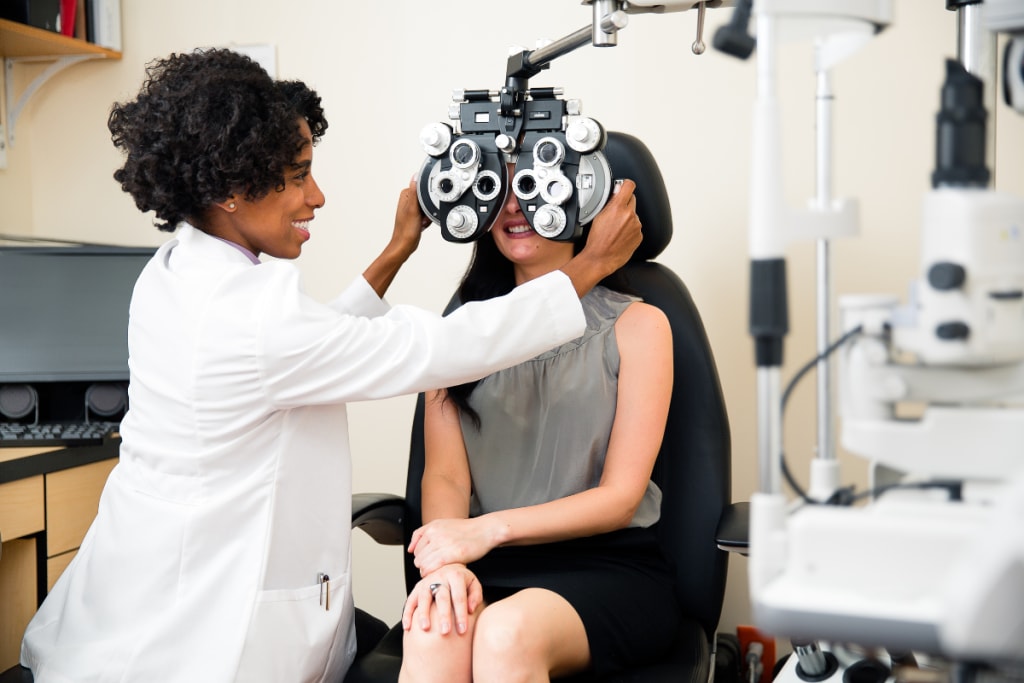
A little morning haze that clears up after a few blinks is nothing to worry about. But if that blur hangs around, keeps coming back, or brings other symptoms along with it, it’s time to get a professional opinion. Watch out for these symptoms:
- Persistent blur: It lasts well past your morning routine and doesn’t improve even with rapid blinking.
- One-sided symptoms: The blur consistently happens only in one eye rather than both.
- Pain and inflammation: Your blurry vision is accompanied by noticeable pain, heavy redness, or sensitivity to light.
- Flashes and floaters: You notice a sudden burst of new floaters, light flashes, or a dark shadow covering part of your field of view.
- Sudden vision loss: Your sight rapidly deteriorates without a clear cause.
Whenever your morning vision strays from what’s normal for you, playing it safe is always the right call. An eye care professional can easily pinpoint whether you’re dealing with a simple case of dry eyes or an issue that needs treatment.
The Bottom Line on Morning Blur
A little temporary haze at the start of the day is just your eyes’ natural way of hitting the power button. A few intentional blinks, a sip of water, and a minute to adjust to the morning light are usually all it takes to clear the view and get your day in focus.

Your eyes are great communicators, and persistent morning blurring is their way of asking for help. If the fog refuses to lift or comes with pain and redness, don’t hesitate to reach out to an eye care professional to ensure your eyes stay clear, comfortable, and healthy for many mornings to come.
Disclaimer: This content is for general informational purposes only and is not a substitute for professional advice, diagnosis, or treatment.
References
Dry Eye. National Eye Institute. https://www.nei.nih.gov/eye-health-information/eye-conditions-and-diseases/dry-eye. August-06-2025. Date Accessed: August 25, 2026.
About Dry Eye Disease. American Academy of Ophthalmology. https://www.aao.org/eye-health/diseases/what-is-dry-eye. January-16-2025. Date Accessed: August 25, 2026.
Contact Lens Risks. U.S. Food and Drug Administration. https://www.fda.gov/medical-devices/contact-lenses/contact-lens-risks. September-04-2018. Date Accessed: August 25, 2026.
About Sleeping in Contact Lenses. Centers for Disease Control and Prevention. https://www.cdc.gov/contact-lenses/about/about-sleeping-in-contact-lenses.html. May-27-2025. Date Accessed: August 25, 2026.
About Contact Lenses. Centers for Disease Control and Prevention. https://www.cdc.gov/contact-lenses/about/index.html. May-27-2025. Date Accessed: August 25, 2026.
The Effects of Overnight Contact Lens Wear on the Cornea. Holden BA, Sweeney DF, Sankaridurg PR, et al. Eye & Contact Lens / Contact Lens Association of Ophthalmologists. https://journals.lww.com/claojournal/. 2001. Date Accessed: August 25, 2026.