
Aqualite Contact Lenses
The Aqualite family includes private-label versions of select CooperVision lenses, but the products within it are built for different types of vision correction. Some use an aspheric design for standard spherical prescriptions, while Aqualite Toric is made to correct astigmatism and keep the lens properly oriented on the eye.
These lenses are designed to refine how light is focused across the lens surface, while the toric design helps maintain stable astigmatism correction. Together, these reusable soft contact lenses address common refractive needs through two distinct optical approaches. If your prescription needs Aqualite lenses, you can order yours right here at an affordable price.
How Aqualite Lenses Manage Different Types of Vision Correction
Aqualite lenses use different optical designs to address different refractive needs. The standard spherical products use an aspheric surface to manage how light is focused across the lens, while Aqualite Toric adds astigmatism correction that must remain aligned with the eye.
Each of these contact lenses have different approaches, so let's help you understand how they differ and why, despite being in the same family, they aren't interchangeable.
Aspheric Lens Refines Focus
A perfectly spherical surface maintains the same basic curvature pattern from the center toward the edge. An aspheric contact lens changes curvature more gradually across its optical surface, allowing the design to manage how central and peripheral light rays come together. This can help reduce certain optical distortions and support clearer, more consistent focus.
Aspheric design doesn't mean it's meant as a contact lens for astigmatism. It describes the shape of the optical surface rather than the type of prescription written for the wearer. A spherical Aqualite lens can therefore use aspheric optics while still being prescribed primarily with a standard sphere power.
How Aqualite Toric Keeps Astigmatism Correction Aligned
Astigmatism requires different amounts of correction in different directions across the eye. Aqualite Toric uses cylinder power and an axis measurement to place that correction in the required orientation. For the wearer to receive stable vision, the lens must keep those corrective powers aligned rather than rotating freely with every blink.
The toric lens design helps manage this movement and encourages the lens to settle in a predictable position. When orientation remains consistent, the cylinder correction stays closer to its intended axis. If the lens rotates excessively or settles inconsistently, vision may temporarily blur, shift, or fluctuate after blinking.
Two Designs With Different Jobs
The spherical and toric branches of Aqualite aren't simply different strengths of the same lens. The aspheric spherical design focuses on refining light for prescriptions that don't require cylinder-and-axis correction, while Aqualite Toric must correct astigmatism and control the lens's rotational position at the same time.
This difference affects more than the prescription numbers printed on the box. Optical surface shape, thickness distribution, lens movement, and orientation all influence how each design performs on the eye. The correct Aqualite product therefore depends on the complete prescribed lens design, not just the sphere power.
Compare Aqualite Lenses By Manufacturer, Material, and Price
|
Average Cost per day
|
Contact Lens Manufacturer
|
Contact Lens Type
|
Contact Lens Material Type
|
Contact Lens Water Content Percentage
|
Contact Lens Blocks UV
|
Each Box Contains
|
Average Star Rating
|
|
|---|---|---|---|---|---|---|---|---|
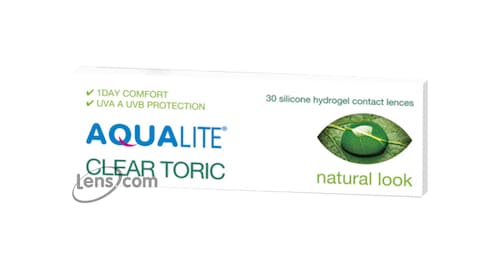
| Aqualite Toric (Same as Biomedics Toric) | $0.88 | CooperVision | Daily | 45% ocufilcon D | 55% | 6 lenses, a 3-month supply |
|
|
| Aqualite 55 Pro Aspheric (Same as Biomedics 55 Premier Asphere) | $0.64 | CooperVision | Daily | 45% ocufilcon D | 55% | 6 lenses, a 3-month supply |
|
|
| Aqualite 55 Premier (Same as Biomedics 55 Premier Asphere) | $0.64 | CooperVision | Daily | 45% ocufilcon D | 55% | 6 lenses, a 3-month supply |
|
Save More on Aqualite Lenses With Rebates
|
Contact Lens Manufacturer
|
Contact Lens Type
|
Contact Lens Material Type
|
Contact Lens Water Content Percentage
|
Contact Lens Blocks UV
|
Each Box Contains
|
Average Star Rating
|
|---|
What Aspheric Means in Contact Lenses
Aspheric describes an optical surface whose curvature gradually changes from the center toward the outer portion of the lens. Instead of following one uniform spherical curve, the lens is shaped to control how light rays passing through different areas are brought into focus.
How an Aspheric Surface Differs From a Spherical One
A basic spherical surface follows a consistent curvature pattern across the lens. With an aspheric design, the curvature changes progressively from the center to the edge. This gives the lens designer greater control over how light travels through both the central and peripheral optical zones.
Why Curvature Can Affect Visual Quality
Light entering through the outer areas of a curved lens may focus slightly differently from light passing through the center. This effect is known as spherical aberration and can contribute to halos, glare, reduced contrast, or less precise focus in some viewing conditions. An aspheric design can be shaped to help manage this difference and support more consistent image quality across the optical surface.
Aspheric Doesn't Mean Toric
An aspheric lens isn't automatically an astigmatism lens. Aspheric refers to how the curvature changes across the lens, while toric refers to a design that provides different corrective powers in different directions. A wearer can therefore have an aspheric contact lens for a standard spherical prescription without having cylinder or axis values.
The Prescription Still Determines the Correct Lens
Aspheric optics are one feature within a complete contact lens design. Material, base curve, diameter, power range, and how the lens fits the eye also influence its performance. Even when two lenses both use aspheric surfaces, they shouldn't be treated as interchangeable unless the complete prescribed product matches.
Is an Aspheric Lens the Same as an Astigmatism Lens?
No. Although both designs are intended to improve visual performance, they solve different optical problems. An aspheric lens refines how light is focused through the lens surface, while a toric lens is specifically engineered to correct astigmatism by providing different corrective powers in different directions.
Aspheric Refers to the Shape of the Lens
An aspheric contact lens gradually changes its curvature from the center toward the edge instead of following a single spherical curve. This optical shape can help manage spherical aberration and produce more consistent focus across the viewing area. The design improves how light passes through the lens, but it doesn't add the cylinder-and-axis correction required for astigmatism.
Toric Refers to the Type of Vision Correction
A toric contact lens is designed for eyes with astigmatism, where the eye doesn't focus light evenly in every direction. Instead of using one uniform corrective power, the lens combines sphere, cylinder, and axis values so different meridians of the lens correct different amounts of refractive error. This is why toric lenses must maintain a specific orientation on the eye.
Can an Astigmatism Lens Also Be Aspheric?
Yes. These terms describe different characteristics of a contact lens, so they aren't mutually exclusive. A toric lens may incorporate aspheric surfaces as part of its optical design while still providing cylinder-and-axis correction for astigmatism. In other words, aspheric describes the lens shape, while toric describes the prescription it is built to correct.
How Eye Care Professionals Choose Between Them
The decision isn't based on whether one design is better than the other. Instead, the prescribed lens depends on the wearer's refractive error, corneal measurements, visual needs, and clinical fitting results. Someone with a standard spherical prescription may benefit from an aspheric spherical lens, while a wearer with clinically significant astigmatism typically requires a toric design to achieve stable, accurate vision.
Toric Lenses Need to Stay in Position
A toric contact lens corrects astigmatism by placing different amounts of power in specific directions across the lens. For that correction to remain accurate, the lens must settle in a predictable orientation on the eye. If it rotates too far away from its intended position, the cylinder correction may no longer align with the wearer's astigmatism axis.
Astigmatism Correction Has a Direction
A standard spherical lens applies the same corrective power in every meridian. A toric lens works differently. It contains a cylinder power that corrects the uneven focusing associated with astigmatism, along with an axis value that identifies where that correction must be positioned. This directional component is why toric lenses can't rotate freely without affecting vision.
The Axis Must Line Up With the Eye
The axis on a contact lens prescription is measured in degrees and describes the orientation of the cylinder correction. When the toric lens settles properly, its optical zones align with the prescribed axis. If the lens rotates, those zones shift away from the intended direction, which can reduce clarity even though the printed prescription values haven't changed.
Blinking Naturally Moves the Lens
Every contact lens moves slightly as the eyelids blink across its surface. Small, controlled movement helps support tear exchange and normal lens wear, but a toric lens must also return to a stable position after each blink. Its shape and thickness distribution are designed to make that movement predictable rather than random.
How Toric Lenses Control Rotation
Toric lenses use stabilization features that interact with the eyelids and the shape of the eye. Depending on the design, certain areas may be thicker, thinner, or shaped differently to guide the lens into its intended orientation. The goal isn't to stop all movement, but to help the lens settle consistently after blinking or eye movement.
Stable Position Supports Stable Vision
When a toric lens maintains a consistent orientation, the cylinder and axis correction remain aligned with the eye. Excessive or inconsistent rotation may cause blur, ghosting, or vision that shifts after blinking. This is why eye care professionals evaluate both visual sharpness and rotational behavior when fitting a toric lens.
How Is Aqualite Toric Different From a Spherical Aqualite Lens?
Aqualite Toric and spherical Aqualite lenses belong to the same private-label family, but they aren't simply versions of the same lens with different powers. Each is built around a different type of refractive correction. The spherical design addresses prescriptions that use one primary power, while Aqualite Toric adds directional correction for astigmatism.
They Correct Different Refractive Errors
A spherical Aqualite lens is generally used when the eye needs a consistent amount of nearsighted or farsighted correction across its meridians. Aqualite Toric is designed for astigmatism, where the eye focuses light unevenly in different directions. It must correct the wearer's basic refractive error while also compensating for that directional difference.
The Prescription Contains Different Measurements
A spherical contact lens prescription mainly identifies the required sphere power, along with the prescribed product and fitting parameters. A toric prescription adds cylinder and axis values. Cylinder indicates the amount of astigmatism correction, while axis identifies the orientation in which that correction must be placed.
The Optical Designs Have Different Priorities
The spherical Aqualite design uses aspheric optics to refine how light is focused across the lens surface. Aqualite Toric has the additional task of delivering astigmatism correction in the correct direction. Its optical and physical design must therefore account for both visual correction and rotational behavior on the eye.
They May Feel and Move Differently
Differences in thickness profile, edge geometry, and stabilization can affect how the two lenses interact with the eyelids and tear film. A toric lens may feel or settle differently from a spherical lens even when both come from the Aqualite family. Comfort and movement depend on the complete lens design and how it fits the individual eye.
One Isn't an Upgrade From the Other
Aqualite Toric isn't a more advanced replacement for a spherical Aqualite lens, and a spherical lens isn't a simpler substitute when astigmatism correction is prescribed. They perform different jobs. Either way, the best contact lens for you will always depend on the wearer's refractive error, prescription measurements, and fitting results rather than a preference for one design over the other.
Can Two Lenses With the Same Power Produce Different Clarity?
Two contact lenses can have exactly the same prescription power yet produce noticeably different visual results. The sphere power determines how much refractive error is corrected, but it doesn't define every aspect of a lens's optical performance. Lens geometry, optical design, material characteristics, and the way the lens fits the eye all contribute to how clearly a wearer sees.
Power Is Only One Part of the Prescription
The sphere value tells the lens how much nearsightedness or farsightedness to correct, but it doesn't describe the complete optical design. Features such as aspheric optics, toric correction, center thickness, and edge profile can all influence how light passes through the lens and reaches the retina.
Lens Fit Changes Optical Performance
Even a well-manufactured lens must sit properly on the eye to deliver its intended vision. Base curve, diameter, and the relationship between the lens and the cornea influence how the optical center aligns with the pupil. If the lens centers or moves differently than intended, clarity may be reduced despite the correct prescription power.
The Tear Film Becomes Part of the Lens System
Once a contact lens is placed on the eye, it works together with the tear film rather than functioning as an isolated optical device. A smooth, stable tear layer helps create a more uniform refracting surface, while tear film instability or dryness can scatter light and reduce sharpness. This is one reason vision may fluctuate throughout the day even when the prescription hasn't changed.
Optical Designs Can Produce Different Viewing Experiences
Different contact lenses are engineered with different priorities. Some emphasize minimizing optical aberrations, while others balance comfort, stability, or specialized vision correction. As a result, two lenses with identical sphere powers may provide different levels of contrast, crispness, or consistency under changing lighting conditions.
Why Eye Care Professionals Evaluate More Than the Numbers
A successful contact lens fitting considers much more than prescription strength alone. Eye care professionals evaluate how the lens centers, moves, interacts with the tear film, and performs during everyday blinking. These factors help determine whether a lens delivers clear, stable vision for a particular wearer, even when another lens has the same printed power.
Who Is the Aqualite Family Best Suited For?
The Aqualite family may suit wearers who prefer reusable soft contact lenses and need either standard spherical correction or a toric design for astigmatism. Its appeal comes from providing distinct optical designs within one family rather than trying to make one lens work for every prescription. The right Aqualite lens still depends on the product prescribed and how it performs during an individual fitting.
Wearers Who Prefer a Reusable Lens Routine
Aqualite may be a practical fit for people who are comfortable removing, cleaning, disinfecting, and storing their lenses between wears. This routine requires more daily care than wearing disposable lenses, but some wearers prefer continuing with a reusable format they already understand and manage successfully.
People Who Need a Choice Between Spherical and Toric Correction
The family includes designs for different refractive needs. A spherical Aqualite lens can address standard nearsightedness or farsightedness, while Aqualite Toric adds cylinder and axis correction for astigmatism. This range may make the family relevant to households or long-term wearers whose prescriptions change without making every Aqualite lens interchangeable.
Wearers Whose Prescriptions Call for Aspheric Optics
The spherical Aqualite design uses an aspheric optical surface rather than relying on a uniform spherical curve across the lens. This may be appropriate when an eye care professional determines that the design provides suitable visual performance, centration, and movement on the wearer's eyes. It is a design characteristic rather than a guarantee that the lens will appear clearer for everyone.
People Already Fitted Successfully in an Aqualite Lens
Aqualite can be especially relevant to wearers who already receive clear vision, comfortable wear, and acceptable lens movement from the prescribed design. Contact lens selection is highly individual, so a lens that fits reliably can be more useful than changing to another family based only on branding or a similar power range.
Why Choose Aqualite Instead of Another Lens Family?
Aqualite may make sense when its reusable schedule, available prescription design, and on-eye performance match the wearer's needs. Other families may use different materials, replacement schedules, fitting dimensions, or optical technologies, but those differences do not automatically make them better substitutes. The strongest reason to choose Aqualite is that the specific lens has been prescribed, fitted, and shown to work well for the individual wearer.