
Bifocal Contacts Pros and Cons
Bifocal contact lenses can help you see both near and far without constantly switching between contact lenses and reading glasses, but they also come with a few trade-offs. Many people use the term "bifocal contacts" to describe contact lenses for presbyopia, including today's more common multifocal designs. That doesn't necessarily mean they're right for you. It still depends on your vision needs, lifestyle, and how well your eyes adapt to wearing these bifocal lenses.
Many wearers appreciate the convenience of seeing at multiple distances with a single pair of contact lenses, while others need time to adjust to changes in sharpness, contrast, or low-light vision. If you need help finding the right one, your eye care professional can determine which lens design best matches your prescription and daily activities. Once you're ready to shop, check out some of our selection of bifocal and multifocal contact lenses, then choose the exact product your eye care professional prescribed.
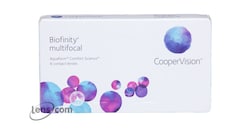
to
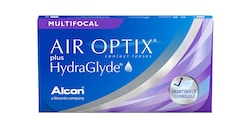
to
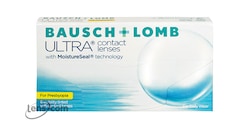
to
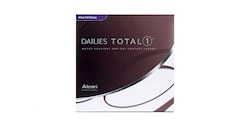
to
to
to
to
to

to
to
to
to
to
to
to
The Pros and Cons of Bifocal and Multifocal Contact Lenses
Bifocal and multifocal contact lenses help many people manage presbyopia by providing vision correction at multiple distances in a single pair of lenses. While they can reduce the need for reading glasses and simplify everyday activities, they aren't the perfect solution for everyone. Understanding both the benefits and potential drawbacks can help you discuss the right option with your eye care professional.
The Pros of Multifocal Contact Lenses
Clear Vision at Multiple Distances
Bifocal and multifocal lenses are designed with different optical zones that help you see nearby objects and those farther away without changing eyewear. Many wearers can comfortably read, use digital devices, work at a computer, and drive while wearing the same pair of contact lenses.
Less Dependence on Reading Glasses
Many people choose bifocal or multifocal contacts to reduce how frequently they need reading glasses. Although some close-up tasks may still benefit from additional magnification, these contact lenses can make many daily activities more convenient.
Greater Convenience Throughout the Day
Switching between different viewing distances becomes more seamless once your eyes adapt to the lenses. This can be especially helpful for work, travel, hobbies, and other activities that require frequent changes in focus.
The Cons of Multifocal Contact Lenses
An Adjustment Period Is Common
Many first-time wearers need time to adapt to bifocal or multifocal contact lenses. During this period, your brain learns how to use the different focusing zones, and you may temporarily notice mild halos, reduced contrast, or slight fluctuations in vision before adapting.
Vision May Not Feel Perfect at Every Distance
Unlike single-vision contact lenses that optimize one viewing distance, bifocal and multifocal designs balance vision across multiple distances. Some wearers may notice that one range, such as very small print or distant details, isn't quite as crisp as they'd experience with a dedicated single-vision prescription.
Not Every Lens Works for Every Wearer
Your prescription, pupil size, tear film, eye health, and visual demands all influence how well these lenses perform. Finding the best multifocal contact lenses may require more than one fitting or lens design before achieving the best balance of comfort and vision.
Explore Our Bifocal/Multifocal Contact Lenses
Biofinity Multifocal
Air Optix plus HydraGlyde Multifocal
ULTRA for Presbyopia
Dailies Total 1 Multifocal
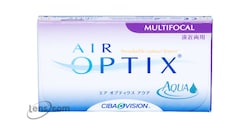
Air Optix Aqua Multifocal
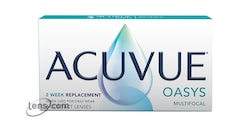
Acuvue Oasys 2-week Multifocal
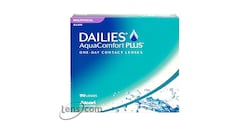
Dailies AquaComfort Plus Multifocal
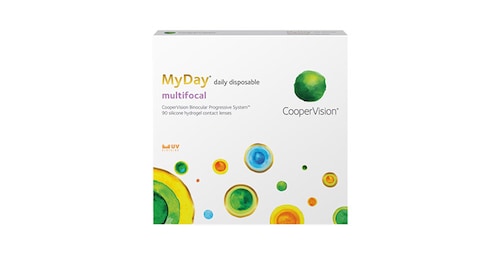
MyDay Daily Disposable Multifocal
Compare Bifocal/Multifocal Lenses by Manufacturer, Material, and Price
|
Average Cost per day
|
Contact Lens Manufacturer
|
Contact Lens Type
|
Contact Lens Material Type
|
Contact Lens Water Content Percentage
|
Contact Lens Blocks UV
|
Each Box Contains
|
Average Star Rating
|
|
|---|---|---|---|---|---|---|---|---|
| Biofinity Multifocal | $0.16 | CooperVision | Monthly | Silicone Hydrogel | 48% | 6 lenses, a 6-month supply |
|
|
| Air Optix plus HydraGlyde Multifocal | $0.28 | Alcon | Monthly | Silicone Hydrogel | 33% | 6 lenses, a 6-month supply |
|
|
| ULTRA for Presbyopia | $0.13 | Bausch & Lomb | Monthly | Silicone Hydrogel | 46% | 6 lenses, a 6-month supply |
|
|
| Dailies Total 1 Multifocal | $0.82 | Alcon | Daily | Silicone Hydrogel | 33% | 90 lenses, a 3-month supply |
|
|
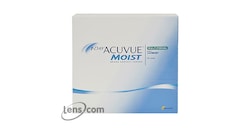
| 1-Day Acuvue Moist Multifocal | $0.67 | Johnson & Johnson | Daily | Hydrogel | 58% | 30 lenses, a 1-month supply |
|
|
| Air Optix Aqua Multifocal | $0.22 | Alcon | Monthly | Silicone Hydrogel | 33% | 6 lenses, a 6-month supply |
|
|
| Acuvue Oasys 2-week Multifocal | $0.38 | Johnson & Johnson | Weekly | Silicone Hydrogel | 38% | 6 lenses, a 3-month supply |
|
|
| Dailies AquaComfort Plus Multifocal | $0.55 | Alcon | Daily | Hydrogel | 69% | 90 lenses, a 3-month supply |
|
|
| MyDay Daily Disposable Multifocal | $1.22 | CooperVision | Daily | Silicone Hydrogel | 54% | 90 lenses, a 3-month supply |
|
|
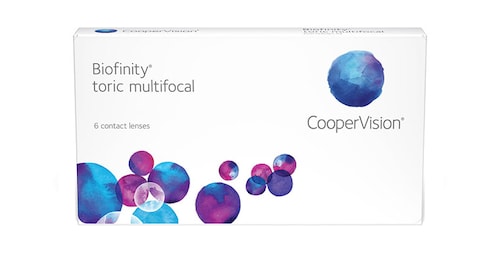
| Biofinity Toric Multifocal | $0.64 | CooperVision | Monthly | 52% comfilcon A | 48% | 6 lenses, a 6-month supply |
|
|
| Purevision 2 Multi-Focal | $0.33 | Bausch & Lomb | Monthly | Silicone Hydrogel | 36% | 6 lenses, a 6-month supply |
|
|
| Total30 Multifocal | $0.47 | Alcon | Monthly | Silicone Hydrogel | 55% | 6 lenses, a 6-month supply |
|
|
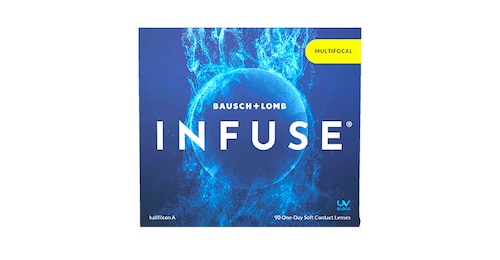
| INFUSE One-Day Multifocal 90PK | $1.22 | Bausch & Lomb | Daily | Hydrogel | 55% | 90 lenses, a 3-month supply |
|
|
| Proclear Multifocal | $0.38 | CooperVision | Monthly | Hydrogel | 62% | 6 lenses, a 6-month supply |
|
|
| SofLens MultiFocal | $0.59 | Bausch & Lomb | Daily | Hydrogel | 38% | 6 lenses, a 3-month supply |
|
Save More on Bifocal/Multifocal Lenses With Rebates
|
box rebate
Rebate amount with a 4 box purchase
|
box rebate
Rebate amount with a 8 box purchase
|
Contact Lens Manufacturer
|
Contact Lens Type
|
Contact Lens Material Type
|
Contact Lens Water Content Percentage
|
Contact Lens Blocks UV
|
Each Box Contains
|
Average Star Rating
|
|
|---|---|---|---|---|---|---|---|---|---|
| Biofinity Multifocal | $145 | -- | CooperVision | Monthly | Silicone Hydrogel | 48% | 6 lenses, a 6-month supply |
|
|
| Air Optix plus HydraGlyde Multifocal | $135 | -- | Alcon | Monthly | Silicone Hydrogel | 33% | 6 lenses, a 6-month supply |
|
|
| ULTRA for Presbyopia | $145 | -- | Bausch & Lomb | Monthly | Silicone Hydrogel | 46% | 6 lenses, a 6-month supply |
|
|
| Dailies Total 1 Multifocal | -- | $220 | Alcon | Daily | Silicone Hydrogel | 33% | 90 lenses, a 3-month supply |
|
|
| 1-Day Acuvue Moist Multifocal | $75 | $290 | Johnson & Johnson | Daily | Hydrogel | 58% | 30 lenses, a 1-month supply |
|
|
| Air Optix Aqua Multifocal | $75 | -- | Alcon | Monthly | Silicone Hydrogel | 33% | 6 lenses, a 6-month supply |
|
|
| Acuvue Oasys 2-week Multifocal | -- | $160 | Johnson & Johnson | Weekly | Silicone Hydrogel | 38% | 6 lenses, a 3-month supply |
|
|
| Dailies AquaComfort Plus Multifocal | -- | $290 | Alcon | Daily | Hydrogel | 69% | 90 lenses, a 3-month supply |
|
|
| INFUSE One-Day Multifocal 90PK | -- | $160 | Bausch & Lomb | Daily | Hydrogel | 55% | 90 lenses, a 3-month supply |
|
|
| Proclear Multifocal | $85 | -- | CooperVision | Monthly | Hydrogel | 62% | 6 lenses, a 6-month supply |
|
|
| SofLens MultiFocal | -- | $160 | Bausch & Lomb | Daily | Hydrogel | 38% | 6 lenses, a 3-month supply |
|
|
| PureVision MultiFocal | $75 | -- | Bausch & Lomb | Monthly | Silicone Hydrogel | 36% | 6 lenses, a 6-month supply |
|
|
| Biotrue ONEday for Presbyopia | -- | $290 | Bausch & Lomb | Daily | Hydrogel | 78% | 30 lenses, a 1-month supply |
|
|
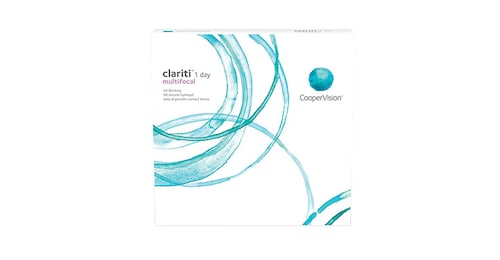
| Clariti 1-Day Multifocal | -- | $160 | CooperVision | Daily | Silicone Hydrogel | 56% | 30 lenses, a 1-month supply |
|
|
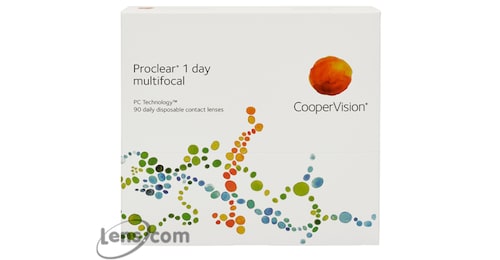
| Proclear 1 Day Multifocal | -- | $180 | CooperVision | Daily | Silicone Hydrogel | 60% | 90 lenses, a 3-month supply |
|
Bifocal Contacts vs. Multifocal Contacts
Bifocal and multifocal contact lenses both help correct presbyopia, but the terms describe slightly different optical designs. Bifocal contacts contain two primary prescription powers, typically one for distance vision and another for near vision. Multifocal contacts use several powers or a gradual progression of power to support near, intermediate, and distance vision.
- Bifocal contacts separate near and distance correction into distinct zones. Depending on the lens, wearers may look through different portions of the lens or rely on simultaneous images that the brain learns to interpret.
- Multifocal contacts provide a broader range of correction through multiple zones or progressive changes in power. The added intermediate range can be useful for computer work, dashboards, and other tasks performed between reading and distance vision.
People frequently use bifocal contacts as a general term for contacts that correct both near and distance vision. Most modern soft contact lenses sold for presbyopia are labeled multifocal, while true bifocal designs are more commonly associated with certain rigid gas permeable or specialty lenses.
Neither design is automatically better for every wearer. Your prescription, pupil size, visual priorities, eye health, and ability to adapt can influence which lens provides the clearest balance of near, intermediate, and distance vision. An eye care professional can evaluate these factors and fit you with the most suitable design.
How Long It Takes to Adjust to Bifocal Contacts
Many people adapt to bifocal or multifocal contact lenses within a few days to a few weeks, although the adjustment period varies from person to person. During this time, your brain learns to interpret the different focusing zones in the lenses, allowing your vision at near, intermediate, and distance ranges to become more natural with continued wear.
- Your prescription can influence how quickly you adapt. People with stronger prescriptions or more advanced presbyopia may need additional time to become comfortable with the new visual experience.
- The lens design also plays a role. Different multifocal designs distribute the focusing zones differently, so some may feel more natural to you than others.
- Wearing the lenses consistently can help the adaptation process. Frequently switching between multifocal contacts and other forms of vision correction may make it take longer for your brain to adjust.
- Your visual demands matter as well. Reading small print, working at a computer, and driving each place different demands on your vision, so it's normal to notice gradual improvement as you become accustomed to the lenses.
Mild halos, slight fluctuations in sharpness, or reduced contrast may occur during the adjustment period, but these symptoms typically improve with time. If your vision remains unsatisfactory, your lenses feel uncomfortable, or the symptoms don't improve after a reasonable adaptation period, schedule a follow-up visit with your eye care professional. A different lens design or prescription may provide a better balance of vision and comfort.
Can Bifocal Contacts Correct Astigmatism?
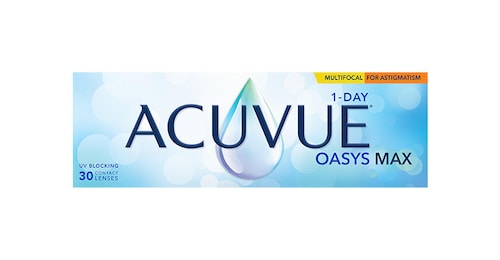
Yes, certain bifocal or multifocal contact lenses can correct astigmatism and presbyopia at the same time. These are commonly called multifocal toric contacts. The toric portion corrects the uneven curvature that causes astigmatism, while the multifocal design provides different powers for near, intermediate, and distance vision.
Standard multifocal contacts may work for people with little or no astigmatism, but they don't contain the cylinder and axis correction required for more significant astigmatism. Available toric multifocal lenses include products such as Biofinity toric multifocal and Proclear multifocal toric, although the suitable choice depends on your complete prescription and fitting needs.
Toric multifocal contacts require precise positioning on the eye. The lens must remain stable so the astigmatism correction stays aligned while the multifocal zones provide usable vision across different distances. Your eye care professional may need to try different powers, add strengths, lens designs, or brands before finding the best balance.
People whose prescriptions fall outside the available toric multifocal ranges may have other options, such as custom soft or rigid gas permeable lenses, monovision correction, or contact lenses worn with reading glasses. An eye care professional can determine which approach is most suitable based on the amount of astigmatism, degree of presbyopia, eye health, and daily visual demands.
Will You Still Need Reading Glasses?
You may still need reading glasses for certain tasks, even when bifocal or multifocal contact lenses provide useful near vision. These contacts are designed to balance vision across several distances, but they may not make very small print or prolonged close-up work as sharp as dedicated reading glasses.
Some wearers rarely need extra magnification after adapting to their lenses. Others keep a pair of low-power readers available for activities such as reading fine print, sewing, working in dim lighting, or looking at a screen for an extended period. The amount of additional help you need can depend on your degree of presbyopia, lens design, lighting, and daily visual demands.
Your eye care professional may adjust the distance power, near addition, or lens design to improve your near vision without sacrificing too much clarity at other distances. Wearing reading glasses over multifocal contacts when needed doesn't mean the lenses have failed. It can be a practical way to sharpen vision for specific close-up tasks while keeping the convenience of contact lenses throughout the rest of the day.
Why Bifocal Contacts Require a Professional Fitting
Bifocal and multifocal contact lenses require a professional fitting because the prescription power is only one part of getting clear, comfortable vision. Your eye care professional also evaluates the shape of your cornea, tear film, pupil size, lens movement, and how the lens centers on your eye. These factors can affect how well you use the near, intermediate, and distance zones.
The fitting process may involve trying more than one lens design or prescription combination. One eye may need slightly different correction from the other, or the near addition may need adjustment to improve reading vision without reducing distance clarity too much. Small changes can make a noticeable difference in how the lenses perform during everyday activities.
Your eye care professional will also check if the lenses remain stable and provide enough comfort throughout the day. A lens that fits too tightly, moves excessively, dries out quickly, or shifts away from the center may cause blurred or fluctuating vision. Follow-up visits give your provider a chance to assess how your eyes are responding and fine-tune the fit when needed.
Even if two bifocal or multifocal lenses have the same power, they may use different optical designs, base curves, diameters, materials, and replacement schedules. That means you shouldn't switch products without a new fitting and approval from your eye care professional.
Can You Wear Bifocal Contacts Every Day?
Yes, many bifocal and multifocal contact lenses are designed for everyday wear. How you wear them daily depends on the specific lens prescribed, your eye health, your tear film, and how well your eyes tolerate contact lenses. Many people wear their lenses comfortably throughout the day for work, reading, driving, and other routine activities.
- Follow the prescribed wearing schedule. Daily disposable lenses should be discarded after each day of wear, while reusable lenses must be cleaned, disinfected, and replaced according to the manufacturer's recommended schedule.
- Give your eyes a break when needed. Dry environments, extended screen time, and long hours of near work can make your eyes feel tired. Using contact lens-compatible lubricating eye drops, taking regular breaks from digital devices, or wearing your glasses for part of the day may help improve comfort.
- Never sleep in your lenses unless your eye care professional has specifically prescribed a lens approved for overnight wear. Sleeping in contact lenses that aren't intended for extended wear increases the risk of eye infections and other complications.
- Pay attention to changes in comfort. Remove your lenses if you develop persistent redness, pain, blurred vision, light sensitivity, excessive tearing, or discharge, and contact your eye care professional if the symptoms don't improve after removal.
Regular eye examinations are an important part of successful contact lens wear. Your prescription, vision needs, and eye health can change over time, so routine follow-up visits help confirm that your bifocal or multifocal contact lenses continue to fit properly and provide the vision correction you need.
Alternatives to Bifocal Contact Lenses
Bifocal and multifocal contact lenses aren't the only ways to correct presbyopia. The most suitable option depends on your prescription, eye health, daily activities, and personal preferences. An eye care professional can help you compare different approaches based on how you use your vision throughout the day.
- Monovision contact lenses correct one eye primarily for distance vision and the other for near vision. Many people adapt well to this approach, although it may slightly affect depth perception for some wearers.
- Single-vision contact lenses with reading glasses provide clear distance vision while allowing you to put on reading glasses only when needed for close-up tasks.
- Progressive eyeglasses combine distance, intermediate, and near correction in one pair of glasses without requiring contact lenses.
- Rigid gas permeable (RGP) or specialty contact lenses may provide sharper vision for some people, particularly those with irregular corneas, higher amounts of astigmatism, or complex prescriptions.
- Surgical options, such as refractive lens exchange or certain laser vision correction procedures, may be appropriate for some individuals. These procedures aren't suitable for everyone and require a thorough evaluation by an eye care professional.
Each option has its own advantages and limitations, so there isn't a single solution that's best for everyone. Your prescription, visual priorities, lifestyle, and eye health all play a role in determining which form of vision correction is most appropriate. Discussing these factors with your eye care professional can help you make an informed decision.
References
Presbyopia. American Optometric Association. https://www.aoa.org/healthy-eyes/eye-and-vision-conditions/presbyopia. Accessed July 28, 2026.
5 Tips for Multifocal Contact Lens Success. American Optometric Association. https://www.aoa.org/news/clinical-eye-care/health-and-wellness/5-tips-for-multifocal-contact-lens-success. Published February 9, 2016. Accessed July 28, 2026.
Adult Vision: 41 to 60 Years of Age. American Optometric Association. https://www.aoa.org/healthy-eyes/eye-health-for-life/adult-vision-41-to-60-years-of-age. Accessed July 28, 2026.
Precision7, Precision7 for Astigmatism, Precision7 Multifocal, and Precision7 Multifocal Toric Soft Contact Lenses. U.S. Food and Drug Administration. https://www.fda.gov/medical-devices/recently-approved-devices/precision7-precision7-astigmatism-precision7-multifocal-precision7-multifocal-toric-serafilcon. Published May 17, 2023. Accessed July 28, 2026.
Types of Contact Lenses. U.S. Food and Drug Administration. https://www.fda.gov/medical-devices/contact-lenses/types-contact-lenses. Updated January 16, 2018. Accessed July 28, 2026.
Contact Lens Prescription. U.S. Food and Drug Administration. https://www.fda.gov/medical-devices/contact-lenses/contact-lens-prescription. Updated October 28, 2020. Accessed July 28, 2026.
About Contact Lens Types. Centers for Disease Control and Prevention. https://www.cdc.gov/contact-lenses/about/about-contact-lens-types.html. Updated May 27, 2025. Accessed July 28, 2026.
Biofinity Toric Multifocal. CooperVision. https://coopervision.com/contact-lenses/biofinity-toric-multifocal. Accessed July 28, 2026.
Proclear Multifocal Toric. CooperVision. https://coopervision.com/contact-lenses/proclear-multifocal-toric. Accessed July 28, 2026.
Popular Contact Lens Reviews
Contacts
This particular company is trustworthy and easy to order from and their prices are competitive as well!
Dalies Rule
I have experienced dailies for the first time and will not go back to the conventional lenses. No cleaning or cleaning supplies and always comfortable. At the end of the day I forget that I have them on. Great product!
Price
I've used Air Optix for several years and have been satisfied with this product. I compared costs and Lens.com was the most competitive.
Mr.
As with my last order, I received the contacts in only days. The product is excellent and the price is excellent and the service is excellent. I had an issue with one order several years ago and it was resolved to m satisfaction immediately and generously. Keeping my prescription on file makes a second ordering even easier. Thank you!
Shipping and rebate expediency and accuracy.
I have been doing business with lens.com for many years now, and have found them to be an excellent provider of contact lenses. I would highly recommend them to anyone, wishing to save money on their contract purchase.
Can read the dash again
I can finally see my phone and look up at the road while driving without weird blurs. Price tag hurts but they work perfectly.
Regular customer now
First time ordering from lens.com and they got my prescription right and shipped it fast. lenses feel great.
smooth focus
Seamless transition between reading up close and long distance. No headaches or squinting for me. Great service thank you!
Saved me from bifocals
I was so resistant to getting bifocal glasses, so my doctor suggested these instead. It took a couple of days for my brain to adjust to the zones, but now I can read my text messages and watch TV with zero issues.