
Transition Contact Lenses
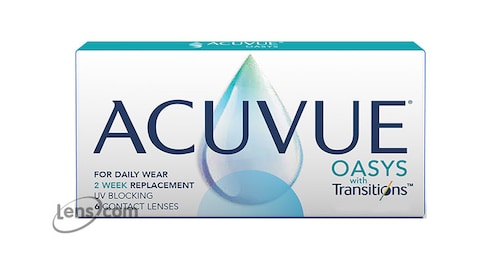
Transition contact lenses are photochromic contact lenses designed to adjust from clear to darker when exposed to certain light conditions. The lens most closely associated with this category was ACUVUE OASYS with Transitions Light Intelligent Technology, which Johnson & Johnson now lists as discontinued. It was a 2 week contact lenses made with senofilcon A and belonged to the broader category of silicone hydrogel contact lenses. It was designed for wearers who wanted vision correction with light filtering for changing indoor and outdoor environments.
Choose the exact product name, power, base curve, diameter, and replacement schedule written on your current prescription contact lenses. Transition contact lenses are not interchangeable with standard ACUVUE OASYS, daily disposable lenses, toric lenses, multifocal lenses, or non-prescription lenses unless your eye doctor approves the change.
How Transition Contact Lenses Help With Light Filtering and Daily Wear
Transition contact lenses use photochromic technology to adjust to changing light while still functioning as prescription contact lenses.
1. Photochromic Light Response
ACUVUE OASYS with Transitions used photochromic molecules that reacted to ultraviolet and certain bright light. The lens darkened in less than a minute and faded back toward clear in about 90 seconds after bright light was removed.
2. Two-Week Reusable Schedule
ACUVUE OASYS with Transitions followed the replacement routine used for 2 week contact lenses when prescribed for that schedule. Because it was reusable, it needed proper cleaning, disinfection, storage, and on-time replacement.
3. UV Blocking and Eye Protection Limits
The lens helped block UV transmission to the cornea and into the eye. It still did not replace sunglasses or UV-protective eyewear because contacts leave parts of the eye area uncovered.
Why Wearers Choose Transition Contact Lenses
The lens helped block UV transmission to the cornea and into the eye. Like other UV-blocking contact lenses, it still did not replace sunglasses or UV-protective eyewear because contacts leave parts of the eye area uncovered.
- Designed to darken when exposed to ultraviolet light and certain bright light.
- Helped reduce exposure to bright light indoors and outdoors.
- Used the ACUVUE OASYS Senofilcon A silicone hydrogel material.
- Followed a two-week schedule for reusable contact lenses, with cleaning and storage required after removal.
- Included UV-blocking properties, with the standard reminder that UV-blocking contacts do not replace sunglasses.
- Was made for spherical prescription correction, not astigmatism or multifocal correction.
- Required a valid contact lens prescription and eye doctor fitting.
- Is now discontinued by Johnson & Johnson Vision, so wearers may need to ask their eye doctor about current ACUVUE alternatives.
What to Check Before Ordering Transition Contact Lenses
Exact Product Name
Match the full product name on your prescription. ACUVUE OASYS with Transitions and standard ACUVUE OASYS are different lenses, so do not switch between them unless your eye doctor approves the change.
Replacement Schedule
Check whether your prescription names a two-week reusable lens. ACUVUE OASYS with Transitions was not one of the daily disposable contact lenses, so it required cleaning and storage after removal.
Prescription Type
Review your power, base curve, diameter, and lens name before ordering. ACUVUE OASYS with Transitions was not available as a toric lens for astigmatism or a multifocal lens for presbyopia.
Care Routine
Reusable transition contact lenses need clean hands, approved contact lens solution, fresh storage solution, and a clean contact lens.
How Do Transition Contact Lenses Work?
Transition contact lenses use light-responsive molecules inside the lens material.
- The lenses appear clearer when they are not exposed to strong activating light.
- The photochromic molecules open when exposed to ultraviolet or certain bright light.
- The lens darkens to reduce the amount of visible light reaching the eye.
- The lens fades back toward clear after the activating light is removed.
Acuvue Oasys with Transitions
Do Transition Contact Lenses Replace Sunglasses?
Transition contact lenses do not replace sunglasses or UV-protective eyewear.</p>
1. They cover only the contact lens area
The lens covers the cornea, not the whole eye or surrounding skin. Sunglasses help cover more of the eye area.
2. They do not get as dark as sunglasses
ACUVUE OASYS with Transitions was designed to darken, but not to fully mask eye color or act like dark outdoor sunglasses. Bright outdoor settings may still call for sunglasses.
3. They still need UV eye protection support
UV-blocking contacts help with covered areas only. Continue using sunglasses or UV-protective eyewear outdoors as directed by your eye doctor.
Can You Get Transition Contact Lenses for Astigmatism?
ACUVUE OASYS with Transitions was not available as a toric contact lens for astigmatism. If your prescription includes cylinder and axis values, you usually need toric contact lenses designed to keep astigmatism correction properly aligned. Do not order a spherical transition lens using only the sphere power from a toric prescription. Ask your eye doctor about current toric options if astigmatism correction is part of your prescription.
Prescription vs. Non-Prescription Transition Contact Lenses
Transition contact lenses require valid prescription contact lenses.
- A contact lens prescription includes fit details, not just power.
- A glasses prescription is not enough to order contact lenses.
- Non-prescription or plano contacts still require fitting and prescription verification.
- Avoid sellers that market transition-style contacts without asking for prescription details.
How Fast Do Transition Contact Lenses Change From Clear to Dark?
ACUVUE OASYS with Transitions was reported by Johnson & Johnson to darken in less than a minute when exposed to activating light. The same source described the lens as fading back toward clear in about 90 seconds once bright light was removed.
1. Activation depends on light exposure
The lens reacts to ultraviolet and certain bright light. Indoor lighting, shade, car windows, and weather can affect how noticeable the change looks.
2. The lens does not become sunglasses-dark
The tint was designed to filter light while keeping the eyes visible. It was not meant to fully replace outdoor sunglasses.
3. Vision comfort still varies
Light sensitivity, dryness, screen habits, and prescription accuracy can affect comfort. Ask your eye doctor if bright light still bothers you while wearing contacts.
Can You Wear Transition Contact Lenses While Driving?
Transition contact lenses were designed as daily wear contact lenses, but their light response can vary depending on lighting conditions, vehicle glass, weather, and time of day. They responded to ultraviolet and certain bright light but should not be treated as a replacement for driving sunglasses in bright sun.
For daytime driving, ask your eye doctor whether your lenses and sunglasses give enough comfort and clarity for your route and lighting conditions. For night driving, report halos, glare, dim vision, or contrast problems before ordering more lenses.
Safe driving depends on clear vision, stable comfort, and your current prescription. If vision feels dim, blurry, or slow to adjust, remove the lenses when safe and contact your eye doctor.
Transition Contact Lenses for Light Sensitivity and Glare
Transition contact lenses were designed for wearers who wanted contacts that reacted to changing light.
Good match if:
- Your eye doctor prescribed ACUVUE OASYS with Transitions before discontinuation.
- You wanted light filtering in changing indoor and outdoor conditions.
- You preferred the routine associated with 2 week contact lenses.
- You understood that sunglasses were still needed outdoors.
Recheck before ordering if:
- You have astigmatism, presbyopia, or another prescription not covered by the lens.
- Your prescription has expired.
- The product stock appears old, unclear, or unverified.
- You expect the lenses to work exactly like transition eyeglass lenses.
Are Transition Contact Lenses Available as Daily Disposables?
ACUVUE OASYS with Transitions was a two-week reusable contact lens, not one of the daily disposable contact lenses. Daily contacts are worn once and discarded after removal, while two-week reusable lenses need cleaning and storage after each wear. If you prefer a fresh pair every day, ask your eye doctor about current daily disposable lenses in your prescription range. A daily disposable lens will not automatically include transition-style photochromic technology.
What to Expect When Switching From Glasses to Transition Contact Lenses
Switching from glasses to transition contact lenses needs a contact lens fitting and a short adjustment period.
Step 1. Confirm your contact lens prescription.
A glasses prescription does not include the same fit details as a contact lens prescription. Your eye doctor needs to confirm the lens brand, power, base curve, diameter, and wearing schedule.
Step 2. Practice insertion and removal.
Reusable contacts need careful handling every day. Wash and dry your hands before touching the lenses, and ask for guidance if insertion feels difficult.
Step 3. Review light response and comfort.
Photochromic lenses can look and feel different from clear contacts or transition eyeglasses. Eye doctor-directed trial wear can help you evaluate vision in indoor light, outdoor light, screen use, and normal daily activities before ordering a larger supply.
ACUVUE OASYS With Transitions vs. ACUVUE OASYS 2-Week
Shared Lens Family
Both lenses are part of the ACUVUE OASYS two-week reusable family. Both require a valid prescription, cleaning, disinfection, storage, and replacement on schedule.
Main Difference
ACUVUE OASYS with Transitions included photochromic technology that changed tint in response to activating light. Standard ACUVUE OASYS does not have that same transition-style tint behavior.
Availability Difference
ACUVUE OASYS with Transitions is listed as discontinued by Johnson & Johnson Vision. Standard ACUVUE OASYS 2-Week remains an available product, but your eye doctor should confirm whether it fits your current needs.
References
Discontinued ACUVUE� Brand Contact Lenses. Johnson & Johnson Vision Professional. https://www.jnjvisionpro.com/en-us/discontinued-products/. Date Accessed: May 27, 2026.
Determining the Spectral Transmittance of Photochromic Contact Lenses. Emmanuel B. Alabi, Trefford L. Simpson, Tyler Harris, and Keith Whitten / Contact Lens and Anterior Eye. https://www.sciencedirect.com/science/article/abs/pii/S1367048421000059. Date Accessed: May 27, 2026.
Effect of Photochromic Contact Lens Wear on Indoor Visual Performance and Patient Satisfaction. Kazutaka Kamiya, Shuya Suzuki, and Fusako Fujimura / Ophthalmology and Therapy. https://link.springer.com/article/10.1007/s40123-022-00552-5. Date Accessed: May 27, 2026.
Unexpected Vision Performance With Photochromic Contact Lenses in Normal and Low Light Conditions: An Analysis of Two Randomized Trials. John Buch, Leilani Sonoda, and Jessica Cannon / Journal of Optometry. https://www.sciencedirect.com/science/article/pii/S1888429622000383. Date Accessed: May 27, 2026.
About Contact Lens Types. Centers for Disease Control and Prevention. https://www.cdc.gov/contact-lenses/about/about-contact-lens-types.html. Date Accessed: May 27, 2026.