
Contacts for Astigmatism and Presbyopia
Contacts for astigmatism and presbyopia are designed for people who need correction for both an irregular corneal shape and age-related vision changes. Astigmatism makes images that you see look blurred or distorted at different distances. Presbyopia makes close-up tasks such as reading or checking a phone harder as the eye's natural lens becomes less flexible with age. Multifocal toric contact lenses combine both types of correction in a single lens.
The contacts listed below use a toric design to correct astigmatism and multifocal optics to help you see at near, intermediate, and far distances. Since the lens has to stay properly positioned while also balancing several viewing zones, fit and prescription accuracy are especially important. Your eye doctor can determine the right cylinder, axis, ADD power, and contact lens type based on your vision needs and how the contacts perform during a fitting.
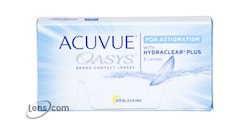
to
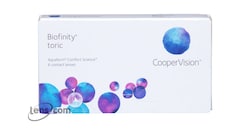
to
to
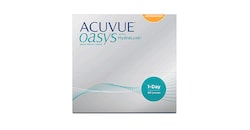
to
to
to
to
to


to
to
to
to
to
to

to
to
to
Things To Know Before Buying ACUVUE VITA Lenses
Choosing contacts for astigmatism and presbyopia involves more than finding contact lenses that correct both conditions. The lens also needs to stay properly positioned, give you usable vision at different distances, and feel comfortable throughout the time you're wearing them..
A Stable Toric Design
Toric contact lenses need to remain properly oriented on the eye so the cylinder and axis correction stays aligned with your astigmatism prescription.
Multifocal Vision Correction
Look for a design that helps you see across near, intermediate, and distance ranges. This is especially useful for reading, computer work, driving, and switching between tasks.
The Right ADD Power
Presbyopia prescriptions include ADD power for near vision. Your eye doctor can determine how much additional focusing power you need for close-up tasks.
Good Lens Centration
A multifocal toric lens has to sit in the right position for both corrections to work properly. Poor centration can make vision seem inconsistent or blurry.
Controlled Lens Movement
The lens should move slightly when you blink without rotating too far out of position. Excess movement can interfere with astigmatism correction and multifocal performance.
Comfortable Lens Material
Pay attention to how the lenses feel after several hours, not only when you first put them in. Material, surface moisture, and oxygen transmission can all affect wearing comfort.
A Replacement Schedule That Fits Your Routine
Daily disposable contact lenses give you a fresh pair each morning, while reusable lenses require regular cleaning and replacement. Prescription availability can also differ by replacement schedule.
Clear Intermediate Vision
Intermediate vision becomes especially relevant for computer screens, dashboards, and other arm's-length tasks. Make sure your trial lenses work well at these everyday distances.
A Prescription Range That Matches Your Needs
Multifocal toric contacts need to accommodate several prescription values, including sphere, cylinder, axis, and ADD power. Not every lens comes in every parameter combination.
Good Performance During Real-Life Tasks
Test your lenses while reading, working on a computer, driving, and moving between near and far objects. A successful fit should work beyond the eye exam and suit the way you use your vision every day.
How Astigmatism and Presbyopia Affect Your Contact Lens Prescription
Astigmatism and presbyopia affect different parts of your contact lens prescription. Astigmatism requires cylinder and axis values to correct the way light focuses through an irregularly shaped cornea or lens.
Presbyopia adds another requirement. As focusing at near objects becomes harder with age, your prescription may include an ADD power that gives extra correction for reading and other close-up tasks.
When you need correction for both conditions, your contact lenses have to combine these prescription values in one design. Multifocal toric lenses are made for this purpose, using toric correction for astigmatism along with multiple focal zones for near, intermediate, and distance vision. Getting the right fit can take some fine-tuning, since lens rotation, centration, and the balance between distance and near vision can all affect how clearly you see throughout the day.
Defining Astigmatism and Presbyopia
Astigmatism
Astigmatism is a common refractive error when the cornea or the eye's natural lens has an uneven curvature. Instead of focusing light evenly on the retina, the eye focuses it at different points, which can make vision look blurry, stretched, or distorted at both near and far distances. Contact lenses for astigmatism use a toric design that stays oriented in a specific position so the cylinder and axis correction remain properly aligned.
Presbyopia
Presbyopia is an age-related alteration in focusing near objects that develops as the eye's natural lens loses its natural flexibility. It typically becomes noticeable around the 40s, when reading small print, checking a phone, or focusing on other close objects starts to require more effort. Multifocal contacts address presbyopia by incorporating different powers within the lens, helping the wearer see across near, intermediate, and distance ranges.
Can You Wear Contacts If You Have Astigmatism?
People with astigmatism can wear standard eye contacts for nearsightedness or farsightedness, but they usually need lenses designed specifically to correct it. Toric contact lenses use different powers in different parts of the lens and are shaped to stay in a stable position on the eye. That stability is important because excessive rotation can move the cylinder and axis correction out of alignment and make vision seem blurry.
The right lens depends on your prescription, eye shape, and how the contact behaves during wear. Some people do well with daily contacts for astigmatism, while others prefer reusable options such as biweekly or monthly contacts. An eye doctor can check lens centration, movement, and rotation during a fitting and adjust the prescription or lens design when needed.
What Prescription Values Matter for Multifocal Toric Contacts?
Multifocal toric contacts combine astigmatism correction with near-vision support. The prescription includes more values than a standard spherical contact lens prescription.
- Sphere (SPH)
Sphere power corrects nearsightedness or farsightedness. A minus value is used for myopia. A plus value is used for hyperopia. - Cylinder (CYL)
Cylinder measures how much astigmatism correction you need. A higher cylinder value generally means a greater degree of astigmatism. - Axis
Axis shows the orientation of the astigmatism correction and is measured from 1 to 180 degrees. It tells the lens where the cylinder power needs to be positioned. - ADD Power
ADD power provides the extra near-vision correction needed for presbyopia. It helps with close-up tasks such as reading, using a phone, or viewing a computer screen. - Base Curve (BC)
Base curve describes the curvature of the contact lens. The right base curve helps the lens sit properly on the eye and supports stable vision. - Diameter (DIA)
Diameter refers to the overall width of the lens. It affects how the contact fits and centers over the cornea. - Dominance or Multifocal Design
Some multifocal fittings also consider which eye is dominant or how near and distance powers are distributed across the lenses. Your eye doctor may adjust the design to improve the balance between close and far vision.
How Long Does It Take to Adjust to Multifocal Toric Contacts?
Adjusting to multifocal toric contacts can take anywhere from a few days to a few weeks. These lenses correct both astigmatism and presbyopia, so your eyes and brain need time to adapt to seeing through the torics' different optical zones. You might notice mild blur, changes in depth perception, or that near and distance vision feel different from what you are used to.
Wearing the lenses consistently during your trial period can make adaptation easier. It also helps to test them during real activities such as reading, computer work, driving, and looking across different distances.
Vision that remains noticeably blurry or uncomfortable for an unusually long time may mean the prescription, ADD power, lens fit, or toric stability needs to be fine-tuned by your eye doctor.
Multifocal Toric Lenses to Compare
Multifocal toric contacts are made for patients who need astigmatism correction along with near-vision correction for presbyopia. The options below differ in replacement schedule, lens design, material, and available prescription parameters. Your eye doctor can help determine which one matches your eyes and vision needs.
Biofinity Toric Multifocal
Biofinity Toric Multifocal is a monthly lens that combines toric and multifocal correction. It comes in a broad range of sphere, cylinder, axis, and ADD values, making it worth comparing for more complex prescriptions.
Proclear Multifocal Toric
Proclear Multifocal Toric is another monthly option designed for people with both astigmatism and presbyopia. It combines multifocal correction with a toric design and uses PC Technology to help the lens retain moisture during wear.
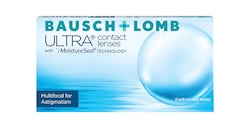
ULTRA Multifocal for Astigmatism
This monthly silicone hydrogel lens combines multifocal optics with an OpticAlign design that helps stabilize astigmatism correction. It also comes in Low and High ADD ranges for different levels of near-vision correction.
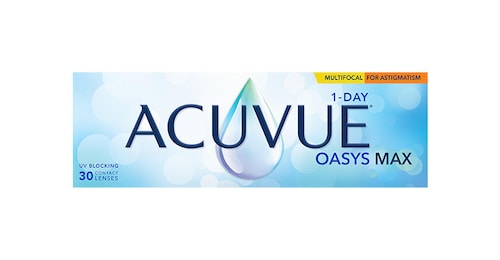
ACUVUE OASYS MAX 1-Day Multifocal for Astigmatism
This daily disposable multifocal toric lens corrects astigmatism and presbyopia without a reusable-lens cleaning routine. Each lens is worn for one day and discarded, making it the daily option to compare against the monthly lenses above.
Daily vs. Monthly Contacts for Astigmatism and Presbyopia
Daily multifocal toric lenses give you a fresh pair each morning and require no nightly cleaning or storage. This can make them convenient for frequent travelers, occasional contact lens wearers, or anyone who prefers a simpler care routine. The main limitation is availability, since fewer daily lenses are made with the combination of sphere, cylinder, axis, and ADD powers needed for these prescriptions.
Monthly multifocal toric contacts provide more reusable options and can accommodate a wider range of prescription parameters in some lens brand families. One pair is worn for up to a month according to the prescribed replacement schedule, so the lenses need to be cleaned, disinfected, and stored properly after each use.
Your eye doctor can compare daily and monthly designs based on your prescription range, lens fit, wearing habits, and how clearly you see at near, intermediate, and far distances.
Features That Make Wearing Multifocal Toric Contacts More Comfortable
Comfort can depend on the lens material, surface design, edge profile, and how well the contact works with your natural tear film.
- Breathable Lens Materials
Silicone hydrogel materials let more oxygen reach the cornea, which can help the eyes feel better during longer wearing periods. - Moisture-Retaining Technology
Some lenses are made to hold water or maintain a hydrated surface throughout the day. This can reduce dryness, grittiness, and end-of-day discomfort. - A Smooth Lens Surface
A smooth surface creates less friction between the contact and the eyelid during blinking. The lens can feel less noticeable as a result. - Thin, Rounded Lens Edges
Edge design affects how the eyelid moves over the contact. A thinner, well-shaped edge can make blinking feel more natural. - Stable Toric Positioning
A lens that stays properly aligned is less likely to shift or rotate excessively. Better stability reduces repeated refocusing and the visual strain that comes with fluctuating clarity. - Controlled Lens Movement
Multifocal toric contacts should move slightly with each blink without sliding too much. Proper movement helps support tear exchange while keeping the prescription aligned. - Deposit-Resistant Surfaces
Protein, oil, and debris can build up on reusable lenses and make them feel rougher over time. Materials that resist deposits can help maintain a smoother wearing experience. - A Replacement Schedule That Suits Your Eyes
Daily lenses give you a fresh surface every morning. Reusable lenses depend more on consistent cleaning and replacement. - Proper Base Curve and Diameter
These measurements affect how the lens sits and moves on the eye. A lens that is too tight or too loose can feel uncomfortable and interfere with stable vision. - Balanced Multifocal Optics
A well-fitted multifocal design can reduce the effort needed to switch between near, intermediate, and distance tasks. Less visual strain can make wearing the lenses feel more natural throughout the day.
When to See an Eye Doctor After Wearing Contacts for Astigmatism and Presbyopia
Schedule an eye exam when your multifocal toric lenses keep causing blurry or fluctuating vision, feel uncomfortable for long periods, or do not stay stable on your eyes. Trouble seeing clearly at near, intermediate, or far distances can point to an issue with the prescription, ADD power, lens rotation, centration, or overall fit. An eye doctor can check how the lenses move and sit on your eyes and adjust the fitting when needed.
Remove your lenses and contact an eye doctor promptly if you develop eye pain, persistent redness, light sensitivity, swelling, discharge, or a sudden decrease in vision. These symptoms can signal irritation, corneal injury, or infection and should not be ignored.
Regular follow-up visits are also useful after a new multifocal toric fitting so your doctor can confirm that the lenses remain comfortable and give you consistent vision during everyday wear.
References
Refractive Errors. National Eye Institute. https://www.nei.nih.gov/eye-health-information/eye-conditions-and-diseases/refractive-errors. December-19-2025. Date Accessed: August 28, 2026.
Presbyopia. National Eye Institute. https://www.nei.nih.gov/eye-health-information/eye-conditions-and-diseases/presbyopia. November-26-2025. Date Accessed: August 28, 2026.
Visual Performance of a Multifocal Toric Soft Contact Lens. David Madrid-Costa, Elena Tom�s, Teresa Ferrer-Blasco, Santiago Garc�a-L�zaro, and Robert Mont�s-Mic�. Optometry and Vision Science. https://pubmed.ncbi.nlm.nih.gov/23034336/. November-2012. Date Accessed: August 28, 2026.
Prospective Evaluation of a Novel Multifocal Toric Daily Disposable Contact Lens in Presbyopic Adults with Astigmatism. Ross Franklin, Jessica Lin Cannon-Hill, Ryan Sherrill, and Giovanna E. Olivares. Clinical Optometry. https://pubmed.ncbi.nlm.nih.gov/41230335/. November-07-2025. Date Accessed: August 28, 2026.
About Contact Lens Types. Centers for Disease Control and Prevention. https://www.cdc.gov/contact-lenses/about/about-contact-lens-types.html. May-27-2025. Date Accessed: August 28, 2026.
Popular Contact Lens Reviews
I have been using B+L SofLens Toric Astigmatism.
After I had been happily using them for decades, I could not reorder my contact lenses since Bausch+Lomb officially discontinued many SofLens® Toric lenses in July  2023.
As my Rx had not changed, my optometrist recommended another manufacturer, which I tried using for months, and was very disappointed.
Then on the Lens.com website, I ordered B+L ULTRA for Astigmatism Contact Lenses, and they seem just the same to me as the discontinued B+L SofLens® Toric contact lens. Now I couldn't be happier!
Great service
Lens.com is my go to resource for ordering my contacts each year. They provide a great product and good customer service.
Always Satisfied
The Best on-line shopping experience, EVERYTIME! The rebates are what brought me here- NOBODY gives this good of a deal!!!
I've been a customer for over 5 years now and will continue!!!
Your prescription
These contacts were excellent. Exactly what I ordered. I called lens.com. And they were great helped me with my order in every way possible. I had it wrong and they made sure it was right before I ordered them. I love my contacts and will be ordering more from them.
good price
I like the price of the contacts and in the 4 plus years that i have ordered from lens.com i always get a rebate incentive. so bonus.
Reliable monthlies for me
Standard comfort. Package got here fast. thanks lens!
Contacts stay locked in place
Great!!! Doesn't rotate out of whack when I tilt my head or move quickly while working out.
Decent biweeklies
vision is clear but they get a bit sticky if you keep them in past 10 hours. thanks for the super fast delivery
Stops the blurry blinking fits
Used to have to blink like crazy to get my focus back cause my old lenses would slide around on my eye. These stay put when I look around.
love them
my eye doc recommended these and they are way better than my last brand. shipping from lens.com was fast too.